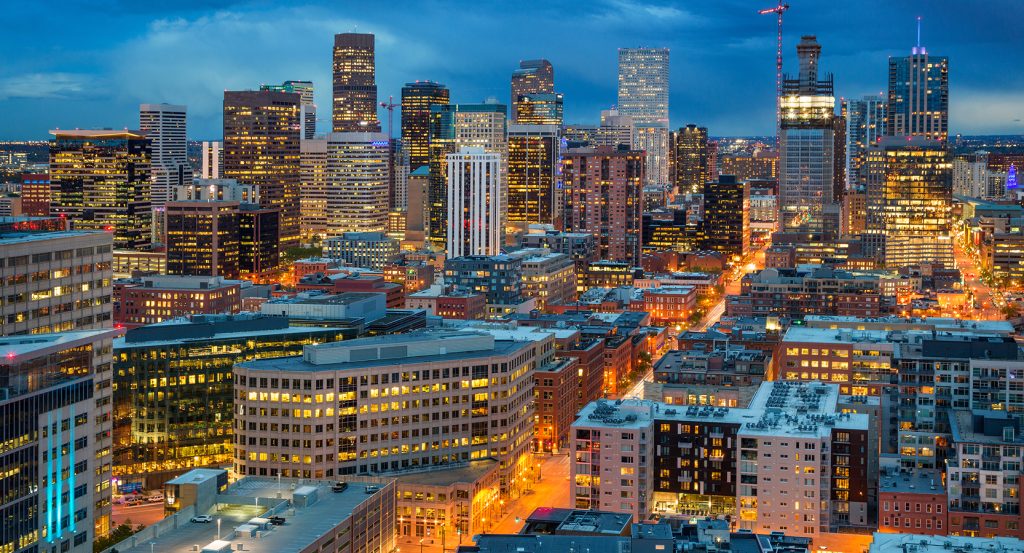
Why you should experience 19th Street in Denver, Colorado.
19th Street is an enterprising corridor where LoDo's mercantile heritage, industrial ingenuity, commercial ambition, and architectural continuity remain vividly preserved.
Running through LoDo between Ballpark and Auraria, the corridor developed as one of Denver's principal warehouse streets, where freight commerce, wholesale enterprise, and durable masonry construction established the physical structure of the city's nineteenth-century business economy. Brick warehouses, cast-iron storefronts, restored commercial blocks, and broad rights-of-way preserve a streetscape shaped by generations of investment while retaining its original urban character. The corridor ultimately reflects Denver's rise as the commercial crossroads of the Rocky Mountain West. The result is an experience defined by historic enterprise, architectural authenticity, and enduring urban vitality.
What you should know about 19th Street.
19th Street is best known for emerging as a major wholesale corridor after the arrival of the Denver Pacific Railway in 1870, which connected Denver to the national rail network and accelerated commercial expansion throughout Lower Downtown. By the 1880s and 1890s, the surrounding blocks supported commission merchants, produce dealers, implement distributors, hardware wholesalers, and manufacturing firms that relied upon nearby freight spurs for regional distribution across the Rocky Mountain West. Sanborn Fire Insurance Maps document brick warehouses, machine works, transfer companies, cold-storage facilities, coal dealers, and agricultural supply houses lining adjoining properties, illustrating an increasingly specialized commercial landscape. Warehouse construction introduced heavy timber framing, thick load-bearing masonry walls, iron fire shutters, freight elevators, and raised loading platforms engineered specifically for large-scale freight handling and long-term merchandise storage.
Business directories from the early twentieth century trace continual occupancy by food processors, printing companies, coffee roasters, paper merchants, machinery distributors, and regional wholesalers whose investment sustained the corridor through successive commercial cycles. Structural evolution accompanied that economic growth as reinforced concrete floor systems, steel window assemblies, and improved fireproofing methods appeared within newer warehouse buildings while older masonry structures received substantial industrial modernization. Historic preservation surveys identify an exceptional concentration of surviving commercial architecture retaining original parapets, loading docks, ornamental brickwork, ghost signs, and heavy timber interiors that collectively document Denver's emergence as the dominant wholesale center of the interior West. Together, railroad commerce, documented industrial engineering, business succession, warehouse technology, and preserved mercantile architecture establish 19th Street as one of LoDo's defining commercial corridors.
How to fold 19th Street into your trip.
19th Street works as an exploration of Lower Downtown's railroad heritage, architectural preservation, and contemporary urban revival.
Begin at Union Station, where the restored transportation hub introduces the railroad era that fueled Lower Downtown's remarkable commercial growth while establishing the historical context that makes the surrounding warehouse district easier to understand. Continue to McGregor Square, whose thoughtfully integrated public spaces demonstrate how adaptive redevelopment can extend the neighborhood's commercial legacy while introducing a contemporary layer to the district's evolving urban story. Conclude at Coors Field, where the transformation of former warehouse blocks into one of Denver's defining civic destinations provides the historical and resonant payoff, illustrating how preservation and reinvention together shaped the modern character of Lower Downtown. The sequence progresses from transportation origins through adaptive urban renewal before culminating in the place that most powerfully synthesizes LoDo's industrial past and energetic present.
Where your story begins.
Foresyte Travel reveals places that feel extraordinary long before you arrive.
Experience premium editorial crafted for luxury travelers.