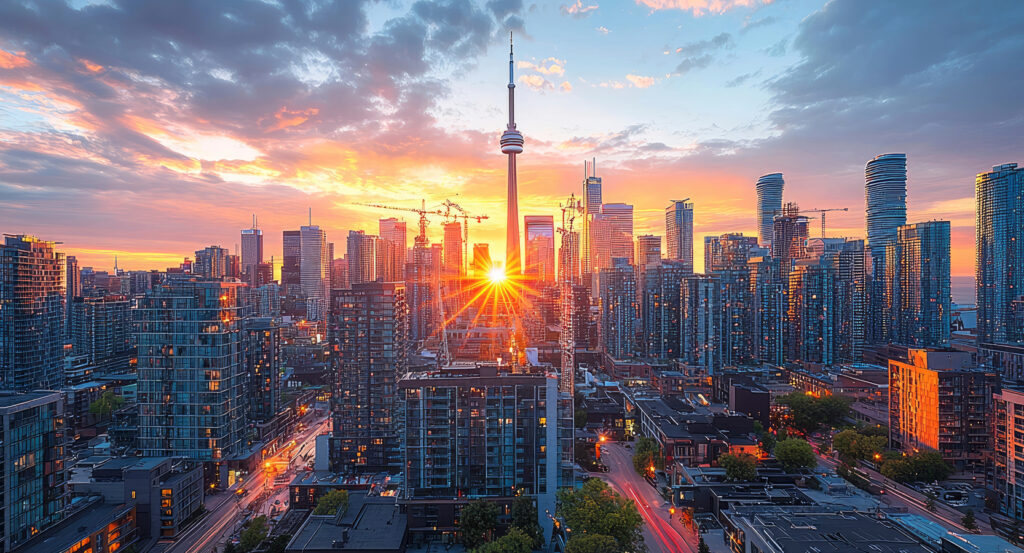
Why you should experience Main Street in Toronto, Ontario.
Main Street is a storied corridor where East End-Danforth's railway heritage, small-town origins, commercial legacy, and enduring community character preserve one of Toronto's most authentic historic main streets.
Running through East End-Danforth between Danforth Village and the Upper Beaches, the corridor connects former municipal institutions, long-established commercial buildings, residential streets, and transit infrastructure that collectively trace the evolution of the independent Town of East Toronto before its incorporation into the City of Toronto. Successive blocks reveal how rail transportation, civic ambition, neighborhood commerce, and continued reinvestment shaped an avenue whose character has remained remarkably resilient for more than a century. Throughout the corridor, historic storefronts, community institutions, and evolving local businesses continue reinforcing a streetscape that reflects both Toronto's metropolitan growth and East Toronto's distinct municipal past. The result is an experience defined by historical continuity, neighborhood character, and one of the city's most compelling legacy corridors.
What you should know about Main Street.
Main Street is best known for serving as the principal commercial street of the former Village of East Toronto, incorporated in 1888 before becoming the Town of East Toronto in 1903 and annexed by the City of Toronto in 1908. The corridor developed around the nearby Grand Trunk Railway yards and station, whose freight operations employed hundreds of workers and transformed East Toronto into one of the region's principal railway communities during the late nineteenth century. The commercial center emerged at the intersection of Main Street and Lake View Avenue, today's Gerrard Street East, where banks, theatres, merchants, a farmers' market, public institutions, and professional offices established the civic and economic heart of the municipality. Growth accelerated after the Toronto and Scarboro' Electric Railway, Light and Power Company introduced radial streetcar service in 1893, strengthening connections with Downtown and Scarborough while encouraging residential subdivision throughout the surrounding district. Together, these municipal, transportation, commercial, and industrial milestones established Main Street as the defining corridor of historic East Toronto.
Industrial expansion surrounding the corridor attracted employers including the Grand Trunk Railway, whose freight yards influenced residential construction, commercial investment, and population growth throughout East Toronto during the late nineteenth century. Replacement of the original wooden Main Street Bridge with modern infrastructure maintained an essential crossing above the railway corridor while preserving the avenue's longstanding role as the community's primary north-south connection. Heritage properties including 292 Main Street, completed by 1887 and associated with former mayor Donald G. Stephenson, preserve rare examples of polychromatic brick construction linked directly to East Toronto's formative years as an independent municipality. Collectively, these engineering works, industrial enterprises, and surviving heritage buildings demonstrate how Main Street evolved through successive eras of municipal development while retaining a remarkable physical record of East Toronto's independent civic identity.
How to fold Main Street into your trip.
Main Street works as an exploration of East Toronto's municipal heritage, transportation history, and neighborhood identity.
Begin at Dentonia Park, where the wooded landscape and recreational grounds establish the natural setting that framed East Toronto's northern expansion before residential neighborhoods gradually spread toward Danforth Avenue. Continue to Main Street Station, whose connection to Toronto's Bloor-Danforth subway line demonstrates the transportation evolution that succeeded the railway and radial streetcar era while continuing the corridor's longstanding role as a regional connector. Conclude at Ted Reeve Community Arena, where one of Toronto's best-known east-end recreation complexes reflects the civic investment and community traditions that have defined the former Town of East Toronto for generations. Together, the sequence progresses from landscape to transportation before culminating in civic life, revealing how Main Street continues connecting the historical foundations and modern character of Toronto's east end.
Where your story begins.
Foresyte Travel reveals places that feel extraordinary long before you arrive.
Experience premium editorial crafted for luxury travelers.