Why you should experience Colborne Lodge in Toronto, Ontario.
Colborne Lodge is the soul of High Park, a perfectly preserved window into 19th-century Toronto, where the city's past still whispers through creaking floorboards and candlelit rooms.
Tucked on a wooded hill overlooking Grenadier Pond, this Georgian-style cottage feels worlds away from downtown, even as the skyline glimmers faintly through the trees. Built in 1837 by John George Howard and his wife Jemima, the lodge was more than a home, it was the heart of an artist's and architect's vision for the city that would one day rise around it. Today, its white stucco walls and black shutters frame a museum rich with atmosphere: original furnishings, Howard's own architectural drawings, and personal artifacts that bring the early decades of Toronto vividly to life. Walking its halls feels like stepping through time, the faint scent of wood smoke, the filtered light through lace curtains, the sense that its inhabitants have only just stepped outside. Colborne Lodge isn't just a relic; it's a living story of how Toronto grew from pastoral beginnings into a city of culture, ambition, and enduring heart.
What you should know about Colborne Lodge.
Colborne Lodge stands as one of Toronto's oldest surviving residences and the birthplace of one of its greatest public legacies.
When John George Howard, an English-born architect, designed the cottage, he fused classical symmetry with the rustic charm of a country retreat, an uncommon blend for its time. He and Jemima lived here for over forty years, filling the home with art, design, and devotion to the surrounding land. In 1873, Howard donated the property, including their home and more than 400 acres, to the City of Toronto to create a public park for future generations. That gift became High Park, now one of the city's most beloved natural landmarks. After his death in 1890, Colborne Lodge became a museum, preserving the couple's legacy of civic generosity and creative spirit. The lodge still contains many of their personal belongings: John's architectural instruments, Jemima's handmade quilts, and even their original furniture, carefully maintained to reflect the 1850s interior. Beneath the floorboards, a small stone vault marks the couple's final resting place, a rare and deeply personal connection between the home, its history, and the land it gave life to.
How to fold Colborne Lodge into your trip.
Make Colborne Lodge the reflective conclusion to your High Park visit.
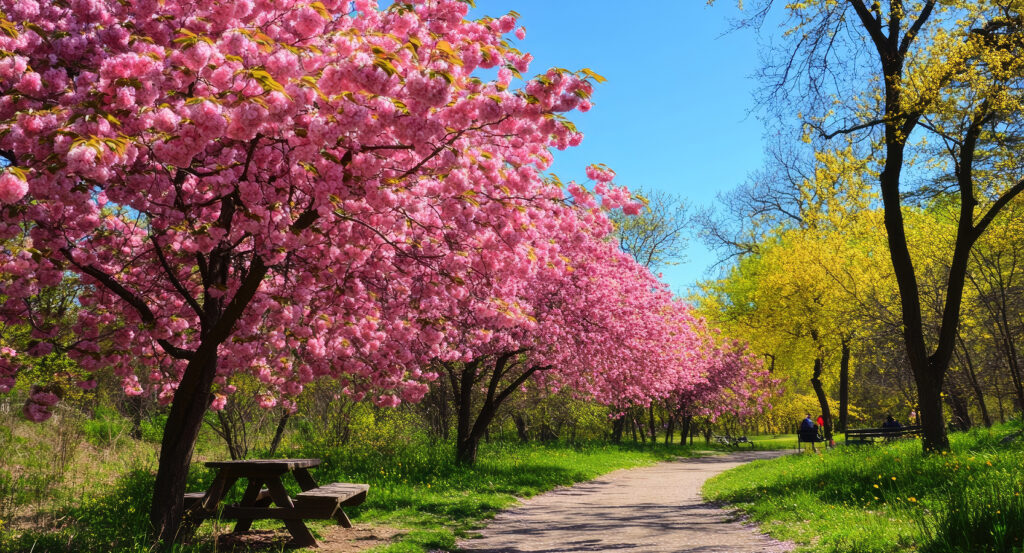
After exploring the trails, zoo, and cherry blossoms, follow the southward path toward the lodge, tucked among towering oaks and quiet lawns. Allow an hour to tour the house, guided visits reveal stories that photographs can't capture, from Howard's urban planning ideas to the personal letters that shaped his philosophy of public space. Visit during daylight hours, when sunlight pours through the parlor windows, or in autumn when fallen leaves carpet the surrounding grounds in gold. The museum's docents offer context that turns architecture into narrative, you'll learn how every beam and hearthstone tells part of Toronto's origin story. Afterward, take a short walk downhill to the edge of Grenadier Pond, the view that inspired Howard's lifelong affection for the land he donated. Sit on one of the nearby benches and look back toward the cottage, its white façade glowing softly against the trees, and you'll feel it too: the quiet satisfaction of a man who gave his city a home that would outlive him, and in doing so, gave it a soul.
Where your story begins.
Foresyte Travel reveals places that feel extraordinary long before you arrive.
Experience premium editorial crafted for luxury travelers.