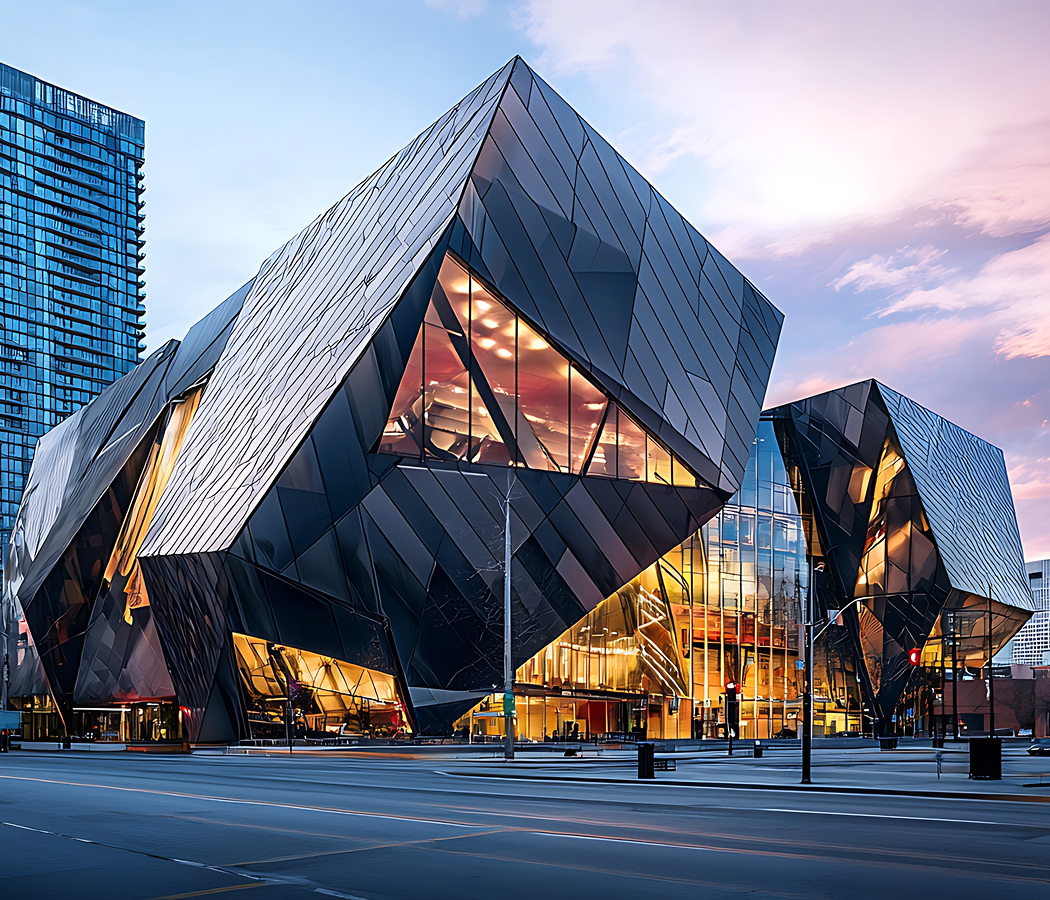
Why Alo matters.
Alo is a MICHELIN-starred contemporary French restaurant where Toronto's Fashion District's industrial heritage meets Patrick Kriss's internationally informed cooking, the evolution of Canadian fine dining and a decade of culinary achievement that established the restaurant among the country's most influential dining institutions.
Positioned on the third floor of a heritage building at Spadina Avenue and Queen Street West, Alo occupies an elevated setting between the historic commercial corridors of the Fashion District, the former industrial buildings surrounding Richmond Street and the contemporary entertainment venues of King Street West. Its discreet street-level entrance leads upstairs to a dining room whose intimate proportions establish a sense of separation from the surrounding city. A substantial renovation completed in early 2026 introduced curved walls, a recessed ceiling with diffused lighting, plush carpeting and a palette of beige and burgundy. The adjoining barroom features an arched silver-toned wall, creating a distinctive architectural relationship between the restaurant's principal spaces. A marble-topped chef's counter provides direct views into the kitchen, and the separate Parlour Room accommodates cocktails and more flexible dining. The result is a sophisticated contemporary restaurant whose carefully composed interiors and elevated position connect Toronto's historic commercial architecture with the city's internationally recognized fine-dining culture.
What defines Alo.
Alo is best known for chef-owner Patrick Kriss's transformation of a modest independent restaurant into one of Canada's most consistently recognized fine-dining establishments. A Toronto native, Kriss began working in professional kitchens at fifteen and subsequently developed his technical foundation through appointments in Canada, France and New York. His international experience included training at Daniel Boulud's MICHELIN-starred Daniel in Manhattan, where the discipline of classical French cooking informed his professional development. Returning to Toronto, he became chef at Splendido, an influential restaurant whose demanding standards helped shape a generation of Canadian culinary professionals. Kriss subsequently led the kitchen at Acadia, developing a more independent approach to contemporary cooking through a restaurant associated with the ingredients and traditions of the American South. These appointments established the technical and managerial foundation for his first ownership venture. In July 2015, Kriss opened Alo in partnership with restaurateur Zane Pearl, introducing a fine-dining concept centered on an ambitious multicourse tasting menu. The restaurant served sixteen guests on its opening evening, beginning an operation that would subsequently become a defining institution within Toronto's restaurant industry. Its early success reflected the relationship between meticulous culinary execution and a comparatively intimate form of hospitality. Kriss developed a professional team capable of delivering an elaborate sequence of courses with the precision associated with internationally recognized tasting-menu restaurants. The establishment's reputation expanded rapidly, earning first place in Canada's 100 Best Restaurants in 2017. Alo subsequently retained the top position for five consecutive editions, establishing an exceptional period of national recognition. Its international reputation also developed through inclusion in the extended World's 50 Best Restaurants rankings, reaching number ninety in 2020. The arrival of the MICHELIN Guide in Toronto in 2022 brought another important distinction when Alo received one MICHELIN star in the guide's inaugural Canadian selection. The restaurant retained its star in subsequent editions, confirming its position among the city's leading contemporary French establishments. Kriss expanded his business through the creation of Alo Food Group, developing complementary restaurants that introduced his culinary direction to different dining formats. Aloette opened on Spadina Avenue in 2017, adapting the group's technical standards to a neighborhood bistro specializing in refined comfort food. Alobar Yorkville followed in 2018, extending the enterprise into an established Toronto dining district through a restaurant emphasizing seafood, premium meats and sophisticated wine service. The group subsequently developed Salon, Aloette Go, Alder and additional Alobar locations, establishing a diversified hospitality business across the city. Christopher Sealy contributed to the development of the group's wine program, strengthening the relationship between its restaurants and international producers. Alo received the Best Service distinction from Canada's 100 Best Restaurants in 2025, recognizing the importance of hospitality within its sustained reputation. A major renovation followed in January 2026, temporarily closing the restaurant for improvements to its dining spaces. Alo reopened in early March with a refreshed interior and an expanded culinary direction developed by Kriss and chef de cuisine Tim Yun. The transformation introduced a more internationally varied repertoire and unified the tasting-menu program across the principal dining room and adjoining lounge. Canada's 100 Best Restaurants ranked Alo seventh nationally in 2026, reflecting its continued standing within the country's evolving fine-dining landscape. Its significance rests on this progression from an ambitious independent opening into a nationally influential restaurant group, establishing Kriss as a central figure in the development of contemporary Canadian gastronomy.
Patrick Kriss's cooking develops through classical French technique, exceptional seasonal ingredients and an increasingly international range of culinary influences. His approach emphasizes the relationship between carefully selected products, precise temperature control and sauces that contribute depth to otherwise restrained compositions. The restaurant's blind tasting-menu format establishes a sequence of courses selected by the kitchen, encouraging guests to encounter changing ingredients through a carefully organized sequence. Four-, six- and ten-course options accommodate different approaches to the meal, with the longer progression allowing the kitchen to develop a more extensive interpretation of its seasonal repertoire. Koshihikari risotto provides a representative expression of the restaurant's contemporary direction, combining Japanese short-grain rice with dashi, thinly sliced wagyu beef and truffle. The preparation connects the creamy texture associated with Italian risotto to the savory clarity of Japanese stock, demonstrating the kitchen's ability to integrate distinct culinary techniques. Duck breast introduces a complementary expression of classical French cooking, accompanied by white asparagus and stuffed morels that reinforce the relationship between carefully prepared poultry and seasonal vegetables. The dish depends upon precise cooking and the controlled development of its accompanying sauce, preserving the natural richness of the principal ingredient. Rack of lamb with Thai curry provides another example of the restaurant's expanded international repertoire, introducing aromatic Southeast Asian seasoning into a composition grounded in European meat preparation. The relationship between the lamb's substantial flavor and the curry's aromatic complexity demonstrates the kitchen's willingness to draw upon a broader range of culinary traditions. Desserts extend this approach through preparations that combine familiar ingredients with unexpected accents, including strawberries and cream finished with sake foam. Their restrained presentation preserves the balance established throughout the savory courses. The restaurant's wine program emphasizes carefully selected international producers, with pairings developed around the contrasting requirements of seafood, meat, fermented seasonings and delicate desserts. Christopher Sealy's direction contributes a substantial understanding of wine regions and individual producers, reinforcing the relationship between the cellar and the kitchen's evolving menu. A dedicated cocktail program introduces classically inspired drinks through the adjacent barroom, extending the restaurant's hospitality beyond the principal tasting-menu service. Tim Yun's culinary leadership supports the daily execution of the kitchen's increasingly varied repertoire, preserving the technical standards associated with the restaurant's established reputation. Alo's distinction emerges from this integration of French culinary discipline, international ingredients and carefully coordinated service, establishing a contemporary tasting-menu experience shaped by technical precision and seasonal change.
How Alo fits.
Alo works as the dining culmination of an exploration connecting Toronto's industrial manufacturing heritage, the preservation of independent cultural institutions and the development of contemporary Canadian cinema, placing the restaurant within the historical and creative landscape of the Fashion and Entertainment Districts.
Begin at 401 Richmond, the heritage-designated industrial complex developed between 1899 and 1923 for the Macdonald Manufacturing Company. The enterprise specialized in lithography on tinware, contributing to Toronto's growth as a major Canadian manufacturing center during the late nineteenth and early twentieth centuries. Continental Can Company acquired the business in 1944, continuing industrial operations until 1967. Following decades of declining occupancy, developer Margie Zeidler acquired the property in 1994 and undertook an ambitious rehabilitation program. The restored complex subsequently developed into an important center for artists, galleries, cultural organizations and independent creative enterprises, demonstrating the potential of historic industrial buildings to accommodate contemporary cultural production. Continue to Graffiti Alley, the celebrated street-art corridor extending along Rush Lane between Spadina Avenue and Portland Street. Its walls contain an evolving collection of murals, painted lettering and large-scale works produced by Toronto's street-art community. The laneway became nationally recognizable through its association with comedian Rick Mercer, whose televised political monologues frequently used the location as a backdrop. Its development reflects the gradual recognition of street art as an important component of Toronto's contemporary visual culture. The changing murals preserve a direct relationship between individual artists, neighborhood character and the creative transformation of public space. Conclude at TIFF Lightbox, the cultural institution established as the permanent headquarters of the Toronto International Film Festival. Completed in 2010 at King Street West and John Street, the complex introduced a substantial purpose-built facility for film exhibition, education and archival research. Its five cinemas support year-round programming, extending the festival's cultural influence beyond its annual September event. The building also accommodates exhibition spaces, educational facilities and the Film Reference Library, connecting contemporary cinema with the preservation and interpretation of moving-image history. Its opening represented an important stage in Toronto's development as an international center for film production, distribution and exhibition. The progression connects the adaptive reuse of Toronto's industrial architecture with the evolution of its independent street-art culture and concludes at a major institution of international cinema, establishing the broader cultural setting surrounding Alo.
Where your story begins.
Foresyte Travel reveals places that feel extraordinary long before you arrive.
Enjoy editorial crafted for luxury travelers.
Foresyte may earn a commission when you book.