
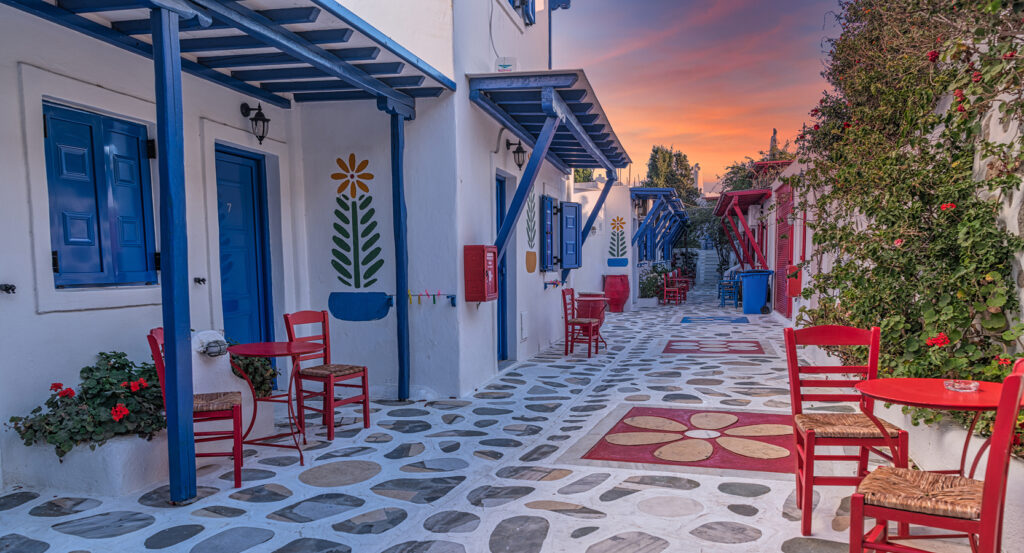
Why you should experience Agricultural Museum, Mykonos in Greece.
Agricultural Museum, or Mylos tou Boni, in Mykonos offers a window into a side of the island few visitors ever see, the Mykonos that existed long before the glamour and nightlife.
Perched on a hill overlooking Chora, this open-air museum feels like stepping back into the rhythm of rural life, where the hum of windmills and the scent of freshly milled grain once defined the island's heartbeat. Centered around the iconic Boni Windmill, the museum unfolds as a collection of restored farmhouses, olive presses, bread ovens, and threshing floors that tell the story of an island built on self-reliance and ingenuity. As you wander among tools worn smooth by generations of hands, you begin to sense the poetry of hard work, of fields tended under the Aegean sun, of water drawn from wells, of life shaped by the rhythm of wind and harvest. From the summit, the view over Mykonos Town and the port below feels timeless, a living reminder that beneath the island's polished surface lies a soul carved from salt, soil, and wind.
What you should know about Agricultural Museum, Mykonos.
The museum isn't just a collection of rural relics, it's part of a much larger narrative that defines Cycladic life itself.
Established in the 1980s as an extension of the Folklore Museum of Mykonos, the Agricultural Museum was created to preserve the disappearing heritage of local farming traditions. The centerpiece, the Boni Windmill, dates back to the 16th century and still turns with the island's powerful northern winds, a masterpiece of early engineering that once kept Mykonos fed through the lean seasons. Surrounding it, exhibits display ancient grape presses, looms, and hand-carved tools, each piece reflecting the resourcefulness of an island that thrived despite its arid land. During summer months, the museum hosts the annual Harvest Festival, complete with music, dancing, and freshly baked bread made the traditional way, in clay ovens fired with olive wood. It's one of the few places on Mykonos where you can still feel the connection between the island's people and the land that sustained them for centuries.
How to fold Agricultural Museum, Mykonos into your trip.
Visiting the Agricultural Museum is like hitting pause on the high tempo of Mykonos, a quiet reset that deepens your understanding of the island.
The best time to visit is late afternoon, when the winds soften and the light over the Aegean turns honey-gold. Begin at the Boni Windmill, where you can watch its wooden sails creak to life, then wander through the open-air exhibits at your own pace. Bring a camera, the view of Chora from here is among the most striking on the island, especially at sunset when the white rooftops below blush pink and gold. If you're lucky, you might catch one of the seasonal demonstrations of bread baking or wine pressing, both carried out by locals with the same techniques their ancestors used. Afterward, take a short walk down into town for dinner, the contrast between old-world Mykonos above and modern Mykonos below makes the experience feel complete. You'll leave not only with photos but with perspective, a quiet reverence for the wind, the work, and the enduring beauty of a simpler Mykonian life.
Where your story begins.
Foresyte Travel reveals places that feel extraordinary long before you arrive.
Experience premium editorial crafted for luxury travelers.




















































































































