Why Pallas-Athene-Brunnen matters.
Pallas-Athene-Brunnen is an allegorical fountain where Innere Stadt's imperial Ringstrasse character meets Theophil Hansen's vision of classical wisdom, constitutional government and the multinational geography of the Habsburg realm.
Set along Dr.-Karl-Renner-Ring near Schmerlingplatz and just steps from the expansive approach to the Austrian Parliament, the fountain occupies the center of the building's forecourt between its twin ramps and the broad Ringstrasse. A stepped stone basin creates the lowest tier before the sculptural composition rises through reclining figures, seated allegories and a tall central column. White Laas marble gives the principal figures a luminous surface against the Parliament's Greek Revival colonnade, with water animating the lower basin beneath the static statuary. Pallas Athene crowns the composition above the approach, carrying a gilded helmet, breastplate, spear and miniature Nike that remain visible across the open forecourt. The result is an expansive civic fountain whose ascending marble composition turns the Parliament's principal approach into an extension of its classical architectural program.
What defines Pallas-Athene-Brunnen.
Pallas-Athene-Brunnen is best known for completing Theophil Hansen's allegorical program for the Austrian Parliament nearly two decades after the building itself entered service. Hansen developed plans for the fountain in 1870, before construction of the Reichsrat building began in 1874, yet work on the monument did not start until 1898 and reached completion in 1902. His original concept placed Austria atop the composition as the personification of the state. National tensions within the Habsburg monarchy made that figure politically contentious, prompting the substitution of Pallas Athene, whose association with wisdom provided a less nationally specific symbol for the legislature. Hansen died in 1891, leaving sculptor Carl Kundmann to execute the central goddess in close adherence to the architect's design. Kundmann also created the Elbe and Vltava figures, Hugo Haerdtl produced the Danube and Inn, and Josef Tautenhayn sculpted the seated personifications of legislative and executive authority. The arrangement transformed the fountain into a compact representation of government and imperial geography, with political powers positioned above four rivers crossing major territories of the monarchy. Its 1902 completion placed the final major sculptural element before a Parliament that had already hosted Reichsrat sessions since 1883.
Athene rises 5.5 meters above the fountain with Nike in her right hand and a spear in her left, joining victory and wisdom within the figure that dominates the composition. The goddess stands on an owl capital, incorporating the bird traditionally associated with Athena into the column directly beneath her feet. Legislative authority and executive authority sit to either side, giving separate sculptural bodies to the division between making laws and carrying them out. The lower basin expands the political symbolism geographically through the Danube, Inn, Elbe and Vltava, rivers whose courses connected different regions of the Habsburg monarchy. Winged Erotes complete the lower ensemble around a basin constructed from Neuhaus granite. Weather, environmental exposure and physical damage led to a major conservation campaign from 2003 through 2005, including restoration of the basin and marble sculpture. Another campaign accompanying the Parliament's twenty-first-century renovation cleaned the figures, repaired damaged sculptural elements, removed corrosion and vegetation, sealed leaking portions of the fountain and renewed gilding on Athene's helmet, breastplate and Nike. Pallas-Athene-Brunnen preserves Hansen's classical political symbolism through a sculptural hierarchy in which river geography supports governmental authority and both rise beneath the goddess of wisdom.
How Pallas-Athene-Brunnen fits.
Pallas-Athene-Brunnen works as the opening point for a Ringstrasse route through three nearby places that connect imperial public gardens, nineteenth-century theater architecture and the expansive rebuilding of Vienna after its fortifications disappeared.
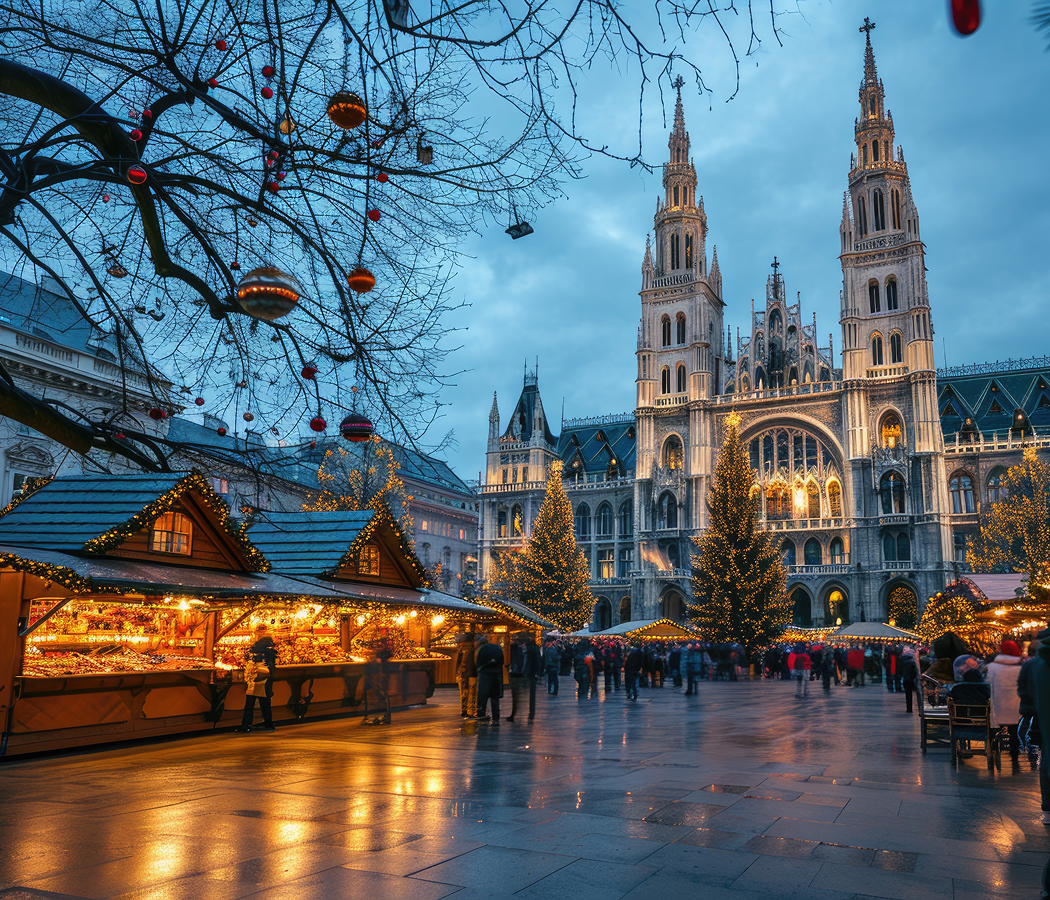
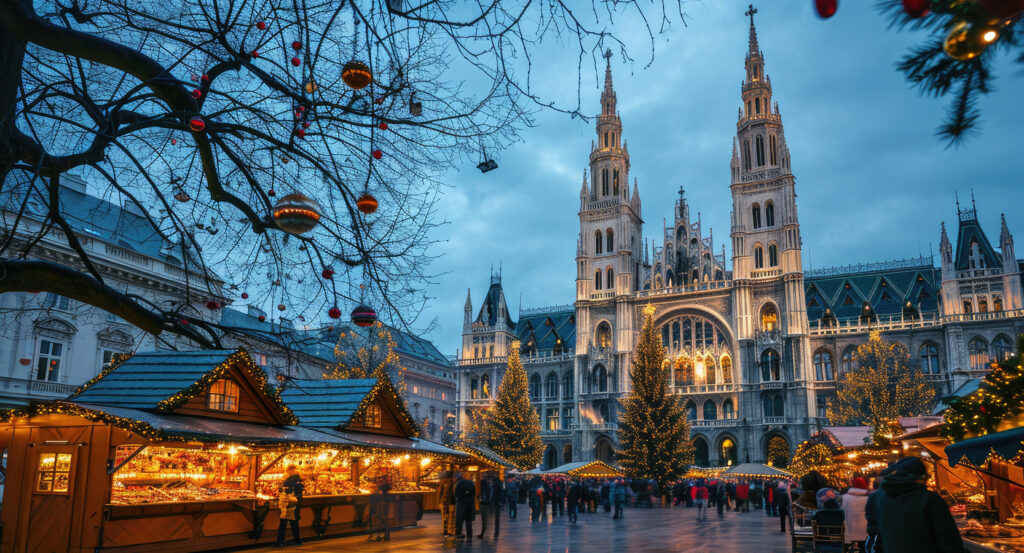
Begin at Theseustempel, the neoclassical structure Peter von Nobile built between 1819 and 1823 inside the Volksgarten. Emperor Franz I commissioned the surrounding garden after Napoleonic warfare damaged Vienna's fortifications, and its 1823 opening created the first Austrian garden explicitly built by the imperial household for public use. Nobile modeled the temple on the ancient Temple of Hephaestus in Athens to house Antonio Canova's Theseus Slaying the Centaur, whose white marble group remained there for nearly seventy years before moving to the Kunsthistorisches Museum in 1890. Continue to Burgtheater, whose institutional ancestry reaches to the court theater established under Maria Theresa and reorganized by Joseph II as the Teutsches Nationaltheater in 1776. Gottfried Semper and Karl von Hasenauer designed its Ringstrasse home, constructed from 1874 through 1888 and opened on October 14, 1888 with works by Beethoven, Josef von Weilen, Franz Grillparzer and Friedrich Schiller. Gustav Klimt, Ernst Klimt and Franz Matsch painted ten works for the ceremonial staircases between 1886 and 1888, including Gustav Klimt's only known painted self-portrait within Shakespeare's Globe Theatre. Conclude at Vienna City Hall, built from 1872 through 1883 after Friedrich Schmidt won the international competition for Vienna's new municipal headquarters. Schmidt gave the enormous complex a Neo-Gothic exterior dominated by its central tower, where the iron Rathausmann rises above the Ringstrasse ensemble as one of the capital's defining nineteenth-century civic sculptures. The progression moves from Peter von Nobile's public temple for Canova through Semper and Hasenauer's theater enriched by the young Klimt brothers and culminates in Friedrich Schmidt's municipal palace, tracing the architectural ambitions that reshaped Vienna from the final decades of the imperial fortifications into the expansive Ringstrasse city.
Where your story begins.
Foresyte Travel reveals places that feel extraordinary long before you arrive.
Enjoy editorial crafted for luxury travelers.
Foresyte may earn a commission when you book.