Why Capilano River Regional Park matters.
Capilano River Regional Park is where Vancouver's wilderness roars back to life, a sanctuary of rushing water, towering evergreens, and deep canyon silence just minutes from the city.
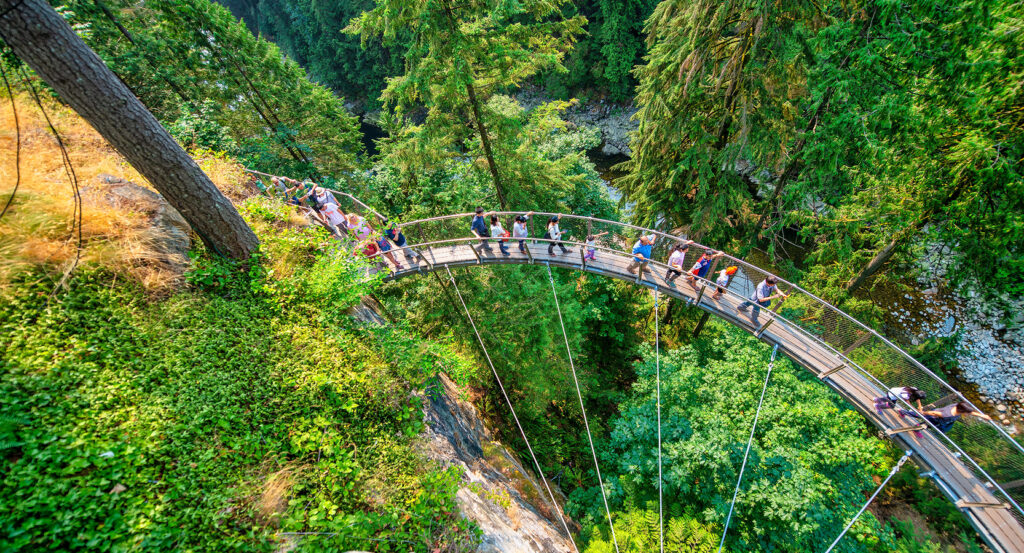
Stretching from the base of the Cleveland Dam to the forested canyons below, the park feels elemental: steep cliffs draped in moss, trails that smell of cedar and earth, and the constant thunder of the Capilano River carving through rock. Here, the hum of the city fades into the rhythm of nature. You can walk beside the river's turquoise currents, cross suspension bridges, and stand on cliffside lookouts that make you feel infinitesimal beneath the weight of the landscape. Every sense comes alive, the sound of the dam's spillway, the cool mist on your face, the sight of bald eagles gliding through the valley. This is Vancouver's quieter masterpiece, raw, untamed, and profoundly alive.
What defines Capilano River Regional Park.
Though Capilano River Regional Park feels like an untouched wilderness, it's also one of Metro Vancouver's oldest managed watersheds, a living example of how conservation and urban life can coexist.
The park's origins trace back to 1954, when the Cleveland Dam was completed to create Capilano Lake, a major source of Vancouver's drinking water. The dam, towering 91 meters (300 feet) high, still supplies 40% of the city's freshwater, drawing from the pristine snowmelt of the North Shore Mountains. Beneath it, the Capilano River continues its descent through canyon walls of volcanic basalt and ancient glacial sediment, shaping one of British Columbia's most dramatic natural corridors. The park spans 200 hectares, preserving ecosystems ranging from salmon-bearing streams to coastal rainforest. The Capilano River Hatchery, established in 1971, plays a vital role in sustaining local fish populations, particularly Coho and Chinook salmon, which you can watch leaping upstream during spawning season. Trails like the Capilano Pacific Trail and Fisherman's Trail reveal glimpses of history, old hydro works, First Nations fishing sites, and remnants of 19th-century logging operations that helped build Vancouver itself. Interpretive signs along the routes detail the Indigenous significance of the river valley, once a vital sustenance and spiritual site for the Squamish Nation, whose traditional territory this remains. The park's geology is equally fascinating: its canyon was formed by meltwater torrents at the end of the last Ice Age, cutting through bedrock over 10,000 years to create today's deep gorge. Even now, the Capilano's currents continue to shape and shift the landscape, a reminder that nothing here is still, not even the stone.
How Capilano River Regional Park fits.
Exploring Capilano River Regional Park is a journey through Vancouver's wild heart, one that rewards both curiosity and quiet reflection.
Start at the Cleveland Dam, accessible via Capilano Road, and stand atop its viewing platform for a panoramic view of Capilano Lake, its mirror-like surface framed by the North Shore Mountains. Then, follow the Capilano Pacific Trail down into the canyon, a gentle descent shaded by ferns and evergreens, where you'll hear the rush of the river long before you see it. Stop at the Capilano River Hatchery, where glass windows let you peer into the underwater world of salmon ascending the fish ladders. From there, continue along the Fisherman's Trail toward the lower canyon, where suspension bridges and lookout points offer breathtaking views of the churning rapids below. Bring water, good footwear, and a camera, the light filtering through the forest creates an ever-changing play of gold and green. If you prefer a shorter visit, the upper park near the dam offers picnic areas and easy access to viewpoints that don't require hiking. But to truly understand the park's character, give it time, two to three hours to wander, pause, and listen. Visit in late September or October to witness the salmon run, when the river flashes with movement and life. Early morning or late afternoon provides the best light for photography and solitude. The park is free to enter and easily reachable by car or public transit from Downtown Vancouver. End your visit where you began, at the dam's edge, looking down into the vast canyon you've just explored. The roar of the water below and the stillness of the lake above remind you that this place, balanced between wildness and necessity, is Vancouver distilled: pure, powerful, and infinitely alive.
Where your story begins.
Foresyte Travel reveals places that feel extraordinary long before you arrive.
Enjoy editorial crafted for luxury travelers.
Foresyte may earn a commission when you book.