Why you should experience Claremont Street in Toronto, Ontario.
Claremont Street is an eclectic corridor where Trinity-Bellwoods' Victorian heritage, creative energy, architectural craftsmanship, and enduring urban character define one of Downtown's most distinctive residential streets.
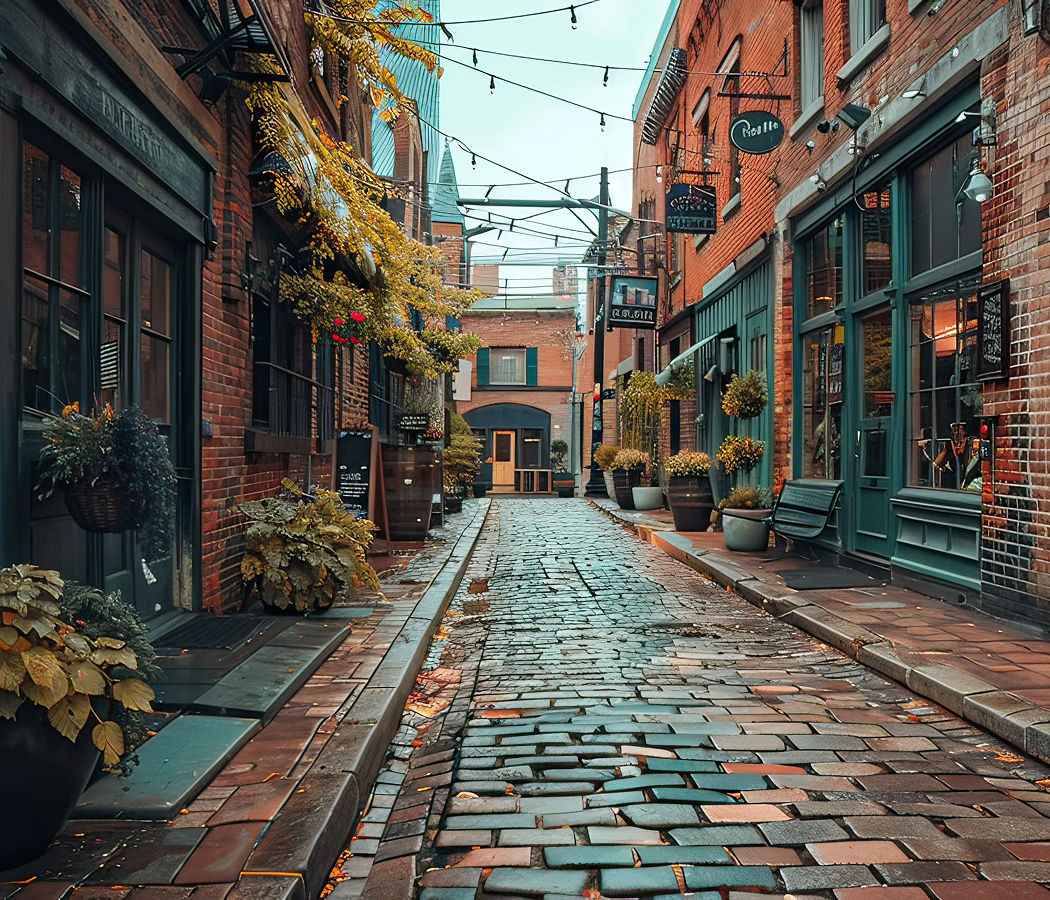
Running through Trinity-Bellwoods between College Street and Queen Street West, the corridor connects nineteenth-century residential blocks, neighborhood institutions, independent businesses, and mature tree-lined streets that collectively reflect the evolution of Toronto's west end from early suburb to one of the city's most sought-after urban communities. Successive blocks reveal how residential subdivision, street railway expansion, skilled masonry, and incremental neighborhood growth produced a cohesive streetscape that has retained its historic fabric through generations of change. Throughout the corridor, preserved brick houses, generous boulevard trees, and human-scaled streets reinforce an atmosphere shaped by craftsmanship and continuity. The result is an experience defined by authenticity, architectural richness, and one of Toronto's most recognizable residential corridors.
What you should know about Claremont Street.
Claremont Street is best known for emerging during Toronto's rapid westward expansion in the 1880s, 1890s, and early 1900s, when subdivision of former estate lands created substantial residential neighborhoods beyond the original city limits. Growth accelerated following expansion of the Toronto Railway Company streetcar network along College Street, Queen Street West, and Dundas Street West, allowing builders to establish dense residential blocks within easy reach of Toronto's commercial core. Construction introduced cohesive collections of Victorian, Edwardian Classical, Anne Revival, and Bay-and-Gable houses distinguished by red brick masonry, decorative corbelling, limestone lintels, stained-glass transoms, projecting bays, ornate wood porches, and steep slate-clad rooflines that continue defining the avenue's architectural identity. Standardized lot dimensions, rear service laneways, landscaped front setbacks, and mature maple canopies reflected late nineteenth-century residential planning principles while creating a remarkably consistent streetscape that survives across much of the corridor. Together, these subdivision patterns, transportation investments, architectural traditions, and thoughtful urban planning established Claremont Street as one of Trinity-Bellwoods' defining residential corridors.
Creation of the Village of Yorkville in 1853, subsequent westward municipal expansion, and the consolidation of surrounding communities into the City of Toronto supported coordinated investment in paved roads, sewer construction, water distribution, gas lighting, and other civic infrastructure that benefited adjoining residential districts. The establishment of Central Technical School in 1911 strengthened the surrounding area's educational character by introducing one of Canada's leading secondary institutions for industrial arts, engineering, applied science, and design education. Ongoing stewardship through the City of Toronto Heritage Preservation Services continues safeguarding original brick façades, decorative masonry, period wood detailing, historic roof profiles, and cohesive residential streetscapes that distinguish Claremont Street from later twentieth-century redevelopment. Collectively, these municipal initiatives, educational investments, infrastructure improvements, and heritage conservation efforts demonstrate how Claremont Street has preserved the physical character of Toronto's late Victorian west end.
How to fold Claremont Street into your trip.
Claremont Street works as an exploration of Trinity-Bellwoods' residential heritage, independent culture, and historic streetscapes.
Begin at Trinity Bellwoods Park, where broad lawns, mature trees, and one of Toronto's most beloved gathering places introduce the neighborhood's relaxed atmosphere while providing a natural gateway into the surrounding residential streets. Continue to The Theatre Centre, where contemporary performances and adaptive cultural programming deepen the area's creative character before leading naturally toward the historic commercial energy of Queen Street West. Conclude at Graffiti Alley, where decades of continually evolving public art provide the visual and cultural payoff, revealing the creative spirit that has become inseparable from Toronto's west end. Together, the sequence moves from neighborhood landscape to contemporary culture before culminating in one of the city's most expressive public art environments, creating an outing that captures the essence of Claremont Street.
Where your story begins.
Foresyte Travel reveals places that feel extraordinary long before you arrive.
Experience premium editorial crafted for luxury travelers.