
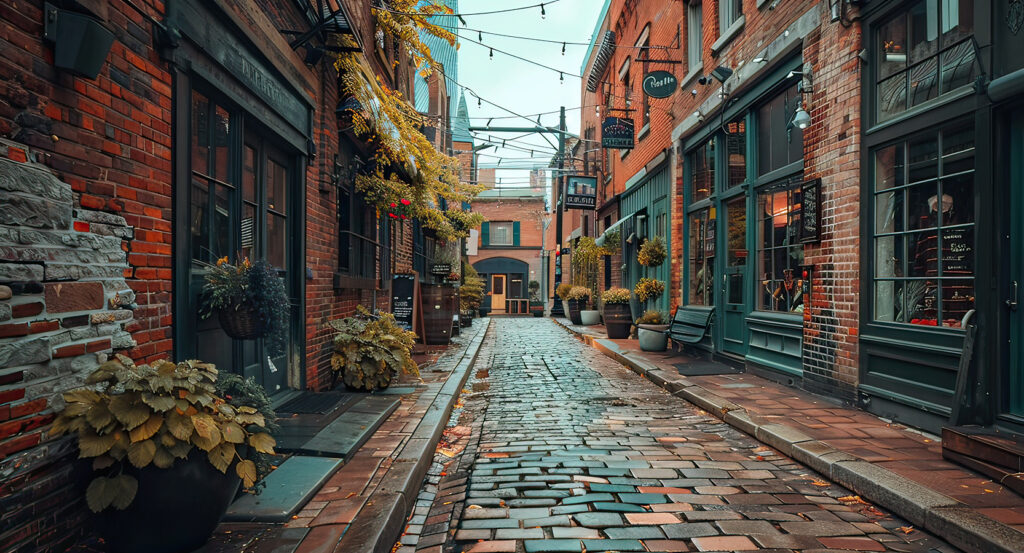
Why The Distillery Historic District matters.
The Distillery Historic District is a remarkable industrial heritage enclave where Corktown's nineteenth-century manufacturing history meets the commercial ambitions of Gooderham and Worts, the architectural legacy of Victorian Toronto and the reinvention of a major whisky-producing complex as a pedestrian cultural quarter.
Situated east of Downtown between Parliament Street and Cherry Street, the district occupies a substantial former industrial property south of Mill Street, where interconnected brick warehouses, cobbled lanes and preserved manufacturing buildings form an enclosed pedestrian precinct near the historic waterfront and surrounding residential neighborhoods. Tall chimney stacks, arched windows and substantial masonry façades preserve the physical scale of the former distillery. Narrow passages open into courtyards framed by industrial buildings of differing heights and construction periods. Galleries, restaurants and shops occupy adapted production spaces, retaining the close relationship between interior commercial activity and the surrounding pedestrian streets. The result is an exceptionally cohesive industrial precinct whose preserved architecture, cultural programming and independent businesses sustain a distinctive part of Toronto's urban heritage.
What defines The Distillery Historic District.
The Distillery Historic District is best known for preserving the former Gooderham and Worts distillery, once among the largest whisky-producing operations in the world, and for its transformation into a major cultural and commercial destination. James Worts established a milling business near Toronto's waterfront in 1832, taking advantage of the city's expanding agricultural trade and access to transportation routes. His brother-in-law William Gooderham joined the enterprise, strengthening the family partnership that subsequently shaped the property's development. Worts died in 1834, leaving Gooderham to assume increasing responsibility for the operation. The business expanded into distilling in 1837, using grain associated with its milling activities to produce whisky. Toronto's commercial growth and improving transportation infrastructure supported the enterprise's expansion during the following decades. Gooderham and Worts developed substantial production facilities, including warehouses, processing buildings and supporting industrial infrastructure. The Stone Distillery, completed in 1861, became the architectural centerpiece of the complex, incorporating substantial limestone construction and advanced industrial organization. Its design reflected the increasing scale of Canadian whisky production during the nineteenth century. The company expanded its international commercial reach as demand for Canadian spirits increased across North American and overseas markets. By the late nineteenth century, the distillery had become one of Canada's most important industrial enterprises, contributing substantially to Toronto's manufacturing economy. Ownership and operating arrangements changed during the twentieth century as the Canadian spirits industry underwent consolidation. Distilling eventually ceased at the property in 1990, leaving a large collection of industrial buildings whose original manufacturing functions had disappeared. The complex subsequently attracted film and television productions, taking advantage of its preserved Victorian architecture and extensive interior spaces. Cityscape Holdings and Dundee Realty acquired the property and undertook a substantial redevelopment program that retained the historic buildings while introducing cultural and commercial uses. The Distillery Historic District opened to the public in 2003, establishing a pedestrian environment organized around galleries, restaurants, performance spaces and independent retail businesses.
Gooderham and Worts' industrial architecture gives the district its distinctive physical character through the unusually complete survival of interconnected production buildings and their supporting infrastructure. The Stone Distillery establishes the principal architectural reference through its substantial limestone walls, regular window openings and carefully organized industrial proportions. Its construction accommodated the equipment and processes required for large-scale whisky production, demonstrating the relationship between nineteenth-century manufacturing technology and substantial masonry architecture. Surrounding brick buildings introduce contrasting materials and construction periods, revealing the complex's expansion through successive phases of industrial development. Former warehouses retain heavy timber structures and substantial interior volumes originally intended for the storage of grain, barrels and finished products. Narrow lanes preserve the circulation routes that connected individual stages of production and transportation across the property. The absence of ordinary vehicle traffic allows these spaces to function as pedestrian passages, directing movement between courtyards and adapted buildings. Original industrial details, including metal fittings, loading openings and exposed structural elements, remain visible throughout portions of the precinct. The Boiler House and other former production buildings accommodate restaurants and commercial establishments whose interior arrangements incorporate substantial remnants of the original industrial fabric. Gallery spaces use high ceilings and exposed masonry to accommodate contemporary artworks within the preserved architectural setting. Seasonal installations introduce temporary visual elements into the courtyards, changing the character of the outdoor spaces while maintaining their underlying industrial structure. The Toronto Christmas Market, subsequently developed into the Distillery Winter Village, established an important annual tradition through illuminated streets, seasonal vendors and large public gatherings. Outdoor sculptures and permanent art installations contribute additional points of interest along the pedestrian routes. The district's commercial activity unfolds within a closely connected network of historic buildings, allowing visitors to encounter the physical organization of a nineteenth-century industrial enterprise through its adaptation for contemporary cultural life.
How The Distillery Historic District fits.
The Distillery Historic District works as the industrial heritage centerpiece for a Toronto outing connecting the city's historic manufacturing waterfront, its preserved nineteenth-century neighborhoods and the public institutions that interpret the development of Canada's largest metropolitan center.
Begin at St. Lawrence Market, the historic public market occupying a prominent site near the eastern edge of Downtown. The market's origins extend to 1803, when the town of York established a permanent public marketplace. Its South Market building incorporates portions of Toronto's former City Hall, completed in 1845 under architect Henry Bowyer Lane. The substantial brick structure accommodates food merchants specializing in meat, seafood, produce, cheese and prepared foods. Its continued commercial activity preserves the relationship between Toronto's early civic institutions and the food distribution networks that supported the growing city. Continue to the First Parliament Site, the historic location associated with the first purpose-built parliamentary buildings of Upper Canada. The original structures were completed in 1797 near the eastern waterfront, providing accommodation for the colonial legislature. American forces destroyed the buildings during the Battle of York in April 1813, an important episode of the War of 1812. Subsequent development altered the property, but archaeological investigations have recovered evidence of its earlier political and institutional functions. The site preserves a direct connection with the formation of representative government in colonial Ontario. Conclude at Corktown Common, the extensive public park developed as part of the West Don Lands redevelopment. Designed by Michael Van Valkenburgh Associates, the park incorporates landscaped hills, wetlands, lawns and recreational spaces within a former industrial district. Its construction formed part of a broader flood-protection initiative associated with the Don River watershed. The park's substantial earthworks and planted landscapes provide recreational space while contributing to the management of stormwater and flood risk. Its relationship with surrounding residential development demonstrates the continuing transformation of Toronto's former industrial waterfront. The progression moves from St. Lawrence Market's commercial heritage through the First Parliament Site's political history and culminates at Corktown Common's reclaimed urban landscape, connecting The Distillery Historic District with the economic and civic development of eastern Toronto.
Where your story begins.
Foresyte Travel reveals places that feel extraordinary long before you arrive.
Enjoy editorial crafted for luxury travelers.
Foresyte may earn a commission when you book.























































































































