
Why the Eagle Bahn Gondola matters.
Eagle Bahn Gondola is a twelve-passenger aerial lift where Lionshead's Alpine resort architecture meets the evolution of Vail Mountain's transportation infrastructure and the development of Eagle's Nest as a year-round center for high-altitude recreation.
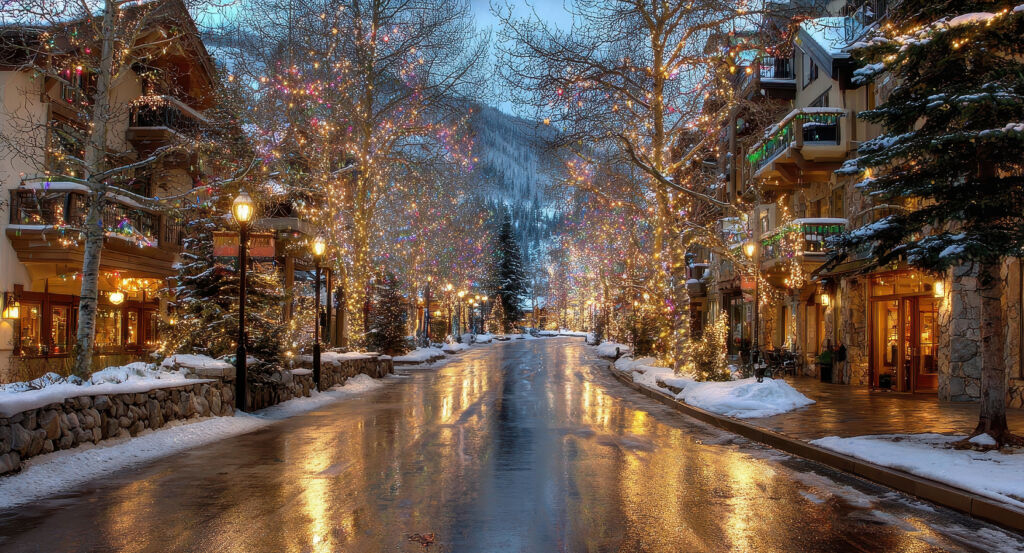
Departing from Lionshead Village near East Lionshead Circle and a short walk from the pedestrian crossing over Gore Creek, the gondola ascends Vail Mountain's western frontside toward Eagle's Nest, crossing forested ski slopes above the Born Free corridor and overlooking the Gore Valley. Enclosed cabins travel above stands of spruce and fir, gaining elevation as the lower village buildings recede beneath the lift. The upper terminal occupies a developed mountain ridge containing dining facilities, observation areas and connections to recreational trails. Panoramic views extend north across the valley toward the Gore Range, whose rugged peaks form a substantial portion of the surrounding skyline. The result is an aerial transportation route connecting the pedestrian resort village with the mountain's upper recreational facilities and the alpine scenery of Central Colorado.
What defines the Eagle Bahn Gondola.
Eagle Bahn Gondola is best known for replacing the original Lionshead gondola in 1996, introducing twelve-passenger cabins and substantially increasing transportation capacity between Lionshead Village and Eagle's Nest. Vail Mountain opened in December 1962 under the leadership of Pete Seibert and Earl Eaton, establishing a ski resort whose growth required increasingly sophisticated mountain transportation. Its original gondola became Colorado's first passenger gondola installation, carrying skiers above the wooded slopes of the newly developed mountain. Expansion westward brought the development of Lionshead during the late 1960s, creating an additional base community with direct access to the ski terrain. The original Lionshead gondola became an important component of that expansion, connecting the new commercial district with the mountain's western slopes. Increasing skier numbers placed greater demands on the resort's early lift infrastructure during subsequent decades. Vail Associates undertook a major transportation improvement program during the 1990s, incorporating faster lifts and increased passenger capacity. The replacement gondola was installed during the summer of 1996, forming part of an investment program that also improved lift access from Golden Peak. Its capacity was designed to reach two and a half times that of the preceding installation. The new cabins incorporated cushioned seating, heating and interior lighting, supporting transportation during a broader range of operating conditions. The installation also enabled evening access to upper-mountain dining and recreational facilities. Adventure Ridge opened during the 1996-1997 winter season, extending the resort's mountain activities beyond conventional downhill skiing. Vail Associates became Vail Resorts in 1997 following a corporate expansion that included additional Colorado ski areas. The gondola subsequently became an important part of the mountain's summer operations, transporting passengers for hiking, mountain biking and scenic sightseeing. Its continued operation connects successive generations of Vail's lift infrastructure with the development of recreational activities across the mountain's different seasons.
Eagle's Nest forms the upper destination of the gondola, providing a developed gathering area near the western summit of Vail Mountain. The terminal opens onto a broad mountain setting containing restaurants, outdoor terraces and recreational facilities. Adventure Ridge occupies the surrounding terrain, incorporating seasonal attractions associated with the resort's family recreation program. During winter, the lift serves skiers and snowboarders traveling from the base village toward the upper mountain. The adjoining trail network connects with intermediate and advanced terrain descending toward the western frontside. The Born Free ski corridor provides a principal route toward the lower village, following the wooded slopes beneath the lift alignment. Additional mountain connections extend toward Game Creek Bowl, where the terrain descends into a separate western basin. During summer, scenic passengers travel in enclosed cabins above slopes covered with grasses, wildflowers and coniferous forest. Mountain biking access allows riders to reach designated downhill routes, with bicycle transport provided during scheduled operating periods. Hiking routes connect the upper terminal with forested terrain and elevated viewpoints across the surrounding mountain ranges. The Simonton Observation Deck provides a developed vantage point overlooking the Gore Valley and neighboring peaks. Its elevated position reveals the contrasting terrain of the forested resort slopes and the more rugged mountains beyond the valley. Talon's Deck provides outdoor mountain dining, connecting the upper terminal with the resort's seasonal food-service operations. Bistro Fourteen occupies an adjoining dining facility, extending the recreational area into an enclosed restaurant setting. The Forest Flyer Mountain Coaster adds a gravity-driven recreational attraction, following a track across the mountain terrain near the upper facilities. Seasonal programming has included outdoor concerts, guided nature activities and recreational events associated with the resort's summer operations. The gondola's transportation role extends across skiing, sightseeing, mountain dining and access to the recreational infrastructure developed around Eagle's Nest.
How the Eagle Bahn Gondola fits.
Eagle Bahn Gondola works as the mountain-access centerpiece for a Vail itinerary connecting Colorado's military skiing heritage, the pedestrian architecture of the resort's original village and the conservation of alpine plants in the Gore Valley.
Begin at Colorado Snowsports Museum, situated beside the principal parking structure near South Frontage Road. The institution preserves historical skis, snowboards, military uniforms, photographs and equipment associated with Colorado's winter sports development. Its exhibitions examine the United States Army's 10th Mountain Division, whose soldiers trained at Camp Hale before fighting in Italy during World War II. Specialized equipment and personal artifacts connect military mountain training with the subsequent growth of American recreational skiing. The Colorado Snowsports Hall of Fame recognizes athletes, instructors, equipment innovators and industry figures whose achievements shaped the state's winter sports institutions. Continue to Vail Village, the Alpine-inspired pedestrian district established alongside the resort's opening in the early 1960s. Architect Fitzhugh Scott contributed to the original commercial plan, including the gently curving alignment of Bridge Street. Steep roofs, timber balconies, stucco façades and stone-paved passages draw upon Austrian and Swiss mountain architecture. The Clock Tower provides a recognizable feature of the early commercial district, and the covered crossing over Gore Creek connects the village's pedestrian streets with the surrounding transportation network. Restaurants, galleries and public courtyards preserve the compact arrangement envisioned by the resort's founders. Conclude at Betty Ford Alpine Gardens, situated within Ford Park east of the village center. Founded in 1985 and named for former First Lady Betty Ford in 1988, the gardens cultivate alpine plants originating in mountainous environments across the world. Their specialized collections include species adapted to short growing seasons, intense sunlight and rocky mountain soils. Rock gardens, waterfalls and carefully arranged planting beds demonstrate the environmental conditions governing high-elevation vegetation. Educational programs address botanical conservation and the protection of fragile alpine habitats. The progression moves from Colorado's skiing history through the architectural development of Vail's original pedestrian community and culminates in the conservation of the mountain environments surrounding the resort.
Where your story begins.
Foresyte Travel reveals places that feel extraordinary long before you arrive.
Enjoy editorial crafted for luxury travelers.
Foresyte may earn a commission when you book.


























































































































