Why Fairmont Le Château Frontenac matters.
Fairmont Le Château Frontenac is a defining capital hotel where Old Québec's fortified history meets French-Canadian culture, St. Lawrence River geography and the city's enduring tradition of grand European hospitality.
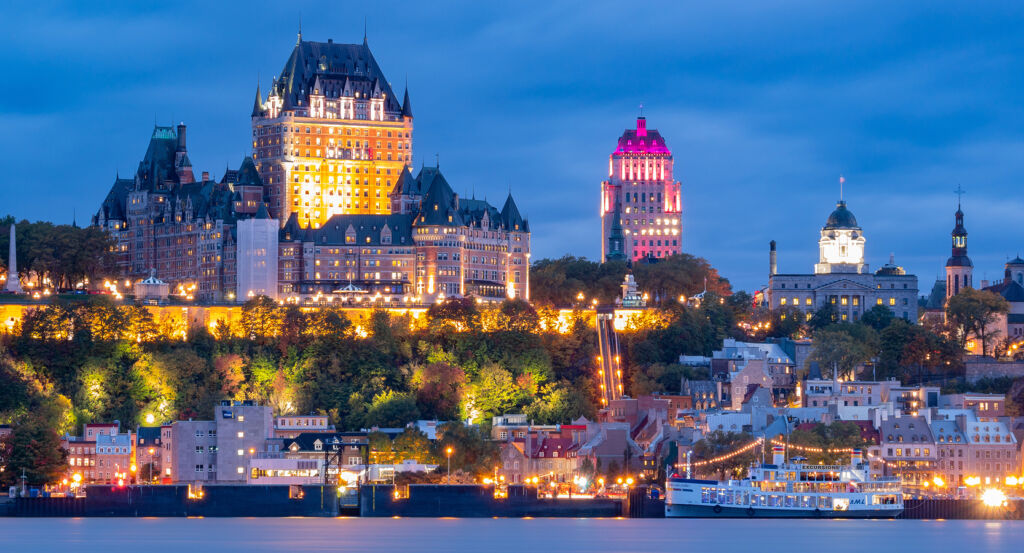
Set above the Dufferin Terrace in Old Québec, Fairmont Le Château Frontenac occupies a position between the St. Lawrence River, Place d'Armes, the Citadelle and the historic streets descending toward Petit-Champlain and the Old Port. Its distinctive physical setting combines a château-style railway hotel, fortified city walls, steep historic streets, public terraces and broad views across the river. The city is encountered primarily through movement between the hotel, Dufferin Terrace, Old Québec's gates, Place Royale, the funicular and the riverfront paths leading through the Lower Town. A second atmosphere develops inside the property through historic public rooms, restaurants, lounges, guest floors, wellness facilities and event spaces that provide a formal refuge from winter weather, summer festivals and the activity of the fortified city. The result is an exceptional capital hotel whose architecture and setting connect Québec City's French heritage, military history, river landscape and grand-hotel tradition.
What defines Fairmont Le Château Frontenac.
Fairmont Le Château Frontenac is best known for its expansive Châteauesque architecture and extraordinary place in Canadian history, standing above the St. Lawrence River as the defining landmark of Old Québec and one of the country's most celebrated historic hotels. Its origins trace to William Cornelius Van Horne, the influential Canadian Pacific Railway executive who recognized the commercial potential of developing grand destination hotels along the company's expanding transcontinental network. Van Horne commissioned New York architect Bruce Price to create an imposing railway hotel inspired by the Renaissance châteaux of France's Loire Valley, establishing a distinctly French architectural character within Québec City's historic fortified landscape. The project occupied the former grounds of the Château Saint-Louis, where successive French governors and British colonial administrators had exercised political authority overlooking the river for more than two centuries. Named for Louis de Buade, Comte de Frontenac, the seventeenth-century governor of New France, the hotel opened on December 18, 1893, introducing an ambitious new institution to the Canadian Pacific Railway's developing hospitality empire. Its success prompted successive expansions, beginning with the Citadel Wing in 1899 and continuing through Walter S. Painter's Mont-Carmel addition of 1908-1909. Montréal architects Edward and William Sutherland Maxwell subsequently designed the Saint-Louis Wing and expansive central tower, completed during the early 1920s and establishing the building's celebrated silhouette above the fortified city. The hotel became a prominent destination for international royalty and political leaders, welcoming King George VI and Queen Elizabeth during their historic Canadian tour in 1939. Its greatest diplomatic significance emerged during the Second World War, when the First and Second Québec Conferences brought British Prime Minister Winston Churchill, American President Franklin D. Roosevelt, and Canadian Prime Minister William Lyon Mackenzie King together in 1943 and 1944. The meetings addressed major Allied military strategy, including preparations for the invasion of occupied France and subsequent operations against Japan, placing the hotel at the center of decisions that influenced the war's final campaigns. Alfred Hitchcock introduced another dimension to the property's international cultural reputation through his 1953 film I Confess, starring Montgomery Clift and Anne Baxter, which incorporated the hotel and Québec City's historic streets into its distinctive visual setting. The Canadian government designated Château Frontenac a National Historic Site in 1981, recognizing its architectural importance as a formative example of the country's Château-style railway hotels. A substantial expansion by Montréal architectural firm ARCOP followed in 1993, extending the building's historic composition through a new wing developed in sympathy with its established architectural character. Canadian Pacific Hotels subsequently adopted the Fairmont identity, and the property became Fairmont Le Château Frontenac in 2001, connecting its railway heritage with an internationally established luxury hospitality brand. Ivanhoé Cambridge acquired the landmark in 2011 and undertook an extensive $75 million restoration completed in 2014, preserving its historic architecture through a comprehensive program of conservation and interior renewal. Fairmont Le Château Frontenac captures the development of Canada's transcontinental railway economy, the architectural inheritance of French Canada, and Québec City's enduring importance within international political and cultural history.
Where your story begins.
Foresyte Travel reveals places that feel extraordinary long before you arrive.
Enjoy editorial crafted for luxury travelers.