
Why Four Seasons Hotel Toronto matters.
Four Seasons Hotel Toronto is a defining urban hotel where Yorkville's luxury culture meets Toronto's financial power, immigrant history and transformation into Canada's most international metropolitan center.
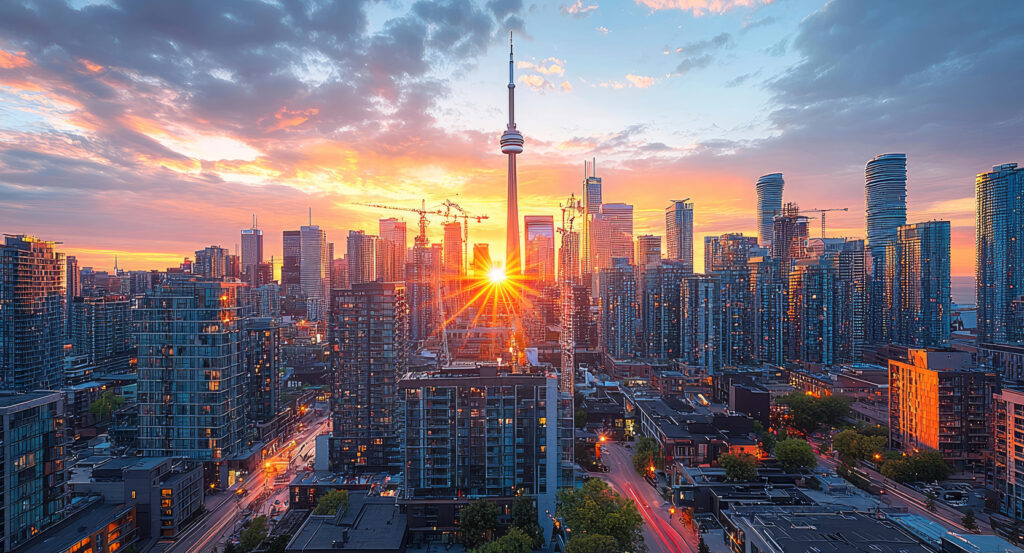
Set along Yorkville Avenue in the heart of Toronto's Yorkville district, Four Seasons Hotel Toronto occupies a position between Bloor Street, the Royal Ontario Museum, Queen's Park and the commercial streets leading toward the University of Toronto and downtown, with the city's high-rise skyline rising southward. Its distinctive physical setting combines a contemporary luxury tower, historic village streets, cultural institutions, designer boutiques and the dense urban landscape of Central Toronto. The city is encountered primarily through movement between the hotel, Yorkville's galleries and restaurants, Bloor Street, museum districts, university buildings and the routes leading toward the financial center. A second atmosphere develops inside the property through restaurants, lounges, guest floors, spa spaces, fitness facilities and event rooms that provide a composed refuge from the active streets and changing seasons of southern Ontario. The result is an exceptional urban hotel whose architecture and setting connect Toronto's luxury culture, cultural institutions, commercial power and cosmopolitan identity.
What defines Four Seasons Hotel Toronto.
Four Seasons Hotel Toronto is best known for serving as the global flagship of the luxury hospitality company founded by Isadore Sharp in the same city in 1961, preserving the brand's Canadian origins through successive generations of landmark hotels. Sharp established the original Four Seasons Motor Hotel on Jarvis Street with his father, Max Sharp, and investors Murray Koffler, Eddie Creed and Fred Eisen, introducing a personalized approach to hospitality that became the foundation of an international hotel company. Architect Peter Dickinson designed that first establishment and the subsequent Inn on the Park, which opened in 1963 and expanded the company's ambitions into sophisticated urban resort hospitality. Four Seasons established its enduring relationship with Yorkville in 1978, when Sharp acquired the former Hyatt Regency Toronto on Avenue Road and transformed it into the company's principal hometown hotel. The property became a gathering place for international celebrities, business leaders and visiting film personalities during the growth of the Toronto International Film Festival, connecting the Four Seasons character with the city's emerging cultural prominence. By the early twenty-first century, the company's international expansion had created an opportunity for a purpose-built flagship reflecting the architectural and commercial ambitions of contemporary Toronto. Developer Mel Pearl of Lifetime Developments began assembling the foundations of a replacement project in 2002, eventually bringing together Menkes Developments, Alcion Ventures and Lifetime through Bay-Yorkville Developments. The $500 million undertaking represented one of Toronto's most ambitious luxury hotel and residential investments, introducing a mixed-use development conceived around the integration of international hospitality and privately owned residences. Peter Clewes of architectsAlliance directed the architectural design in collaboration with Page + Steele, establishing a two-tower composition that brought a substantial new vertical landmark to Yorkville. The development also incorporated landscape architecture by Claude Cormier and NAK Design Group, extending the project into the surrounding pedestrian environment through landscaped public spaces. Four Seasons closed its former Avenue Road hotel in March 2012, concluding thirty-four years of hospitality at the property that had established the company's reputation in Yorkville. The new Four Seasons Hotel Toronto opened on October 5, 2012, with Sharp participating in the inauguration alongside company president and chief executive Katie Taylor. Its completion represented a return to the company's founding city through a purpose-built global flagship, connecting the intimate service principles of the original Jarvis Street motor hotel with Toronto's expanding international luxury market. The adjoining Four Seasons Private Residences introduced another dimension to the development, extending the company's hospitality character into a residential community within one of Canada's most prestigious urban districts. A penthouse sale valued at C$28 million established a Canadian condominium price record, illustrating the project's influence on Toronto's emerging ultra-luxury residential market. Four Seasons Hotel Toronto captures the evolution of a Canadian hospitality enterprise into an internationally influential luxury brand, linking the company's founding philosophy with the architectural and commercial transformation of Yorkville.
Yabu Pushelberg's interior conception established the hotel's distinctive artistic character through a contemporary interpretation of Canadian design, transforming the global flagship into a showcase for the country's creative culture. Toronto-based designers George Yabu and Glenn Pushelberg developed the public interiors around natural stone, carefully composed wood surfaces and a restrained palette enlivened by distinctive yellow accents. Their architectural approach introduced soaring public spaces, sculptural furnishings and precisely integrated lighting, establishing a contemporary visual language for the Four Seasons brand in its hometown. The hotel's collection of more than 1,700 artworks by Canadian artists gives this design philosophy a substantial cultural dimension, incorporating original commissions by figures including Attila Richard Lukacs and Daniel Hutchinson. A dramatic installation of yellow floral forms above the reception desk connects the interior's decorative character with the artistic program, establishing a recognizable centerpiece within the principal arrival space. Claude Cormier's landscape design extends this artistic character outdoors through a distinctive garden composition and expansive courtyard fountain, connecting the hotel's architectural setting with Toronto's contemporary landscape-design tradition. Brian Gluckstein developed the interiors of the adjoining private residences, introducing a complementary residential interpretation of the development's Canadian design ambitions. The hotel's culinary character established another consequential relationship with international creative culture through French chef Daniel Boulud, whose Café Boulud brought his Lyonnais culinary heritage to Toronto's Yorkville dining scene. Boulud's approach connects classical French cooking with the convivial traditions of the neighborhood brasserie, emphasizing regional culinary techniques and the social character of French dining. In 2015, British designer Martin Brudnizki transformed the restaurant's interiors through a midcentury-inspired composition of leather banquettes, textured furnishings and warm decorative finishes, accompanying a culinary relaunch developed with chef Sylvain Assié. The redesign strengthened Café Boulud's relationship with the informal elegance of French brasserie culture, establishing a distinct culinary character within the hotel's broader contemporary design program. The adjoining d|bar extends that social environment into the lobby, connecting the hotel's public spaces with Yorkville's established culture of fashionable gathering places. Together, the Canadian art collection, internationally influential interior designers and Daniel Boulud's French culinary program establish a coherent expression of the hotel's cultural significance, preserving Four Seasons' Toronto origins through an enduring relationship with contemporary design and international hospitality.
How Four Seasons Hotel Toronto fits.
Four Seasons Hotel Toronto works as the starting point for an exploration connecting the city's museums, university landscape and architectural landmarks with the cultural and civic institutions that define Toronto's central districts.
Begin at Royal Ontario Museum, the major cultural institution where natural history, world cultures, Indigenous collections, art and architecture occupy one of Toronto's most recognizable buildings. The museum stands at the edge of Yorkville and the University of Toronto, connecting the city's luxury district with a global collection of artifacts, fossils, textiles, sculpture and historical objects. Its galleries reveal Toronto's role as a center of scholarship, immigration and cultural exchange. Continue to Casa Loma, the grand hilltop residence where towers, stone halls, gardens, tunnels and formal rooms preserve one of Toronto's most distinctive architectural environments. Built during the city's early twentieth-century expansion, the residence connects industrial wealth, private ambition and European-inspired design with the neighborhoods surrounding the escarpment. Its elevated position provides views across Toronto's urban landscape and reveals the city's long relationship with grand domestic architecture. Continue to Art Gallery of Ontario, the major art institution where Canadian, Indigenous, European and international collections occupy a landmark building along Dundas Street West. The gallery's architecture combines historic façades with contemporary expansions and creates a cultural corridor linking Queen Street, Chinatown, Kensington Market and the University of Toronto. Its collections connect Toronto's local artistic traditions with broader movements in painting, sculpture, photography, design and contemporary practice. Conclude at Queen's Park, the landscaped civic and academic district where the Ontario Legislative Building, mature trees, university buildings and public paths establish one of Toronto's most important central landscapes. The park connects provincial government with the University of Toronto and preserves a broad green setting within the city's dense core. Its lawns, pathways and surrounding architecture reveal how Toronto's civic character developed through education, public administration and planned urban space. The progression moves from Royal Ontario Museum's global collections through Casa Loma's hilltop architecture, continues across Art Gallery of Ontario's cultural landscape and concludes at Queen's Park, where Toronto's art, education, government and metropolita character meet.
Where your story begins.
Foresyte Travel reveals places that feel extraordinary long before you arrive.
Enjoy editorial crafted for luxury travelers.
Foresyte may earn a commission when you book.























































































































