Why Gardens by the Bay matters.
Gardens by the Bay is a grand botanical garden where Marina Bay's waterfront landscape meets Singapore's ambitions in environmental engineering, tropical horticulture and the creation of an internationally significant public garden.
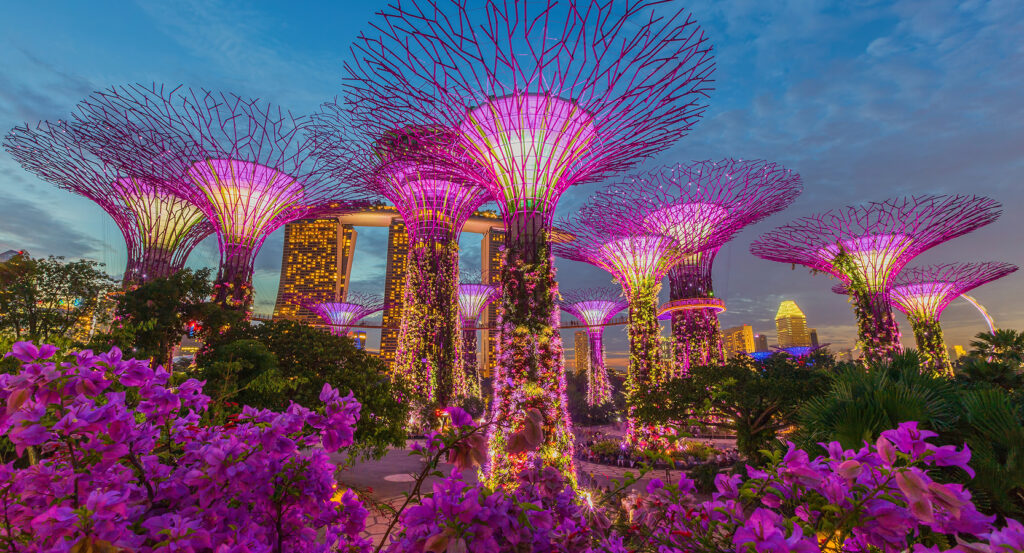
Set along Marina Gardens Drive near Marina Boulevard and just steps from Marina Barrage, the gardens occupy reclaimed waterfront land between the Marina Channel, the southern edge of Marina Bay and the coastal parklands extending east toward the Singapore Strait. Its landscaped grounds combine sweeping lawns, artificial lakes, elevated walkways and densely planted tropical gardens with the sculptural forms of the Supertree Grove. Two immense glass conservatories rise along the waterfront, their curved steel structures and transparent enclosures establishing a striking architectural contrast with the surrounding towers. The central garden paths connect themed planting areas, shaded promenades and elevated viewpoints, organizing an extensive landscape around the relationship between vegetation, water and the city skyline. The result is a public garden whose horticultural ambition, structural engineering and waterfront setting establish one of Singapore's most consequential achievements in contemporary landscape architecture.
What defines Gardens by the Bay.
Gardens by the Bay is best known for transforming reclaimed land beside Marina Bay into an internationally recognized botanical destination combining grand conservatories, engineered vertical gardens and extensive collections of plants from diverse climatic regions. The project originated within Singapore's long-term urban development strategy, which sought to expand public green space alongside the growth of the Marina Bay financial and commercial center. Prime Minister Lee Hsien Loong announced the Gardens by the Bay initiative during the National Day Rally in 2005, establishing the ambition to develop a major horticultural destination on the city's southern waterfront. The project formed part of Singapore's transition from the Garden City concept toward the broader ambition of becoming a City in a Garden. An international design competition organized in 2006 attracted proposals from leading landscape architecture practices, establishing the architectural and horticultural direction of the development. British landscape architecture firm Grant Associates received the commission for Bay South Garden, the largest and most prominent component of the project. The firm's master plan organized the landscape around two principal gardens, Heritage Gardens and World of Plants, together with major horticultural attractions and extensive waterfront spaces. Architectural practice WilkinsonEyre developed the two principal conservatories, creating immense column-free glass structures designed to accommodate plant collections from climates distinct from Singapore's equatorial environment. Engineering firm Atelier Ten contributed environmental design strategies intended to reduce energy consumption through integrated cooling, shading and mechanical systems. The project required extensive land preparation, soil engineering and infrastructure development to establish viable planting conditions on reclaimed coastal terrain. Construction proceeded through a coordinated program involving horticultural specialists, structural engineers, landscape architects and environmental consultants. Bay South Garden opened to the public on June 29, 2012, introducing the principal attractions and establishing a major addition to Singapore's public landscape network. The opening represented a substantial investment in urban greenery and international tourism infrastructure, connecting environmental education with the city's architectural development. The project subsequently received international recognition for its landscape architecture, structural engineering and environmental design. In 2012, the World Architecture Festival awarded the conservatories the World Building of the Year distinction, recognizing the technical and architectural achievements of the project. The development became an important example of Singapore's approach to integrating large-scale public landscapes with high-density urban growth, establishing a botanical destination whose engineering and horticultural programs attracted international attention.
Grant Associates organized the gardens around a horticultural program that combines botanical collections, environmental education and the dramatic presentation of plants within engineered landscapes. The Supertree Grove contains towering vertical structures supporting extensive plantings of ferns, orchids, bromeliads and other tropical species, creating elevated gardens whose surfaces change through seasonal growth and horticultural maintenance. The largest Supertrees rise 50 meters above the ground, establishing prominent architectural features within the waterfront landscape. Their structural systems incorporate environmental technologies associated with solar energy collection, rainwater management and the ventilation of nearby horticultural facilities. The OCBC Skyway connects selected Supertrees through an elevated pedestrian walkway, providing views across the gardens and the surrounding urban landscape. The Garden Rhapsody light and sound program transforms the grove after dark, using synchronized illumination and music to emphasize the sculptural forms of the vertical gardens. Flower Dome recreates a cool, dry Mediterranean climate within an immense glass enclosure, supporting plant collections associated with southern Europe, South Africa, Australia and other regions characterized by seasonal dryness. Its horticultural displays include ancient olive trees, succulents, flowering shrubs and carefully arranged collections that demonstrate the diversity of plant adaptations to Mediterranean environments. Cloud Forest establishes a contrasting cool, humid environment centered on a towering artificial mountain covered with tropical vegetation. A substantial indoor waterfall descends from the elevated structure, introducing moisture and dramatic movement into the conservatory's interior landscape. Elevated walkways pass through planting zones representing different altitudes, connecting botanical displays with the environmental conditions of tropical montane forests. The conservatory's collections include orchids, ferns, mosses and other species associated with cloud forest ecosystems, emphasizing the ecological importance of mountain environments. The cooled conservatories employ integrated environmental systems that manage temperature, humidity and solar gain through a combination of mechanical engineering and architectural design. Their glass envelopes incorporate shading strategies intended to control heat transmission while admitting sufficient natural light for plant growth. The surrounding outdoor gardens develop a complementary horticultural program through collections associated with Singapore's cultural heritage, tropical biodiversity and the relationships between plants and human societies. Dragonfly Lake and Kingfisher Lake introduce freshwater habitats into the landscape, supporting aquatic plants and wildlife within the wider garden environment. The combination of engineered conservatories, grand vertical gardens and extensive outdoor planting establishes a botanical destination that connects scientific horticulture with contemporary landscape design.
How Gardens by the Bay fits.
Gardens by the Bay works as the landscape centerpiece for a Marina Bay itinerary connecting Singapore's waterfront engineering, the architectural development of its financial center and the cultural institutions established along the historic harbor.
Begin at Marina Barrage, the major hydraulic infrastructure project constructed across the Marina Channel to create Singapore's first reservoir within the city center. The barrage opened in 2008, establishing a substantial freshwater catchment area while contributing to flood management and the regulation of water levels within the surrounding urban basin. Its engineering system incorporates movable gates and pumping stations that control the movement of water between the reservoir and the sea. The structure also supports public recreational spaces, including an elevated green roof with extensive views across the waterfront. The project became a significant component of Singapore's long-term water management strategy, connecting urban development with the conservation and distribution of freshwater resources. Continue to Marina Bay Sands, the integrated resort designed by architect Moshe Safdie and opened in 2010 as a defining component of Singapore's modern waterfront skyline. The development consists of three hotel towers connected by the elevated Sands SkyPark, a grand horizontal structure containing landscaped spaces and panoramic observation areas. Its architectural composition introduced a distinctive relationship between high-rise construction, public space and the surrounding bay. The complex incorporates convention facilities, theaters, restaurants and the ArtScience Museum, whose sculptural form resembles an opening lotus flower. The development became a major component of Singapore's expansion as an international destination for business, entertainment and cultural tourism. Conclude at Asian Civilisations Museum, the distinguished institution housed within the historic Empress Place Building beside the Singapore River. The museum's collections examine the cultural connections between Asian societies through trade, religion, artistic production and the movement of people across maritime and overland networks. Its galleries contain significant holdings of Chinese ceramics, Southeast Asian sculpture, Islamic decorative arts and objects associated with the historical development of Singapore as a regional trading center. The building originated as a nineteenth-century government complex, establishing an architectural connection between colonial administration and the city's modern cultural institutions. The museum's exhibitions develop a broader understanding of Singapore's position within the commercial and cultural history of Asia. The progression moves from the engineering infrastructure supporting Singapore's waterfront development through the grand architecture of Marina Bay and culminates in a museum devoted to the historical connections that shaped the city's position within Asia's trading networks.
Where your story begins.
Foresyte Travel reveals places that feel extraordinary long before you arrive.
Enjoy editorial crafted for luxury travelers.
Foresyte may earn a commission when you book.