Why Marina Bay Sands matters.
Marina Bay Sands is an integrated luxury resort where Marina Bay's waterfront transformation meets the architectural ambition of Moshe Safdie and Singapore's emergence as a major international center for hospitality, entertainment and commerce.
Set along Bayfront Avenue near Sheares Avenue and just steps from the Helix Bridge, the resort occupies a commanding waterfront site between the Marina Bay promenade, the reclaimed land extending toward the Singapore Strait and the financial towers rising across the water at Marina Bay Financial Centre. Three gently curving hotel towers support the immense horizontal structure of Sands SkyPark, creating an unmistakable silhouette above the surrounding waterfront. At ground level, expansive glazed entrances, grand atriums and landscaped pedestrian connections organize the relationship between the hotel, convention facilities and adjoining retail spaces. The elevated observation areas provide sweeping views across the central business district, the Singapore River corridor and the surrounding coastal landscape. The result is an architectural complex whose extraordinary structural composition and extensive public spaces establish a defining feature of Singapore's contemporary skyline.
What defines Marina Bay Sands.
Marina Bay Sands is best known for its three interconnected hotel towers and elevated Sands SkyPark, an extraordinary architectural composition that transformed Singapore's waterfront skyline through one of the world's most ambitious integrated resort developments. The project originated within Singapore's decision to introduce integrated resorts as part of a broader strategy to strengthen tourism, international business and entertainment infrastructure. In 2005, the government announced plans to permit two major integrated resort developments, establishing a competitive process intended to attract internationally significant investment. Las Vegas Sands, the hospitality and gaming company founded by Sheldon Adelson, secured the Marina Bay development concession in 2006. The company's proposal combined a major hotel, convention facilities, retail spaces, theaters and a casino within a unified architectural complex. Architect Moshe Safdie developed the master plan, drawing on his longstanding interest in large-scale urban structures, elevated public spaces and the integration of landscape with grand buildings. Safdie had previously achieved international recognition through Habitat 67 in Montreal, an experimental residential development that explored modular construction and the relationship between private dwellings and shared outdoor space. His Marina Bay Sands design organized three hotel towers around a dramatic elevated platform, creating a structural composition that required extensive engineering coordination. The project occupied reclaimed waterfront land within Marina Bay, connecting its construction with Singapore's long-term expansion of the central business district. Engineering firm Arup contributed to the structural design, developing solutions for the towers' complex geometry and the enormous loads associated with the elevated SkyPark. The resort's construction involved substantial foundation works, advanced structural systems and a coordinated program of high-rise building development. Marina Bay Sands opened in phases beginning on April 27, 2010, introducing its principal hotel, retail and entertainment facilities to the public. The Sands SkyPark subsequently opened in June 2010, establishing an elevated public destination above the three towers. The development represented an investment exceeding S$8 billion, making it among the most expensive integrated resort projects undertaken at the time. Its opening coincided with a period of substantial growth in Singapore's international visitor economy, contributing to the city's expansion as a major destination for conventions, entertainment and luxury hospitality. The project became an important architectural reference for the development of large-scale integrated resorts, demonstrating how distinctive structural design and extensive commercial programming could be combined within a single urban destination.
Moshe Safdie's architectural program organizes Marina Bay Sands around the relationship between grand vertical structures and a continuous elevated public landscape. The three hotel towers rise to 200 meters, with their curved profiles creating changing visual relationships across the waterfront skyline. Sands SkyPark extends across the towers through a vast cantilevered platform measuring 340 meters in length, establishing one of the development's most technically demanding structural features. The platform contains landscaped gardens, observation areas, restaurants and the celebrated infinity pool overlooking Central Singapore. The pool extends 150 meters along the elevated structure, creating an extraordinary visual connection between water, architecture and the distant urban landscape. The SkyPark's engineering accommodates structural movement between the towers, incorporating design solutions that respond to wind loads, temperature changes and the complex geometry of the supporting buildings. The Shoppes at Marina Bay Sands occupies an extensive retail complex incorporating luxury boutiques, restaurants and a central canal traversed by small boats. Its interior architecture combines expansive circulation spaces, natural light and carefully arranged commercial environments, connecting the resort with Singapore's international luxury retail market. The Sands Expo and Convention Centre provides substantial facilities for conferences, exhibitions and major corporate events, reinforcing the development's role within the city's international business infrastructure. The resort's entertainment program includes major theatrical productions, concerts and large-scale events presented through purpose-built performance spaces. Celebrity chef restaurants contribute to its culinary profile, bringing internationally recognized dining concepts into the waterfront complex. The ArtScience Museum occupies a distinctive building designed by Safdie, whose sculptural form resembles an opening lotus flower beside the bay. Its galleries present exhibitions connecting art, science, technology and design, establishing a cultural institution within the broader commercial development. The museum's architecture incorporates an innovative rainwater collection system, directing water through the central roof structure for use within the building. The surrounding public promenade connects the development with pedestrian routes extending around Marina Bay, supporting an extensive network of waterfront recreational spaces. The Spectra light and water performance introduces an evening program of illuminated fountains and projected imagery along the Event Plaza, establishing a major public attraction within the resort's waterfront setting. The combination of grand architecture, hospitality infrastructure, cultural programming and public waterfront access establishes Marina Bay Sands as a central component of Singapore's contemporary urban development.
How Marina Bay Sands fits.
Marina Bay Sands works as the architectural centerpiece for a Singapore itinerary connecting the city's environmental engineering, its internationally recognized botanical landscape and the historic commercial institutions of the Singapore River.
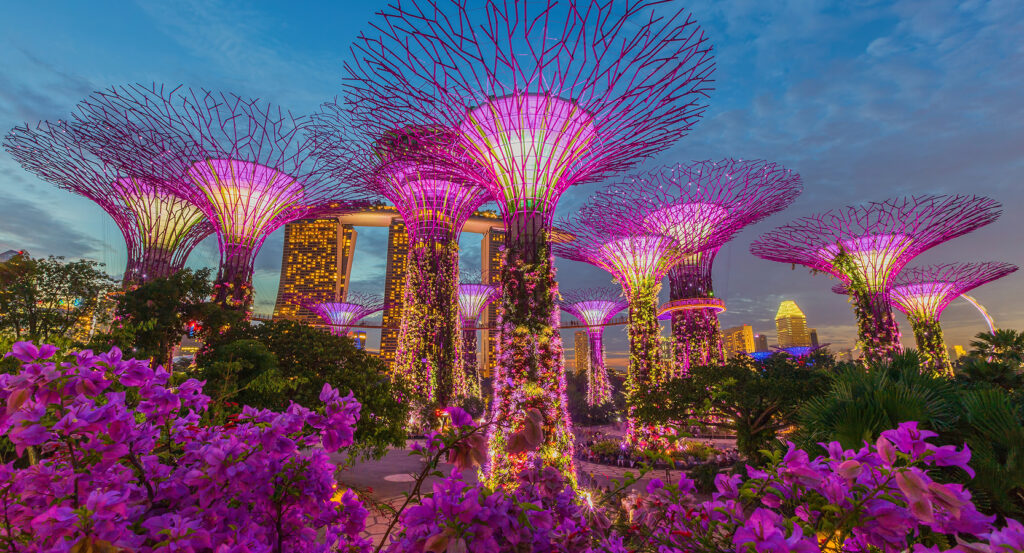
Begin at Marina Barrage, the major hydraulic infrastructure project constructed across the Marina Channel to establish a freshwater reservoir within Singapore's central urban landscape. The barrage opened in 2008, creating a substantial catchment area that supports water supply, flood management and recreational activity. Its engineering system incorporates movable gates and pumping stations that regulate the movement of water between the reservoir and the sea. The structure also contains public recreational facilities, including an elevated green roof overlooking the surrounding waterfront. The project became an important component of Singapore's long-term water management strategy, connecting urban development with the conservation and distribution of freshwater resources. Continue to Gardens by the Bay, the grand botanical destination developed on reclaimed waterfront land as part of Singapore's ambition to expand public green space within its growing urban center. The project was announced in 2005, with Bay South Garden opening in June 2012. Landscape architecture firm Grant Associates developed the principal master plan, organizing the grounds around extensive tropical gardens, waterfront spaces and grand vertical structures. The Supertree Grove contains towering planted structures supporting orchids, ferns and other tropical species, creating an extraordinary combination of horticulture and environmental engineering. The Flower Dome and Cloud Forest conservatories introduce controlled climatic environments supporting plants from Mediterranean and tropical montane regions. Conclude at Asian Civilisations Museum, the distinguished institution housed within the historic Empress Place Building beside the Singapore River. The museum's collections examine the cultural connections between Asian societies through trade, religion, artistic production and the movement of people across maritime and overland networks. Its galleries contain significant holdings of Chinese ceramics, Southeast Asian sculpture, Islamic decorative arts and objects associated with Singapore's development as a regional trading center. The building originated as a nineteenth-century government complex, establishing an architectural connection between colonial administration and the city's modern cultural institutions. The museum's exhibitions develop a broader understanding of Singapore's position within the commercial and cultural history of Asia. The progression moves from the engineering infrastructure supporting Singapore's waterfront development through an internationally significant botanical landscape and culminates in a museum devoted to the historical connections that shaped the city's position within Asian trading networks.
Where your story begins.
Foresyte Travel reveals places that feel extraordinary long before you arrive.
Enjoy editorial crafted for luxury travelers.
Foresyte may earn a commission when you book.