Why you should experience Rush Lane Murals in Toronto, Ontario.
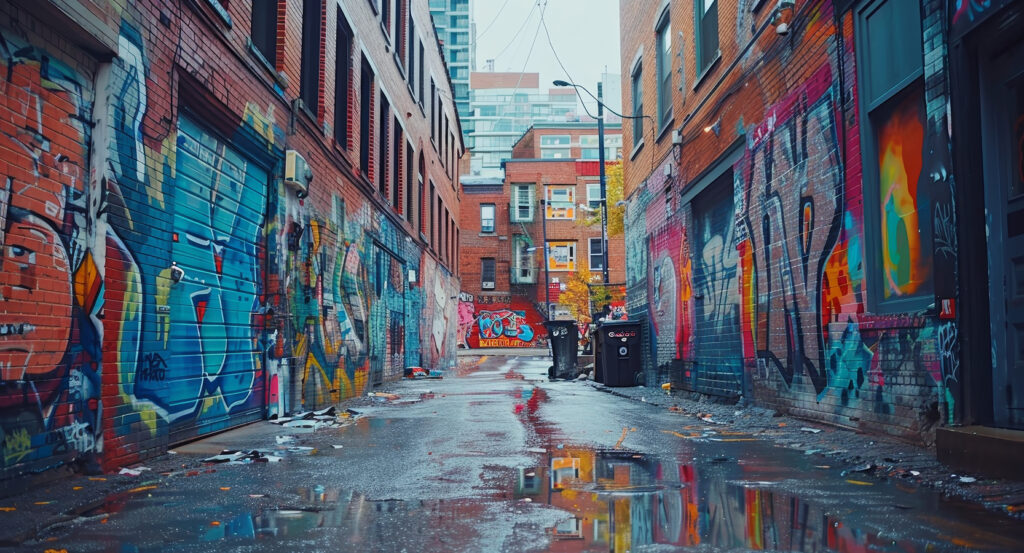
Rush Lane, better known as “Graffiti Alley”, is Toronto's most electric open-air gallery, a kilometer-long burst of color and creativity that transforms an unassuming laneway into a living, breathing work of art.
Stretching behind Queen Street West from Spadina to Portland, this stretch of walls and garage doors has become the beating heart of Toronto's street art culture. Every inch is covered with bold murals, intricate tags, and surreal portraits that change with the seasons, some playful, some political, all unapologetically alive. Walking through Rush Lane feels like stepping into the subconscious of the city: layers of expression, rebellion, humor, and beauty stacked over decades of paint. The alley hums with energy, the hiss of aerosol cans from artists at work, the shuffle of photographers setting up shots, and the constant rhythm of passersby reacting, interpreting, and adding to the dialogue. In a city of polished glass towers, Rush Lane stands rebelliously raw, proof that art doesn't need permission to make people stop and feel something.
What you should know about Rush Lane Murals.
Rush Lane's roots stretch back to the early 1980s, when graffiti began appearing on the backs of Queen Street's industrial buildings, planted by local artists inspired by New York's hip-hop and punk movements.
At the time, it was seen as vandalism; today, it's a cornerstone of Toronto's creative identity. The city officially recognized the space in the early 2000s after a campaign by the Queen Street West Business Improvement Area to preserve and celebrate its art. Since then, the laneway has hosted major mural projects, including work by renowned Canadian artists like Elicser Elliott, Uber5000, and Peru143. Each wall tells a story, some murals honor cultural icons, others challenge social norms or celebrate the vibrancy of the city's neighborhoods. New pieces appear, painted over older layers in a perpetual cycle of reinvention. This impermanence is part of the lane's poetry: what you see today might be gone tomorrow, replaced by something equally bold. Few know that the alley's official name, “Rush Lane,” comes from 19th-century city records, long before paint ever hit its bricks, reminding visitors that even rebellion has roots.
How to fold Rush Lane Murals into your trip.
Visiting Rush Lane is essential for anyone wanting to experience Toronto's creative pulse up close.
Start the walk at Spadina Avenue and head west, entering through the narrow gap behind Queen Street's storefronts. The alley opens up like a secret world, bursts of color stretching in every direction. Visit during daylight for the best photography, when sunlight filters between the buildings and brings out the texture of the paint and brick. Allow 45 minutes to wander slowly, stopping often to take in the scale and detail of each piece. Many visitors pair the alley with nearby stops, grab a coffee at Jimmy's on Portland or explore the boutique shops and galleries along Queen Street West. If you visit in summer, you may even catch artists repainting walls in real time, transforming the space before the eyes. Rush Lane Murals are more than a backdrop, they're a living conversation between the city and its people, a reminder that Toronto's true artistry isn't confined to museums, but sprawled boldly across the walls that hold its stories.
Where your story begins.
Foresyte Travel reveals places that feel extraordinary long before you arrive.
Experience premium editorial crafted for luxury travelers.