Why you should experience Valley Temple of Khafre in Giza, Egypt.
Valley Temple of Khafre in Giza is where eternity begins to take shape, a masterpiece of stone that fuses architecture, astronomy, and faith into one seamless expression.
Standing at the base of the Giza Plateau, beside the Great Sphinx, this temple feels more like a revelation than a ruin. Its walls rise in perfect silence, constructed from colossal limestone and granite blocks so precisely fitted that not even a blade of light slips between them. There are no carvings, no hieroglyphs, no ornamentation, only geometry, balance, and weight. The simplicity is almost shocking, as though the architects stripped away everything that wasn't eternal. Step inside, and the air cools; light filters through narrow gaps, illuminating the floor in golden fragments. It's easy to imagine priests moving here in procession, their footsteps echoing softly across polished basalt, chanting invocations to guide Pharaoh Khafre toward the afterlife. Valley Temple of Khafre doesn't speak in words, it speaks in proportions, in alignment, in stone. It is the purest example of Egyptian order, where human hands shaped faith into permanence.
What you should know about Valley Temple of Khafre.
Valley Temple of Khafre, built around 2520 BCE, is among the best-preserved examples of Old Kingdom architecture, a structure that reveals both the engineering genius and spiritual discipline of ancient Egypt.
Located at the southeastern edge of the Giza Plateau, it formed part of Khafre's grand funerary complex, connecting his pyramid to the Great Sphinx and the causeway leading up from the Nile floodplain. The temple was the ceremonial gateway for the Pharaoh's journey to eternity, where his body was purified and prepared before ascending to the mortuary temple near the pyramid's base. Constructed primarily from massive limestone core blocks, some weighing over 200 tons, and faced with polished red granite from Aswan, the building captures a structural precision unmatched for millennia. Inside, twenty-four square pillars once supported the flat roof, forming a hypostyle hall aligned with astronomical exactness. The inner sanctum contained statues of Khafre seated on his throne, flanked by falcons representing Horus, the god of kingship and protection. One of these statues, discovered buried in the temple's floor, is now a centerpiece of the Egyptian Museum in Cairo, a stunning diorite sculpture that remains one of the finest portraits ever created in stone. Excavations in the 19th and 20th centuries revealed remnants of alabaster flooring, drainage systems for ritual purification, and fragments of copper tools used by the builders, evidence that even perfection was crafted by mortal hands. The temple's design echoes the larger cosmology of Giza: its axis aligns precisely with the Pyramid of Khafre and the Sphinx, linking earth, horizon, and sky in a single divine geometry. To stand within these walls is to enter a space that once bridged the physical and celestial worlds, a structure built not merely to honor a king, but to sustain a cosmos.
How to fold Valley Temple of Khafre into your trip.
Visiting Valley Temple of Khafre offers one of the most immersive and overlooked experiences on the Giza Plateau, a rare chance to step inside the ancient machinery of resurrection.
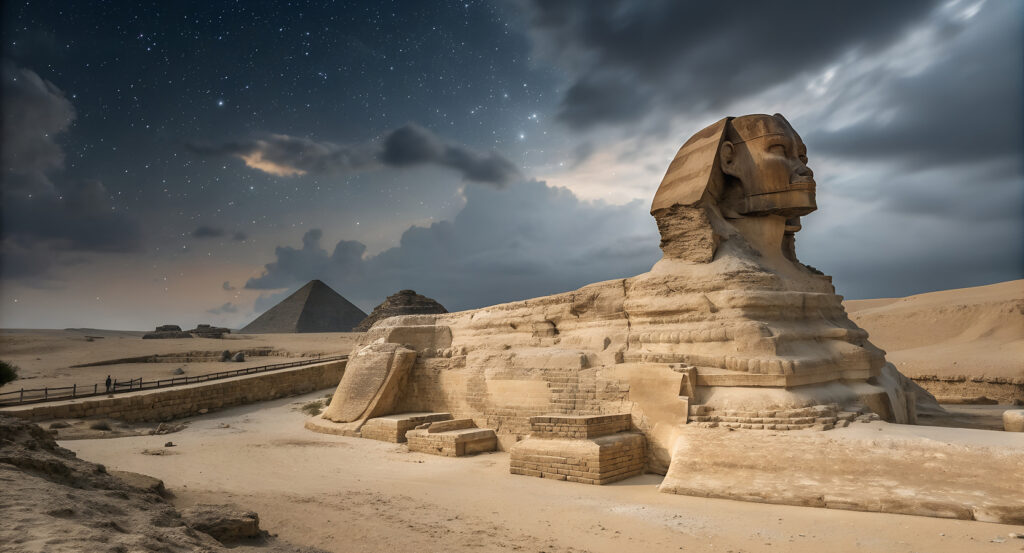
The temple sits just southeast of the Great Sphinx, and entry is included with the same general ticket to the Sphinx Enclosure. Begin your visit in the morning, when the light is soft and the granite walls glow with a warm, reddish hue. As you approach, note the contrast between the temple's massive, unadorned exterior and the quiet complexity of its interior, an intentional design meant to humble before it uplifts. Take your time exploring the main hall; its symmetry and scale are breathtaking in their restraint. Imagine the funeral rites that once took place here: the washing of the Pharaoh's body, the recitations of priests, the offering of incense before the journey up the causeway to his pyramid. The acoustics remain hauntingly clear, even a whisper seems to linger. After walking through the central chamber, step outside to the southern terrace, where you can see how Valley Temple of Khafre, Sphinx Temple, and Khafre Pyramid align along a perfect diagonal. For the most evocative photos, visit near sunset, when the temple glows against the shadowed plateau and the Sphinx gazes toward the horizon, its outline framed in molten gold. Pair your stop with a visit to the nearby Solar Boat Museum or a climb up to the Panoramic Point for a sweeping view of the entire Giza complex. Valley Temple of Khafre isn't simply a ruin, it's a living equation, an architectural meditation on balance, rebirth, and the eternal discussion between the sun and the soul.
Where your story begins.
Foresyte Travel reveals places that feel extraordinary long before you arrive.
Experience premium editorial crafted for luxury travelers.