
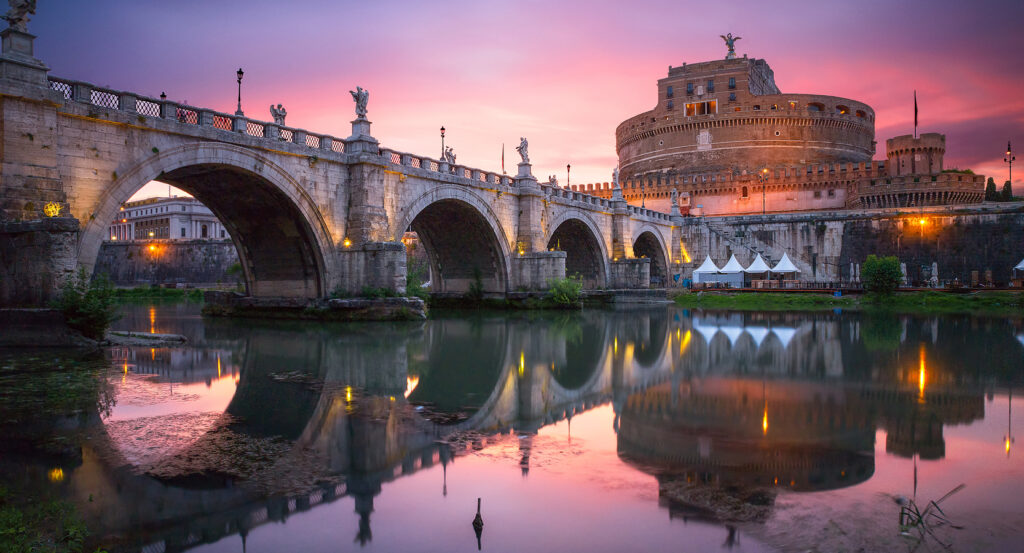
Why you should experience Mausoleum of Hadrian in Rome, Italy.
Hadrian's Mausoleum Rome stands as the emperor's final act of genius, a monument not just to power, but to permanence.
Rising in perfect symmetry along the Tiber, its massive circular form feels both solemn and divine, echoing the ideals of an empire that saw beauty in order and immortality in stone. Here, Emperor Hadrian designed his own resting place, a statement of control over time itself. The smooth tiers of travertine once gleamed white in the Roman sun, crowned with marble statues and gardens that spiraled toward the heavens. Today, though centuries of history have reshaped it into the fortress now known as Castel Sant'Angelo, its essence endures: the vision of a ruler who believed that architecture could outlast mortality. Hadrian's Mausoleum doesn't just honor imperial, it defines imperial, turning legacy into landscape.
What you should know about Mausoleum of Hadrian.
Constructed between 135 and 139 CE, the mausoleum was inspired by the Mausoleum of Augustus, yet it broke from tradition with rebellious simplicity and symmetry.
Its cylindrical base, nearly 90 meters wide, was once faced with gleaming marble and topped by a golden quadriga, a bronze chariot drawn by four horses, carrying Hadrian toward eternity. Within, a spiral ramp ascended to the burial chamber, where the emperor's ashes rested in a purple porphyry urn alongside those of his wife Sabina and later Roman emperors. The mausoleum's design symbolized the cosmic journey of the soul: from the earthly circle below to the divine above. Over centuries, it evolved from tomb to fortress, its marble repurposed for other buildings, yet its core remained untouched, a silent witness to empire's rise, faith's triumph, and history's endurance. Few realize that this was not merely a tomb but a blueprint, the structure's geometry and resilience would influence Renaissance architects like Bramante and Michelangelo.
How to fold Mausoleum of Hadrian into your trip.
When visiting Castel Sant'Angelo, remember you're standing inside one of antiquity's most personal legacies.
Start in the lower corridors, where the spiraling path once led to Hadrian's burial chamber, its sense of ascent still palpable even after centuries of transformation. As you climb toward the terrace, imagine the mausoleum as it once was: clad in white marble, crowned by shining bronze, surrounded by cypress trees and statues. Visit in the golden hour when the sun paints the stone with the same warmth it once reflected to ancient Rome. From the top, look across the river toward St. Peter's Basilica, a line of sight that bridges two eras of power and faith. Hadrian's Mausoleum doesn't just honor imperial, it preserves it, standing as both a tomb and a tribute to the Roman will to endure forever.
Where your story begins.
Foresyte Travel reveals places that feel extraordinary long before you arrive.
Experience premium editorial crafted for luxury travelers.




















































































































