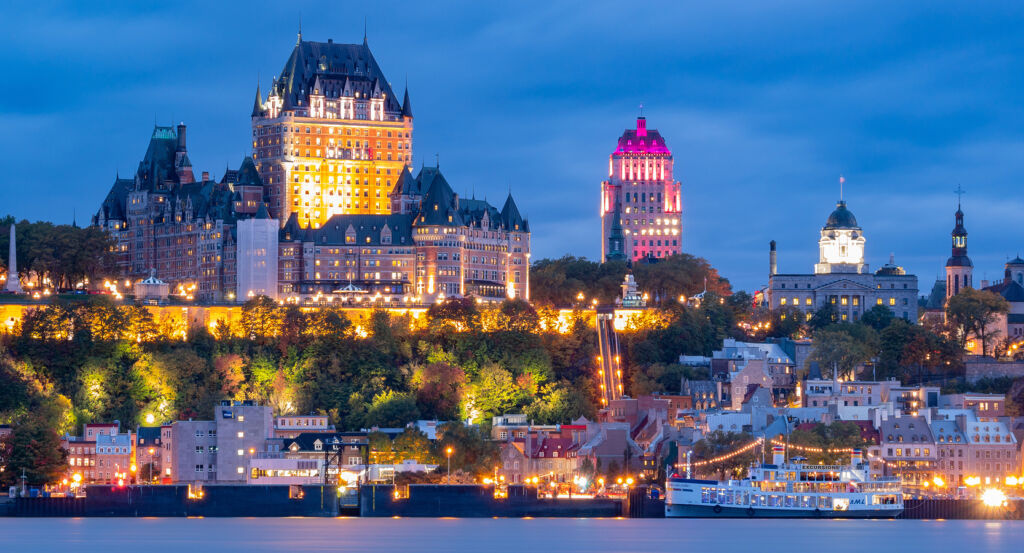
Why you should experience Hôtel Palace Royal in Québec City, Canada.
Hôtel Palace Royal is an inward-facing urban stronghold that is defined by insulation, interior scale, and psychological shelter, placing you at the edge of Old Québec where the city's intensity is felt outside but deliberately held at bay within.
This hotel does not rely on views, elevation, or distance to create calm. Instead, it turns inward, building its sense of refuge from enclosure. Located just outside the fortified walls near Porte Saint-Jean, Hôtel Palace Royal sits at a point of constant motion, traffic, pedestrians, tourism, daily life flowing past in layers. Yet the moment you cross the threshold, the city recedes sharply. Arrival feels like stepping into a controlled interior world, one that prioritizes containment over exposure. The lobby announces this immediately through volume and orientation. Rather than opening outward to the street, it opens inward toward a central atrium, creating a sense of internal gravity. Sightlines pull your attention away from the exterior and into the building itself. Light behaves differently here, filtered, reflected, diffused, never sharp, never insistent. Materials favor solidity and warmth: stone, wood, glass used not for transparency but for separation. Movement through the space feels deliberate and buffered, as though the hotel is designed to absorb momentum. Shared areas reinforce this interior logic. Seating clusters, circulation paths, and transitional zones are arranged around the central volume, allowing guests to move. You are always inside, always held. The atmosphere feels protective rather than performative, signaling that the hotel's value lies not in what it shows you, but in what it shields you from. Guest rooms continue this inward focus with consistency. Layouts are generous and grounded, offering real space to decompress. Beds are substantial and anchoring, supporting rest that feels physically secure. Furnishings prioritize comfort, weight, and usability over trend or ornament. Windows often face the atrium or controlled exterior views, reinforcing the sense that the room is part of a larger interior ecosystem. Bathrooms are calm and well-organized, designed to support unhurried routine. Across the property, the experience feels contained, insulating, and stabilizing. Hôtel Palace Royal is ideal for travelers who want Québec City to feel proximate but not intrusive, a place you can engage deeply during the day and fully shut out at night.
What you should know about Hôtel Palace Royal.
Hôtel Palace Royal is best known for interior-first hospitality, a design philosophy that treats enclosure, continuity, and environmental control as the foundation of comfort rather than scenic exposure or narrative framing.
The hotel's defining architectural move, the large central atrium, is not decorative. It functions as a psychological buffer. By orienting rooms and public spaces inward, the building reduces dependence on external calm. Noise from the surrounding city is intercepted before it reaches guest spaces. Sound dissipates upward and inward. This creates a perceptual quiet that feels structural. Acoustic behavior throughout the hotel reflects this logic. Exterior sounds arrive muted and abstracted, while interior noise disperses across volume. The result is an environment that feels calm even when the hotel is active. Lighting strategy further supports this insulation. Daylight enters indirectly, filtered through interior geometry and reflective surfaces. Artificial lighting remains warm, even, and continuous, avoiding sharp contrasts that would reintroduce external urgency. Time passes gently here. Materials are chosen for durability and visual stability. Surfaces resist glare. Textures absorb. Finishes are meant to be lived with over time, not admired once. This makes the environment particularly effective for longer stays, conferences, and repeat visits, where visual fatigue can undermine comfort. Service culture mirrors this contained orientation. Interactions are composed, efficient, and reassuring. Staff function as stabilizers, clear directions, predictable responses, consistent presence. There is an understanding that guests here are often managing stimulation elsewhere and need the hotel to remain neutral and reliable. Another understated strength of Hôtel Palace Royal is how it handles scale. Large numbers of guests can occupy the property without collapsing intimacy because activity is distributed vertically and inward. Crowds never press against you; they diffuse. This makes the hotel particularly resilient during peak tourism periods when the surrounding city feels compressed. Over multiple nights, guests often notice a distinct effect: mental quiet arrives faster. The transition from outside to inside becomes automatic. The building teaches the body that it is safe to slow down. The hotel does not attempt to declare luxury through opulence or minimalism. Its character emerges from a more architectural truth: enclosure, when designed well, can be profoundly restorative.
How to fold Hôtel Palace Royal into your trip.
Hôtel Palace Royal works best when you treat it as a protective perimeter, a place that allows full engagement with Québec City while preserving a strong internal boundary.
Begin your days outward. Step directly into the energy of Old Québec, knowing that exposure is temporary and controlled. Walk the fortified streets, explore cultural sites, navigate dense pedestrian corridors, and let the city's texture fully register. Because the hotel sits just beyond the walls, movement in and out feels intentional. Midday returns are particularly effective here. Instead of pushing through overload, come back early. Cross the threshold and let the interior volume absorb momentum. A short pause, sitting, showering, regrouping, resets the nervous system. This allows afternoons to unfold with renewed clarity. Evenings benefit from this containment even more. After dining, performances, or nightlife, returning to Hôtel Palace Royal feels like closing a door rather than ending a day. The shift from stimulation to calm is immediate and reliable. Sleep quality often improves not because the day was shorter, but because decompression is built into the architecture. Over longer stays, this rhythm becomes strategic. You stop managing physical load manually and allow the building to do it for you. Business travelers find this especially valuable. Meetings, conferences, and obligations generate pressure that the hotel absorbs. Focus is preserved, and recovery feels passive. Leisure travelers gain endurance. Instead of burning out on density and crowds, curiosity stays intact because rest is predictable. Anchoring your stay at Hôtel Palace Royal allows Québec City to be experienced as intense but bounded, rich. The hotel does not ask you to love its design or admire its style. It asks you to feel protected. In doing so, it delivers a stay that feels secure, restorative, and deeply pragmatic, where comfort comes from containment, presence comes from control, and travel becomes less about escaping stimulation and more about choosing when to engage with it.
Where your story begins.
Foresyte Travel reveals places that feel extraordinary long before you arrive.
Experience premium editorial crafted for luxury travelers.