Why Anzac Memorial matters.
Anzac Memorial is one of Sydney's most profound spaces, a place where architecture, art, and emotion merge into a distinctive act of remembrance.
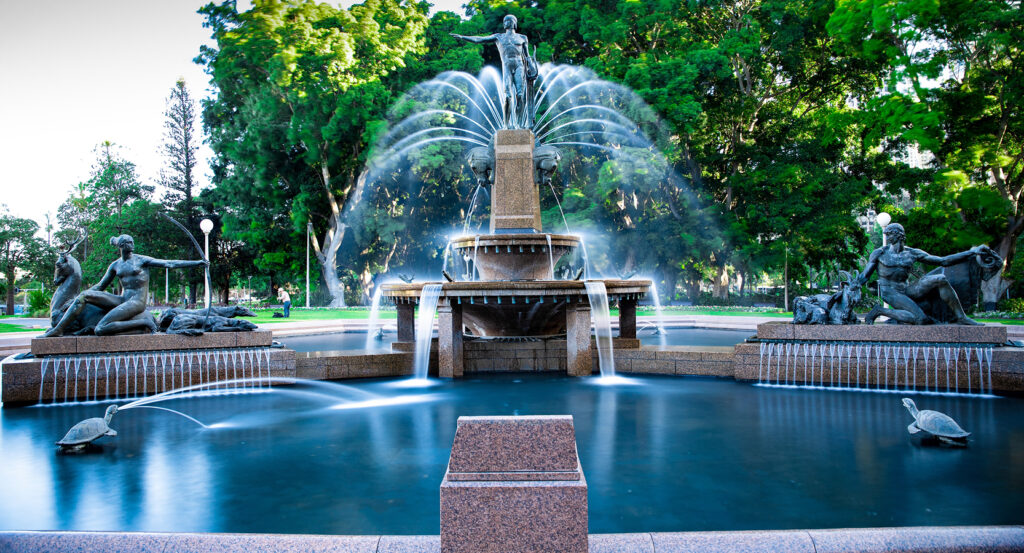
Standing at the southern end of Hyde Park, its mirrored pool and expansive form create a quiet counterpoint to the city's noise. Approach it slowly and you'll feel the atmosphere change, the sounds soften, the air thickens with gravity. Designed by architect C. Bruce Dellit and sculptor Rayner Hoff, the memorial transcends traditional monumentality; it's not just a tribute to the fallen but a living work of art that explores sacrifice, renewal, and the human spirit. The building's pale sandstone catches the light like bone, while the bronze figures surrounding it, soldiers, nurses, mothers, and mythic forms, evoke the endurance of a generation. Step closer, and the reflection pool before it mirrors both sky and sorrow, a sheet of water so still it seems to hold time itself. Beneath the memorial's solemn symmetry lies something more intimate: a story not of war, but of memory, and how a city chose beauty to bear its grief.
What defines Anzac Memorial.
Though widely recognized as a masterpiece of Art Deco design, Anzac Memorial carries layers of meaning that few visitors ever fully uncover.
Completed in 1934, it was conceived not as a shrine to victory, but as an expression of mourning, a space where loss could be dignified by light and form. Architect Bruce Dellit broke from the neoclassical conventions of war monuments, instead crafting something boldly modern: a geometric temple that channels both the spiritual and the secular. Its sculptures by Rayner Hoff are deeply symbolic, the “Sacrifice” group beneath the central dome depicts a slain soldier supported by three women representing Motherhood, Sisterhood, and Wifehood, forming the resonant core of the building. The interior glows with golden mosaic tiles that shimmer like candlelight, an effect intended to suggest the transcendence of the human soul. Every detail carries intention: 120,000 gold stars on the ceiling, one for every citizen from New South Wales who served in World War I; twenty-five bronze reliefs illustrating scenes of endurance, grief, and camaraderie. The structure's orientation aligns precisely with the cardinal directions, reinforcing a sense of order and eternity. The Pool of Reflection, added later in 1938, extends the memorial's axis northward, its still surface echoing both the monument and the sky above. During the 1980s, a major restoration returned Hoff's sculptures to their original brilliance, while the 2018 Centenary Extension beneath the memorial created an educational center that explores Australia's broader history of service. Few realize that the site is also acoustically tuned: stand at the center beneath the dome and your voice reverberates upward with haunting clarity, a design meant to mirror the spiritual resonance of a cathedral. The memorial is not only a cornerstone of Sydney's landscape but of Australia's identity, its design daring, its message timeless. It stands as both an artwork and a moral compass, reminding every visitor that remembrance is not passive, but alive.
How Anzac Memorial fits.
To visit Anzac Memorial is to step into a living moment of reflection, one that deepens as you slow your pace and let the place speak.
Enter from the northern promenade of Hyde Park and follow the fig-lined avenue until the structure rises ahead, centered perfectly beyond the Pool of Reflection. Approach at dawn or dusk if you can: in early light, the sandstone glows warm and tender; by evening, it becomes a lantern of gold. Spend a few minutes beside the pool first, its glassy surface invites quiet contemplation, mirroring the symmetry of the trees and sky. Inside the memorial, allow your eyes to adjust as the marble and mosaic begin to reveal their subtle details. The scent of stone, the hush of footsteps, the echo under the dome, all combine to create a physical experience that borders on the sacred. Take time to stand beneath Hoff's “Sacrifice” sculpture, then circle slowly to view the bronze reliefs that wrap around the interior walls. Each tells a fragment of the human story of war, not through triumph, but through tenderness. The lower-level exhibition, part of the Centenary Extension, offers interactive displays and letters from servicemen and women across generations, deepening the resonant context. If you visit near Anzac Day (April 25), the surrounding park transforms into a field of remembrance with thousands of poppies and the haunting call of the Last Post echoing at dawn. Afterward, step outside and look back, the memorial reflected in the pool, framed by the city skyline, captures the essence of Sydney's duality: modern and timeless, animated and reverent. Allow 45 minutes for your visit; this is not a place to rush. Pair it with a walk through Hyde Park's fig-lined avenues or a visit to nearby St. Mary's Cathedral for a full circle of civic and spiritual beauty. Anzac Memorial doesn't simply commemorate, it transforms, leaving you quieter, humbler, and more awake to the cost of peace.
Where your story begins.
Foresyte Travel reveals places that feel extraordinary long before you arrive.
Enjoy editorial crafted for luxury travelers.
Foresyte may earn a commission when you book.