
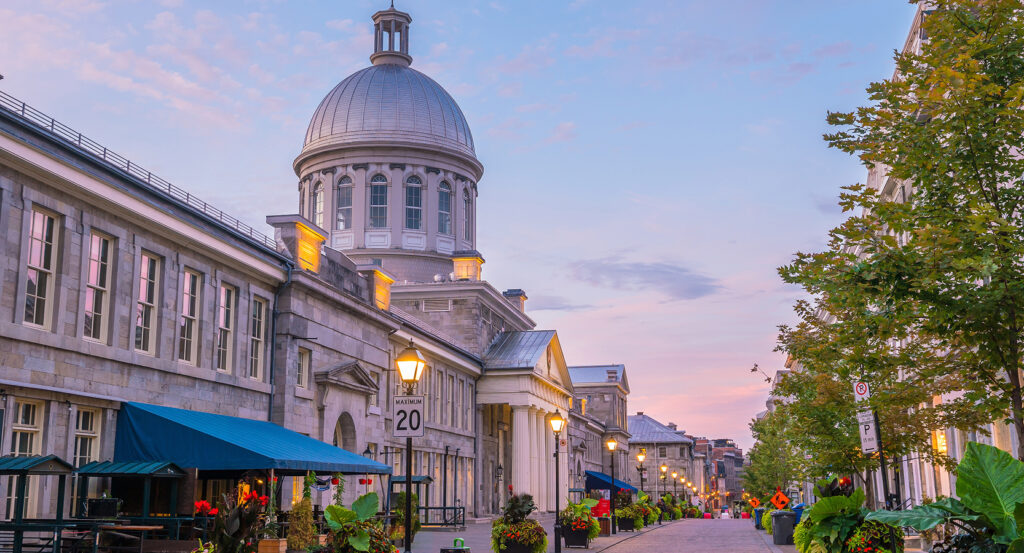
Why Mount Royal Park matters.
Mount Royal is a commanding volcanic hill where Montréal's metropolitan geography meets the landscape architecture of Frederick Law Olmsted, the city's nineteenth-century civic ambitions and the protected green spaces that preserve its most recognizable natural feature.
Rising immediately northwest of Downtown Montréal between the neighborhoods of Ville-Marie, Outremont and Côte-des-Neiges, the mountain occupies a broad wooded massif above the St. Lawrence River plain, where winding park roads, forested slopes and elevated terraces connect the central business district with residential neighborhoods and university campuses. Three principal summits shape its profile, with the highest reaching 233 meters above sea level. Mature hardwood forests cover substantial portions of the slopes, interrupted by open lawns, walking paths and exposed rock. The mountain's southern escarpment provides expansive views across downtown and the river valley. The result is an extensive urban landscape whose geological origins, designed parkland and commanding topography have shaped Montréal's physical development and civic character.
What defines Mount Royal Park.
Mount Royal is best known for giving Montréal its name and for the transformation of its wooded slopes into a major public park designed by Frederick Law Olmsted. The mountain's geological origins extend to the Cretaceous period, when magma intruded into sedimentary rock beneath the region as part of the Monteregian Hills formation. Subsequent erosion exposed the resistant igneous rock, creating the elevated terrain that dominates the surrounding lowlands. Indigenous peoples inhabited and traveled through the region long before European settlement, incorporating the mountain into a broader landscape of waterways, forests and seasonal resources. Jacques Cartier ascended the mountain during his 1535 expedition and named it Mont Royal, establishing the geographical designation from which Montréal subsequently derived its name. The surrounding land gradually became associated with agricultural properties, religious institutions and private estates during the French colonial period. Nineteenth-century urban expansion increased pressure on the mountain's slopes as Montréal developed into a major industrial and commercial center. Wealthy residents established substantial properties along its lower elevations, taking advantage of the elevated terrain and proximity to the expanding city. Municipal authorities began considering the creation of a public park during the 1860s, responding to the need for accessible open space within the growing urban environment. The city acquired land for the project and commissioned Frederick Law Olmsted in 1874 to prepare a comprehensive landscape design. Olmsted had previously collaborated with Calvert Vaux on New York's Central Park, establishing his reputation for large-scale public landscapes. His Mount Royal proposal emphasized gradual ascents, carefully composed views and the preservation of the mountain's natural topography. The park formally opened in 1876, creating a major recreational space accessible to Montréal's expanding population. Later alterations introduced additional roads, recreational facilities and public gathering areas, adapting the mountain to changing patterns of urban use. The establishment of the Mount Royal Historic and Natural District in 2005 strengthened protection for its landscape, built heritage and ecological resources. Its continuing significance rests upon the relationship between Montréal's geological foundations, nineteenth-century landscape planning and the civic decision to preserve a substantial natural area within the growing city.
Frederick Law Olmsted's landscape design organizes the mountain around a gradual progression through wooded slopes, open clearings and elevated viewpoints, allowing changes in terrain to determine the character of the walk. His plan sought to preserve the mountain's natural appearance through carefully controlled circulation and planting, using the existing topography as the principal foundation for the park. Winding paths extend across the slopes, moderating the steep ascent through broad curves and successive changes in direction. This arrangement allows walkers to encounter the forest in stages, with dense vegetation periodically giving way to open views. Mature sugar maples, red oaks and other hardwood species contribute to the woodland canopy, establishing seasonal changes in color and light. The park's vegetation includes areas of regenerating forest and managed open space, requiring ongoing ecological maintenance to protect native plant communities. Beaver Lake, an artificial basin developed during the twentieth century, introduces a broad recreational setting surrounded by lawns and gently sloping terrain. Its shoreline provides a contrasting environment to the steeper wooded paths, accommodating informal gatherings and seasonal activities. The mountain's exposed rock surfaces reveal portions of its underlying geological structure, connecting the designed landscape with the physical processes responsible for its formation. Elevated paths lead toward terraces where the forest opens onto views of Montréal's street grid and distant river landscape. The Kondiaronk Belvedere provides one of the principal observation points, extending a broad terrace above the downtown skyline. Its formal stone balustrade establishes a clear architectural boundary between the public terrace and the steep hillside below. The adjoining chalet accommodates gatherings and provides shelter within the elevated park setting. Winter conditions introduce a different pattern of use, with snow-covered paths supporting walking, cross-country skiing and other seasonal recreation. Mount Royal's distinctive landscape character emerges through this carefully managed sequence of forest, water, open ground and elevated views, preserving Olmsted's central ambition to make the mountain accessible through its natural topography.
How Mount Royal Park fits.
Mount Royal works as the natural centerpiece for a Montréal outing connecting the city's historic educational institutions, its religious architecture and the public spaces that developed along the mountain's slopes.
Begin at McGill University, the historic institution founded in 1821 through the bequest of Montréal merchant James McGill. Its principal campus occupies the southern base of the mountain, where substantial stone buildings and landscaped grounds connect the university with the downtown district. The Arts Building, completed in 1843, preserves an important example of nineteenth-century institutional architecture. The university expanded through successive generations of academic development, establishing faculties and research institutions that contributed to Montréal's intellectual life. Its campus architecture preserves the relationship between educational institutions and the residential neighborhoods surrounding the mountain. Continue to Saint Joseph's Oratory of Mount Royal, the major Catholic pilgrimage sanctuary established through the efforts of Brother André Bessette. His devotion to Saint Joseph attracted increasing numbers of pilgrims during the early twentieth century, leading to the construction of a substantial religious complex on the mountain's northwestern slope. The present basilica was completed in the twentieth century and features an imposing dome visible across Montréal. Its interior accommodates large religious gatherings, and the adjoining grounds preserve chapels, gardens and devotional spaces associated with Brother André's ministry. The sanctuary remains an important center of Catholic pilgrimage in Canada. Conclude at Mount Royal Cemetery, the historic burial ground established in 1852 on the mountain's northern slopes. Designed as a rural cemetery, its landscaped grounds incorporate winding roads, mature trees and substantial funerary monuments. The cemetery became the resting place of prominent figures associated with Montréal's commercial, political and cultural development. Its monuments and family plots preserve changing traditions of memorial architecture across the nineteenth and twentieth centuries. The wooded setting contributes to the continuity of green space across the mountain's northern terrain. The progression moves from McGill University's academic heritage through Saint Joseph's Oratory's religious architecture and culminates at Mount Royal Cemetery's landscaped memorial grounds, connecting Mount Royal with the institutions that developed around Montréal's defining natural feature.
Where your story begins.
Foresyte Travel reveals places that feel extraordinary long before you arrive.
Enjoy editorial crafted for luxury travelers.
Foresyte may earn a commission when you book.























































































































