
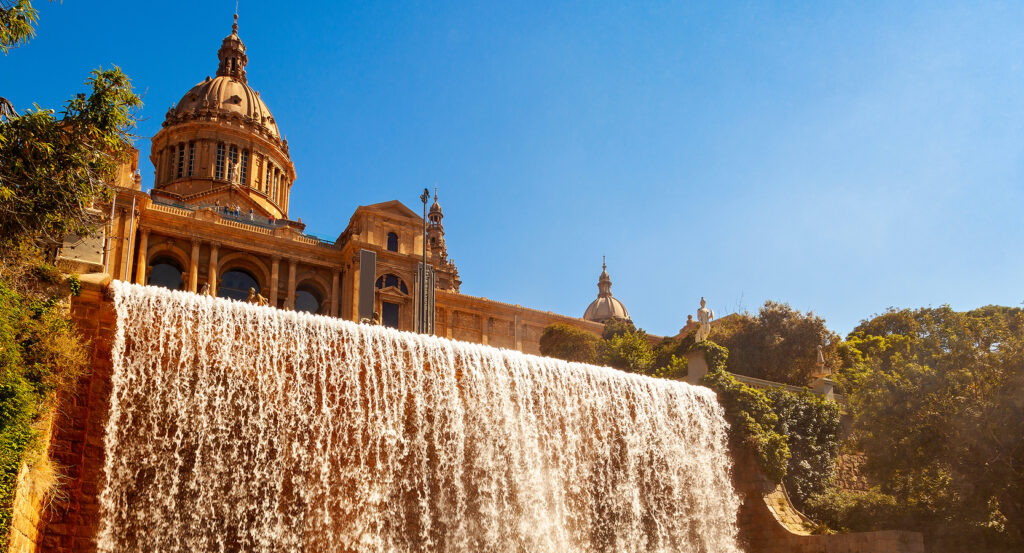
Why Museu Nacional d'Art de Catalunya matters.
The Museu Nacional d'Art de Catalunya, or National Art Museum of Catalonia, is Barcelona's beating cultural heart perched above the city.
Crowning Montjuïc Hill in the grand Palau Nacional, this majestic building commands sweeping views over the city and the glittering Mediterranean beyond. Step inside, and it feels like walking into the soul of Catalonia itself, a living timeline that traces art, identity, and imagination across a thousand years. The galleries unfold like chapters of history: luminous Romanesque frescoes rescued from mountain churches, Gothic altarpieces that glow like stained glass, and Catalan modernist masterpieces that shimmer with Gaudí's spirit. Every corridor feels cinematic, marble halls echoing with footsteps, sunlight streaming through vaulted windows, and the faint hum of the fountains outside. It's more than a museum; it's a sanctuary where architecture and art move together in rhythm, reminding you that Barcelona's creativity didn't begin with Picasso, it began in the mountains, in devotion, and in centuries of color.
What defines Museu Nacional d'Art de Catalunya.
Behind its neoclassical façade and sweeping staircases lies one of the most important art collections in Europe, and one of its most dramatic stories of preservation.
The Romanesque collection, unparalleled in the world, was saved in the early 20th century when Catalan frescoes were literally cut from the walls of remote Pyrenean churches to protect them from looting and neglect. These haunting murals now line MNAC's dimly lit halls like echoes of faith, angels, saints, and beasts painted nearly a millennium ago, their colors still whispering of devotion and defiance. Beyond the medieval, MNAC also champions Catalonia's modern identity, its collection of Noucentisme, Modernisme, and avant-garde art charting the evolution from the pastoral to the urban, from the mystical to the modern. The museum's mission extends beyond preservation; it's an act of cultural resilience, celebrating a region that has continually redefined itself through art. Even its terrace, open to the sky, feels symbolic, a space where the past and present meet, framed by the hum of Barcelona below.
How Museu Nacional d'Art de Catalunya fits.
To experience MNAC the way it's meant to be felt, turn your visit into a slow ascent, both literal and resonant.
Start at the base of Montjuïc, where the Magic Fountain dances in plumes of color and music, then climb the grand steps as the city unfurls behind you. Inside, begin in the Romanesque galleries, quiet, reverent spaces that feel almost monastic, before moving through Gothic altarpieces and into the 19th- and 20th-century wings alive with Catalan modernism. Pause often, especially in front of Ramon Casas or Santiago Rusiñol, whose brushstrokes capture Barcelona's turn-of-the-century spirit. When your feet grow tired, step onto the terrace café for a cortado and a view that rivals any in Europe, the city stretching toward the sea in a mosaic of terracotta and blue. As the afternoon light fades, linger a little longer; the museum's domes glow golden against the sky, and the fountains begin their evening performance below. Museu Nacional d'Art de Catalunya doesn't just hold Catalan art, it is Catalan art, carved into stone, crowned in light, and forever watching over the city that made it possible.
Where your story begins.
Foresyte Travel reveals places that feel extraordinary long before you arrive.
Enjoy editorial crafted for luxury travelers.
Foresyte may earn a commission when you book.














































































































