Why Loggia dei Lanzi matters.
Tucked at the corner of Piazza della Signoria beside Palazzo Vecchio, Loggia dei Lanzi is more than a mere colonnade, it is an open-air gallery where the pulse of Florence's civic and artistic character beats visibly.
Built between 1376 and 1382 and originally conceived as a covered space for public ceremonies and assemblies, the loggia's broad Gothic arches open directly onto the square, inviting both city and visitor into an encounter with art, architecture, and power in one sweeping gesture. The cluster columns and Corinthian capitals provide rhythm, while the clear view into the piazza and across Florence gives it a rare immediacy. Today it stands as one of the city's most cinematic spots, statues shimmer under the Tuscan light, the square hums with history, and the relationship between gate, gallery, and city remains as alive as ever.
What defines Loggia dei Lanzi.
Originally erected by Simone di Francesco Talenti and Benci di Cione, the loggia served medieval Florence's civic needs, gatherings of citizens, oath-taking, and public declarations. With the rise of the Medici and the transformation of Florence into a ducal state, the loggia's role shifted: it became both a display space for art and a symbol of Medici authority. Hence its name, “Lanzi” refers to the Lanzichenecchi, the German-mercenary troops used by Grand Duke Cosimo I, who were once stationed there. Within its arches now stand some of the great sculptural triumphs of the Italian Renaissance and Mannerism: Perseus with the Head of Medusa by Benvenuto Cellini (1545-1554), and The Rape of the Sabine Women by Giambologna (1582-1583), both of which carry deeper allegories of power, virtue and civic identity. The loggia's broad arches themselves represent a pivot: from the vertical piety of medieval architecture toward the human-scaled openness that defines the Renaissance.
How Loggia dei Lanzi fits.
Arriving early in the day or toward sunset ensures the best experience, the light along the facade and within the arches changes the mood entirely.
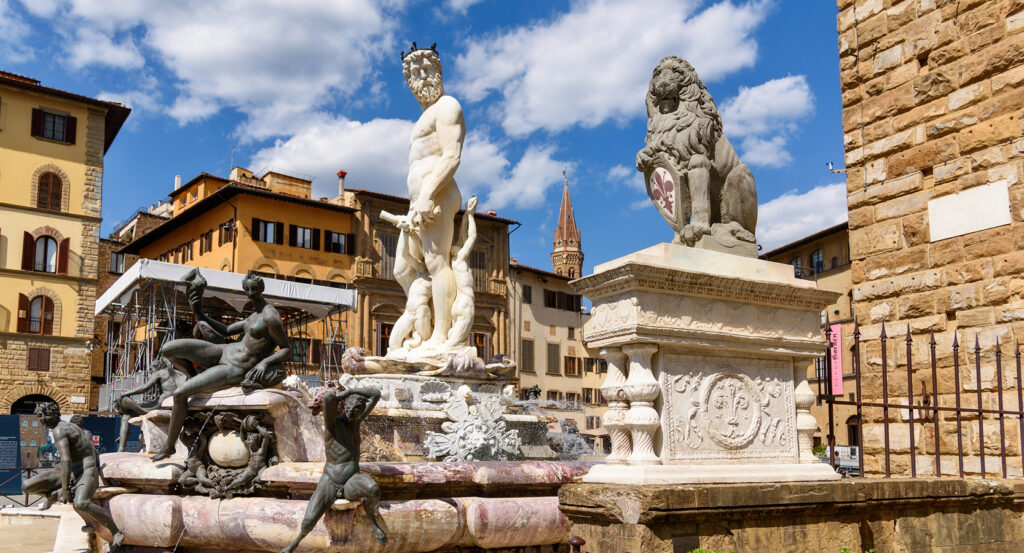
Stand just inside one of its wide arches and look outward into the piazza: you'll feel framed by stone, looking out toward Florence's unfolding story. Begin by pausing before Cellini's Perseus, observe how his stance and gaze project dominance, not just over Medusa, but over the civic soul of Florence. Then turn to Giambologna's Sabine Women, walk around it if you can, as it was designed for viewing from multiple angles. While doing this, take note of the lions flanking the entrance, the coats of arms carved into the stone, and the subtle inscriptions that mark epochs of Florentine history. After a few minutes here, wander into the piazza, glance toward the adjoining Uffizi or Palazzo Vecchio, and then return to the loggia for a final look back, the arch framing the statues, the square, the city behind it. Loggia dei Lanzi isn't just a stop in Florence, it's a portal into how art and public life once intertwined seamlessly under open sky.
Where your story begins.
Foresyte Travel reveals places that feel extraordinary long before you arrive.
Enjoy editorial crafted for luxury travelers.
Foresyte may earn a commission when you book.