Why Ken Spencer Science Park matters.
The Ken Spencer Science Park in Vancouver is where the city's urban pulse slows to the rhythm of soil, sunlight, and sustainable living.
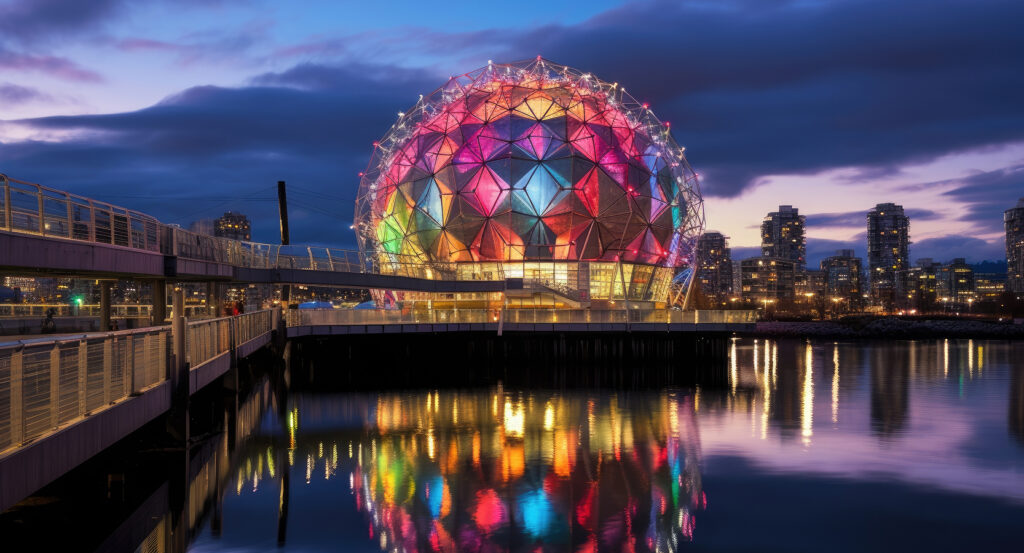
Just outside the shimmering geodesic dome, the park unfolds as a living laboratory, a half-acre of gardens, pollinator meadows, solar panels, and interactive exhibits that reimagine what a modern city can grow. The scent of earth and cedar replaces the hum of exhibits inside; the air carries the mingled sounds of children turning compost and bees working quietly over lavender. Here, science is tangible, not confined to theory or technology, but rooted in the cycles that sustain life. You might catch a school group testing water pH from a rain barrel, a chef harvesting kale for a zero-waste cooking demo, or a family learning how worms transform food scraps into fertile soil. Every station hums with quiet wonder: bicycle generators that light bulbs through human effort, microgreen plots that teach patience, vertical gardens that hint at the future of food in dense cities. The park feels at once lively and profound, a green classroom that reminds Vancouver why sustainability isn't a slogan, but a practice. To step into it is to realize that even within a metropolis of glass and steel, nature still whispers instructions, if you're willing to listen.
What defines Ken Spencer Science Park.
The Ken Spencer Science Park is a tribute to what happens when education, ecology, and urban design intersect, an open-air classroom and model for regenerative city living.
Named after philanthropist Ken Spencer, a local entrepreneur and advocate for science education, the park was conceived as an expansion of Science World's mission to bring scientific principles into everyday life. Built on what was once a concrete lot, the park now hosts more than 20 interactive exhibits and ecosystems, from aquaponic tanks to solar experiments. Its design follows LEED environmental standards, integrating reclaimed materials, rainwater collection systems, and native plant landscaping that requires minimal irrigation. Every feature doubles as a lesson: the solar-powered irrigation system demonstrates energy transfer; the urban beehives demonstrate biodiversity and pollination networks; and the worm composting stations reveal how decomposition closes the nutrient loop. The gardens are cultivated year-round by a mix of staff, volunteers, and students, producing small harvests that feed into workshops on sustainable cooking and nutrition. The park also serves as a testbed for urban agriculture innovation, collaborating with local universities and community organizations to explore rooftop farming, hydroponics, and carbon capture in microclimates. Even the pathways are part of the story, permeable pavers reduce runoff, while strategically placed benches are built from recycled lumber sourced from deconstructed Vancouver homes. Educational signage throughout the park avoids jargon; instead, it asks questions: What powers your food? How much energy does your body make? Can a city feed itself? The park's underlying philosophy mirrors Science World's broader vision, that curiosity, when paired with care, can transform both people and place.
How Ken Spencer Science Park fits.
The Ken Spencer Science Park is the perfect counterpoint to the energy of Science World's interior, a breath of nature before or after the OMNIMAX's intensity.
Plan the visit during daylight hours, ideally between late morning and midafternoon, when the sun filters through the trellises and the interactive exhibits are most active. Begin your exploration at the solar energy zone, where you can trace how light becomes power across panels that hum faintly in the sun. Move on to the urban farm plots, where vegetables and herbs change with the seasons, kale, chard, and tomatoes in summer; hearty root vegetables in autumn. Kids will love pedaling at the human energy station, where each spin lights up a series of bulbs, proving that effort and output are directly connected. Pause by the beehive observation windows to watch the colony at work, a unique, living system of precision and cooperation. Don't skip the composting and worm farms, where docents often demonstrate how waste turns back into resource. Each station includes small challenges or experiments, lift a solar panel flap, weigh a day's worth of food waste, compare soil moisture under sun and shade, all designed to make sustainability participatory. Expect to spend 45-60 minutes wandering the park, longer if you attend a workshop or guided activity. For photographers, the best light arrives in the late afternoon when the Science World dome gleams silver behind rows of greenery, a perfect contrast of technology and earth. Access is included with general admission to Science World, and the park connects directly to the False Creek seawall, making it easy to continue your exploration by bike or foot toward Olympic Village or Granville Island. In spring and summer, local artists and educators host weekend pop-ups, storytelling, planting demos, and science theatre that make the park feel like a community festival. If you're visiting in cooler months, don't dismiss it; winter reveals the park's quiet side, when structure and soil take center stage and sustainability feels less like performance, more like meditation. However you time it, the Ken Spencer Science Park is more than a detour, it's a living equation between human ingenuity and natural grace, proof that science's greatest lesson might be humility before the systems that let us thrive.
Where your story begins.
Foresyte Travel reveals places that feel extraordinary long before you arrive.
Enjoy editorial crafted for luxury travelers.
Foresyte may earn a commission when you book.