Why The Kings Sushi Bar matters.
The Kings Sushi Bar is a polished sushi restaurant where Harbourfront's lake-facing character meets all-you-can-eat Japanese dining, premium sushi rice and a culinary team carrying more than twenty-five years of experience.
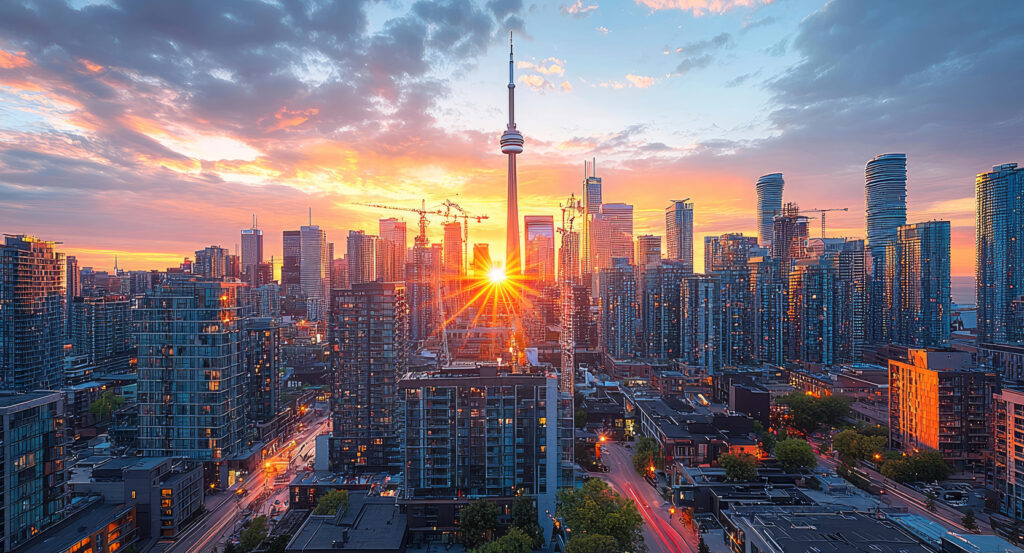
Set along Queens Quay West near Rees Street and just steps from Harbourfront Centre, the restaurant occupies Toronto's central waterfront between the CN Tower and Rogers Centre to the north, Lake Ontario to the south and the cultural institutions extending east and west along the shoreline. Contemporary glazing opens the dining room toward Queens Quay, placing its clean-lined interior against the denser towers rising immediately behind the waterfront. Closely arranged tables and a dedicated sushi counter concentrate activity around the preparation of nigiri, sashimi and rolls, giving the room a stronger restaurant character than the surrounding promenade's open public spaces. Outdoor seating extends service toward the lakefront corridor during warmer weather, connecting the property more directly with pedestrian movement along Queens Quay. The result is a waterfront sushi restaurant whose contemporary interior, sushi counter and proximity to Lake Ontario place an expansive Japanese meal directly within Toronto's principal recreational shoreline district.
What defines The Kings Sushi Bar.
The Kings Sushi Bar is best known for bringing more than twenty-five years of Japanese culinary experience into a contemporary all-you-can-eat sushi restaurant on Toronto's central waterfront. Its kitchen defines that accumulated practice through premium sushi rice and a stated commitment to fresh ingredients, making rice preparation and seafood quality foundational to a menu extending far beyond specialty rolls. The restaurant established itself at Queens Quay as a comparatively recent addition to Harbourfront dining, with Toronto diners already referring to it as a new waterfront sushi destination by June 2026. All-you-can-eat service became the central format, allowing sashimi, nigiri, rolls and cooked Japanese dishes to function within one continuous meal rather than dividing the restaurant between separate tasting and à la carte concepts. Reservations, counter service and table service operate within the same property, giving the sushi bar a visible role inside a restaurant designed for considerably larger meals than a traditional counter sequence. Daily service from noon through 10 p.m. further concentrates the operation around lunch and dinner without changing the underlying format between days. The Kings Sushi Bar has translated a culinary background spanning more than a quarter-century into a high-volume waterfront format built around freshly assembled Japanese dishes and repeated ordering from a broad all-you-can-eat selection.
Raw fish gives the all-you-can-eat format its clearest culinary center, with salmon, tuna and other seafood moving between sashimi, nigiri and maki according to how rice, nori, sauce and additional fillings are introduced. Sashimi isolates the cut fish without rice, making temperature and texture immediately apparent before nigiri adds a compact foundation of seasoned sushi rice beneath each piece. Maki changes that relationship through nori and additional ingredients, allowing avocado, cucumber, tempura components and sauces to build stronger contrasts around the seafood. Spicy salmon rolls push soft fish against heat and rice, creating a richer preparation within the same raw-fish sequence. Miso soup and seaweed salad provide lighter breaks between successive sushi orders, using broth, fermented soybean paste and marine vegetables to reset the meal before another round arrives. The all-you-can-eat structure makes those contrasts cumulative, allowing one sitting to move repeatedly between unadorned fish, seasoned rice, rolled combinations and warm accompaniments.
How The Kings Sushi Bar fits.
The Kings Sushi Bar works as the dining anchor for a waterfront outing connecting Toronto's industrial harbor history, a cultural complex created during the shoreline's reinvention and a railway facility preserving the machinery that powered the city's continental connections.
Begin at Toronto Music Garden, whose design grew from cellist Yo-Yo Ma's interpretation of Johann Sebastian Bach's Suite No. 1 in G Major for Unaccompanied Cello. Landscape designer Julie Moir Messervy translated the suite's six dance movements into separate garden environments, working with landscape architects from the City of Toronto before the garden opened in 1999. Curving paths, a spiral mound and distinct planting areas convert musical structure into physical movement beside Lake Ontario, giving the waterfront a composition derived directly from one of Bach's most familiar instrumental works. Continue to Harbourfront Centre, whose origins lie in the federal government's acquisition of 100 acres of Toronto waterfront property in 1972 during a broader effort to return former industrial shoreline to public use. Harbourfront Corporation followed in 1978, and the cultural organization subsequently developed former warehouses and waterfront structures for visual art, performance, craft and public programming. The Power Plant emerged from that transformation inside a former generating station constructed in 1926, extending the district's industrial inheritance into contemporary art. Conclude at Toronto Railway Museum, occupying Roundhouse Park around the surviving John Street Roundhouse built by Canadian Pacific Railway between 1929 and 1931. The facility used a 120-foot turntable to distribute locomotives among thirty-two maintenance stalls and serviced passenger engines operating through nearby Union Station during the height of steam railway travel. Canadian Pacific continued using the roundhouse until 1986, and its surviving structures subsequently became the foundation for a museum devoted to Toronto's railway history. The progression moves from Bach translated into a waterfront landscape through former industrial shoreline reclaimed for cultural institutions and culminates in Canadian Pacific's surviving locomotive complex, connecting three different reinventions of Toronto's relationship with its Lake Ontario waterfront.
Where your story begins.
Foresyte Travel reveals places that feel extraordinary long before you arrive.
Enjoy editorial crafted for luxury travelers.
Foresyte may earn a commission when you book.