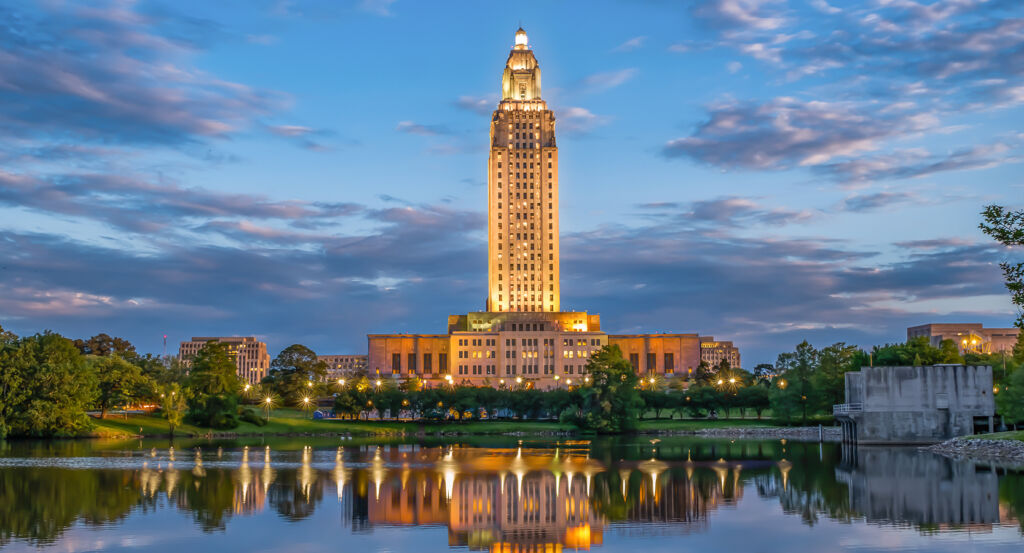
Why you should experience WATERMARK Baton Rouge, Autograph Collection in Baton Rouge, Louisiana.
WATERMARK Baton Rouge is Baton Rouge reframed through confidence and vertical perspective, a hotel that understands the city as a place of authority, ambition, and river-born resilience.
Baton Rouge carries weight. It is a capital city shaped by governance, commerce, and decisions that ripple far beyond its borders. WATERMARK does not shy away from that gravity, it rises directly into it. Occupying one of the tallest and most commanding structures on the riverfront, the hotel announces itself not through ornament, but through posture. From the moment you approach the building, there is a sense of intention and modern authority, as though the city itself has chosen to stand taller at this point along the Mississippi. Arrival feels decisive. You are not eased in gently; you are oriented clearly. Inside, the atmosphere is unmistakably contemporary, but not generic. The design language is sharp, architectural, and deliberate, favoring clean lines, verticality, and restraint over decorative excess. Public spaces feel composed and elevated, designed to support people who arrive with purpose, executives, professionals, creatives, and travelers who expect their environment to reflect forward motion. The lobby reads less like a welcome lounge and more like a threshold between city and command center, a place where conversations begin, strategies are refined, and the tone of the stay is set. Light plays a critical role throughout the property. Natural light floods the space, often pulling your attention upward or outward, reinforcing a sense of scale and perspective that feels rare in Baton Rouge. The Mississippi River is not treated as a scenic afterthought; it is a constant presence, visible, implied, and felt as a reminder of the city's economic and historical backbone. Guest rooms extend this elevated sensibility with precision. They are sleek, spacious, and intentionally uncluttered, designed to give you room to think as much as room to rest. Beds are substantial and composed, lighting is layered and controlled, work surfaces are integrated seamlessly. Floor-to-ceiling windows, where available, shift your relationship with the city, replacing street-level immediacy with horizon and flow. The rooms do not cocoon you; they sharpen you. Sound is managed to preserve focus and recovery without isolating you from the city's pulse, reinforcing that you are staying inside Baton Rouge's engine. Dining and social spaces at WATERMARK reflect the same philosophy of modern authority. The hotel's food and beverage offerings feel intentional and confident, designed for conversation, deal-making, and deliberate unwinding. Rooftop and elevated views introduce a rare sense of detachment from the city's density, offering space to see Baton Rouge as a system. Evenings here feel composed. Returning to your room at night feels like returning to a position of clarity, where the day's inputs can be processed. WATERMARK Baton Rouge is not for travelers seeking softness or nostalgia. It is for those who want to feel aligned with the city's power, pace, and forward direction, a place where Baton Rouge feels decisive, modern, and unapologetically vertical.
What you didn't know about WATERMARK Baton Rouge.
WATERMARK Baton Rouge represents a deliberate shift in how Baton Rouge presents itself to the world, signaling a move from inward-looking tradition to outward-facing confidence.
As part of Marriott's Autograph Collection was never intended to be a neutral or purely functional hotel. Properties in this collection are chosen for their ability to express a strong point of view, and WATERMARK's point of view is unmistakable: Baton Rouge as a modern capital with regional authority and economic relevance. The building itself plays a central role in that message. Rising prominently along the riverfront, it alters the city's skyline and redefines how Baton Rouge is perceived from the water, the road, and the air. This vertical presence is not cosmetic; it reflects the city's evolving identity as a place of commerce, policy, and innovation. The hotel's design choices reinforce this narrative. Interiors avoid overt references to Southern nostalgia or decorative historicism, opting instead for materials, textures, and proportions that communicate modern professionalism. This creates an environment that resonates with guests whose relationship to Baton Rouge is tied to leadership, enterprise, and long-term engagement. Service culture at WATERMARK mirrors this modern orientation. Interactions are polished, efficient, and confident. Staff operate with an understanding that many guests are here to conduct business, host conversations, or represent organizations, and hospitality is delivered as competence. This makes the hotel particularly appealing to repeat visitors whose stays are defined by meetings, negotiations, and institutional cycles. Dining operations follow suit. Rather than positioning food as an indulgent centerpiece, the hotel treats dining as an extension of its professional ecosystem, a place to connect, decompress, and think clearly. Menus and spaces are designed to support varied schedules and purposes, from early starts to late conversations, without demanding ritual or performance. Over time, WATERMARK has become a reference point for Baton Rouge's contemporary identity. It is where visiting executives stay, where events with consequence are hosted, and where the city's ambitions are reflected back at itself. Its significance lies not only in comfort or design, but in what it communicates: Baton Rouge as a city comfortable with authority, scale, and forward-looking presence. In a capital long associated with tradition, WATERMARK represents assertion.
How to fold WATERMARK Baton Rouge into your trip.
WATERMARK Baton Rouge works best when you allow it to frame your experience of the city from a position of elevation, physically, mentally, and strategically.
Begin your stay by orienting yourself upward. Take time to absorb the views, the scale, and the hotel's relationship to the river and skyline before diving into your agenda. This perspective shift matters; it reframes Baton Rouge not as a series of obligations, but as a system you are temporarily operating within. Use the hotel as a central command point. Its proximity to downtown, government buildings, and business corridors makes it ideal for moving efficiently between engagements. Return between meetings or events to reset, regroup, and prepare. The rooms are designed to support this kind of recalibration, offering clarity. Afternoons in Baton Rouge can stretch unpredictably, sessions run long, conversations evolve, priorities shift, and WATERMARK's composed environment helps absorb that variability without draining energy. Evenings are best approached with intention. Use the hotel's elevated social spaces to decompress thoughtfully, whether through quiet conversation, reflection, or a measured close to the day. Avoid overscheduling; the hotel's value lies in how it holds space. Over multiple days, this rhythm compounds. Baton Rouge begins to feel legible and navigable not because it simplifies, but because your base provides perspective. By the time you depart, WATERMARK Baton Rouge will not feel like a hotel you merely stayed in. It will feel like the place from which you operated, a vantage point that sharpened your understanding of the city's power structures, pace, and ambitions. The hotel does not attempt to soften Baton Rouge or romanticize its past. It meets the city where it is becoming, offering an environment that feels decisive, modern, and aligned with the seriousness of a capital city that knows its influence extends well beyond its borders.
Where your story begins.
Start your planning journey with Foresyte Travel.
Experience immersive stories crafted for luxury travelers.