Why Whistler Blackcomb matters.
Whistler Blackcomb is a vast alpine ski resort where Whistler's Coast Mountain wilderness meets the development of Canadian winter sports, the engineering of interconnected mountain transportation and the Olympic achievements that established British Columbia as a major international skiing destination.
Rising above Whistler Village between the forested Fitzsimmons Creek valley and the alpine ridges overlooking Garibaldi Provincial Park, the resort occupies the adjoining slopes of Whistler Mountain and Blackcomb Mountain, extending from densely wooded lower elevations to exposed summits, glaciers and broad high-altitude bowls. An extensive network of gondolas, chairlifts and marked trails connects the two mountains with the pedestrian resort settlement below. Alpine terrain includes steep chutes, open snowfields, glacial basins and long descents through subalpine forest. Mountain lodges and lift terminals occupy strategic elevations, providing access to distinct skiing areas across the expansive terrain. The result is an integrated mountain destination whose scale, engineering and varied alpine geography preserve the evolution of Canadian skiing into an internationally significant recreational industry.
What defines Whistler Blackcomb.
Whistler Blackcomb is best known for combining two major ski mountains into a single resort encompassing more than 8,000 acres of skiable terrain and hosting alpine events during the 2010 Winter Olympic and Paralympic Games. The surrounding mountains form part of the traditional territories of the Squamish Nation and Lil'wat Nation, whose communities maintained longstanding relationships with the region's forests, waterways and alpine environments. Modern recreational development accelerated during the early twentieth century as railway access introduced travelers to the Alta Lake district. The establishment of summer lodges and recreational facilities created the foundations of a regional tourism economy. During the 1960s, a group of Vancouver businessmen led by Franz Wilhelmsen pursued plans for a major mountain resort capable of attracting international skiing competitions. The Garibaldi Olympic Development Association promoted the region as a potential Winter Olympics venue, encouraging investment in transportation and mountain infrastructure. Whistler Mountain opened for skiing in January 1966, introducing chairlifts, a gondola and trails that established the area's first major winter sports operation. The resort subsequently expanded its lift network and terrain as skiing gained popularity across western Canada. Blackcomb Mountain opened in December 1980 under separate ownership, creating a competing ski operation on the neighboring mountain. Its development introduced new lifts, trails and accommodation facilities, strengthening Whistler's position within North American skiing. Competition between the two mountains encouraged continued investment in high-capacity lifts and expanded alpine access. The operations came under common ownership in 1997, establishing a unified commercial structure for the adjoining ski areas. The combined resort introduced coordinated ticketing, mountain services and infrastructure planning. Vancouver and Whistler secured the 2010 Winter Olympic and Paralympic Games in 2003, initiating substantial improvements to regional transportation and sporting facilities. Whistler Mountain hosted Olympic alpine skiing competitions, including downhill, super-G, giant slalom and slalom events. The Games strengthened the resort's international reputation and contributed to the expansion of its year-round recreational economy. Vail Resorts acquired Whistler Blackcomb in 2016, incorporating the Canadian destination into its international mountain resort portfolio. Continued investment in lifts and mountain facilities has maintained its position among North America's largest ski resorts.
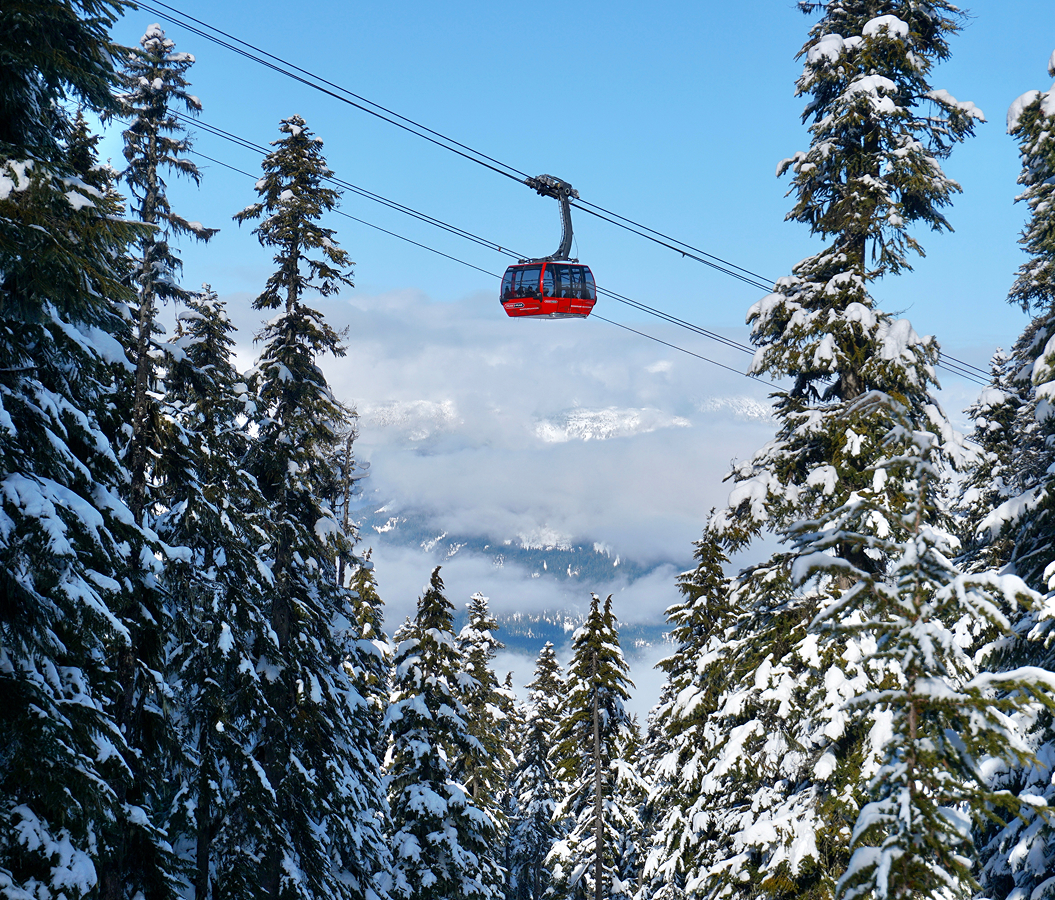
PEAK 2 PEAK Gondola is the resort's defining engineering achievement, connecting Whistler Mountain and Blackcomb Mountain across the deep Fitzsimmons Creek valley. Opened in December 2008, the installation created a direct aerial connection between the mountains' upper elevations, fundamentally changing circulation across the resort. Its 4.4-kilometer route includes an unsupported cable span of more than three kilometers, demonstrating the engineering required to cross a substantial alpine valley. The gondola reaches a maximum height of 436 meters above the valley floor, providing extensive views across the surrounding mountains. Enclosed cabins transport passengers between the two terminals, with selected cabins incorporating glass floor panels that reveal the terrain beneath the crossing. The installation reduced the need to descend to the village when transferring between the mountains, expanding access to terrain on both sides of the valley. Whistler Mountain's upper slopes include broad alpine bowls and steep descents extending toward the forested lower mountain. Blackcomb Mountain contains extensive high-elevation terrain associated with the Horstman Glacier and surrounding alpine ridges. The resort's lift network connects these environments through gondolas, detachable chairlifts and surface lifts suited to different terrain conditions. Snowmaking infrastructure supports selected lower-elevation runs during periods of variable natural snowfall. Grooming operations maintain designated trails, providing consistent surfaces across substantial portions of the resort. Advanced terrain includes steep chutes, ungroomed bowls and areas requiring specialized mountain awareness. Summer operations introduce lift-accessed mountain biking, hiking and sightseeing, extending recreational use beyond the winter season. Whistler Mountain Bike Park has become an important international center for downhill mountain biking, incorporating trails with varying technical difficulty. The resort's high-altitude environment requires ongoing attention to avalanche safety, weather conditions and the management of alpine ecosystems. Its transportation infrastructure and extensive terrain establish a substantial connection between modern mountain engineering and the natural geography of the Coast Mountains.
How Whistler Blackcomb fits.
Whistler Blackcomb works as the alpine recreation anchor for a Whistler outing connecting Indigenous cultural heritage, the history of Olympic competition and the protected mountain landscapes surrounding the resort.
Begin at Squamish Lil'wat Cultural Centre, the Indigenous cultural institution situated in Whistler's Upper Village. Opened in 2008, the center was developed through cooperation between the Squamish Nation and Lil'wat Nation to preserve and share their distinct cultural traditions. Its architecture incorporates design elements inspired by Squamish longhouses and traditional Lil'wat istken dwellings. Exhibitions present weaving, carving, oral histories and ceremonial objects, connecting contemporary cultural practice with generations of Indigenous knowledge. Guided programs examine the nations' relationships with the surrounding mountains, forests and waterways, establishing the historical context of the region's development. Continue to Whistler Olympic Park, the Nordic sporting complex situated in the Callaghan Valley southwest of Whistler. Developed for the 2010 Winter Olympic and Paralympic Games, the facility hosted cross-country skiing, ski jumping, Nordic combined and biathlon competitions. Its infrastructure includes competition trails, ski jumps and specialized shooting facilities associated with biathlon. The surrounding valley provides extensive forested terrain suited to Nordic recreation, with winter programs continuing to use the Olympic facilities. Interpretive features commemorate the athletes and events that established the complex's international sporting significance. Conclude at Garibaldi Provincial Park, the extensive protected wilderness surrounding the volcanic and glacial landscapes east of Whistler. Established in 1927, the park preserves alpine lakes, glaciers, volcanic formations and substantial mountain ecosystems within British Columbia's Coast Mountains. Its landscape includes Garibaldi Lake, a turquoise glacial basin enclosed by steep peaks and forested slopes. Hiking routes provide access to subalpine meadows and elevated viewpoints overlooking the surrounding volcanic terrain. The park's conservation status protects important habitats and geological formations associated with the region's mountain environment. The progression moves from Squamish Lil'wat Cultural Centre's Indigenous heritage through Whistler Olympic Park's competitive sporting history and culminates at Garibaldi Provincial Park's protected alpine wilderness, connecting Whistler Blackcomb with the cultural and environmental foundations of the Coast Mountains.
Where your story begins.
Foresyte Travel reveals places that feel extraordinary long before you arrive.
Enjoy editorial crafted for luxury travelers.
Foresyte may earn a commission when you book.