Why Canada Place matters.
Canada Place is a waterfront convention and cruise terminal complex where Downtown Vancouver's maritime heritage meets the transformation of the Canadian Pacific Railway's former shipping facilities, the international ambitions of Expo 86 and the development of Vancouver as a Pacific gateway for passenger travel and international commerce.
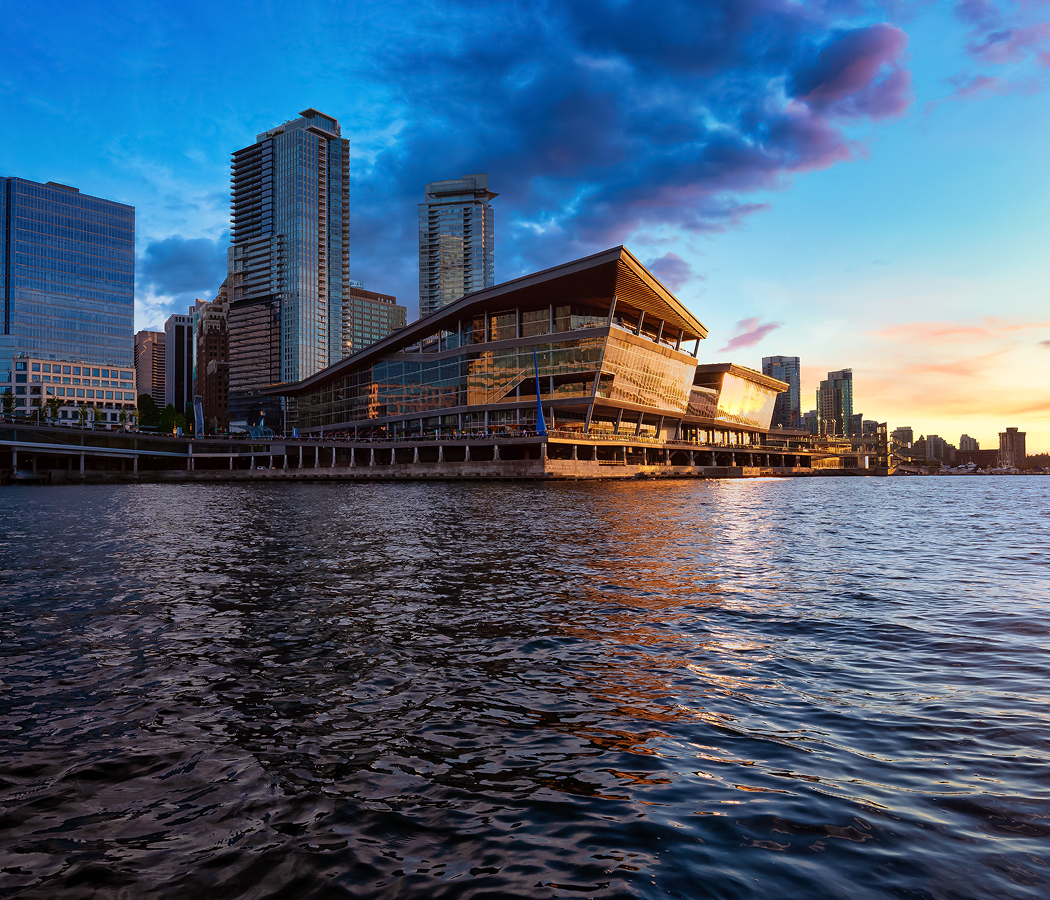
Set along Canada Place near Howe Street and a short walk from Waterfront Station, the complex occupies a pier extending into Burrard Inlet from Downtown Vancouver's northern shoreline, between the West Cordova Street commercial district and the harbor's working shipping channels, facing North Vancouver across the water. Five white fabric sails rise above the terminal's roofline, recalling the rigging of sailing vessels. The pier's outer promenade overlooks the harbor, Stanley Park and the North Shore Mountains. Cruise berths occupy the waterfront edges beneath the convention and hospitality facilities. The result is a maritime complex whose architecture connects Vancouver's historic port infrastructure with international passenger transportation and public access to the harbor.
What defines Canada Place.
Canada Place is best known for its five white roof sails, its construction for Expo 86 and its role as Vancouver's principal cruise ship terminal. The site's commercial history began with the development of Vancouver as the western terminus of the Canadian Pacific Railway during the late nineteenth century. Railway investment connected the port with Canada's transcontinental transportation network, expanding opportunities for trade between the Pacific coast and inland markets. The Canadian Pacific Railway developed waterfront facilities to accommodate cargo handling, shipping operations and the movement of goods between rail and sea. Pier B-C, constructed during the early twentieth century, became an important component of Vancouver's port infrastructure. Its facilities supported commercial shipping and passenger transportation during a period when the city's maritime economy expanded through connections with Asia and other Pacific destinations. By the late twentieth century, changes in cargo handling and port operations had altered the commercial requirements of the historic waterfront. The decision to host Expo 86 created an opportunity to redevelop the former pier into a public facility associated with Canada's participation in the international exposition. The project was conceived as the Canada Pavilion, providing a national exhibition space and a permanent waterfront complex. Architects Eberhard Zeidler and Barry Downs contributed to the design, developing a structure distinguished by its sail-like roof forms and relationship with the harbor. Construction began in 1983, transforming the former shipping facilities into a convention and passenger terminal complex. Canada Place opened in 1986 as part of Expo 86, whose transportation and communication theme connected the development of Vancouver with international exchange. Following the exposition, the building continued as a convention center, cruise terminal and public waterfront destination. The Pan Pacific Vancouver hotel became an integral component of the complex, extending its functions into international hospitality. The development of Vancouver's cruise industry strengthened the terminal's importance as a departure point for Alaska voyages. Subsequent improvements expanded passenger-processing facilities and strengthened connections with the surrounding downtown transportation network. The complex became part of the Port of Vancouver's passenger infrastructure, supporting the city's position within Pacific maritime commerce and international tourism.
Zeidler's architectural design incorporates five tensile fabric sails supported by a structural system rising above the principal building mass. The roof forms draw upon the visual characteristics of sailing vessels, establishing a maritime association through their geometry and material construction. Their white surfaces create a recognizable silhouette against the harbor and surrounding mountains. The building's long pier arrangement organizes cruise operations along the waterfront while accommodating convention and hospitality functions above. Passenger facilities include check-in areas, customs and immigration processing spaces, and connections to cruise ship berths. The terminal's configuration supports the simultaneous handling of large passenger vessels during the Alaska cruise season. The Pan Pacific Vancouver occupies the upper portion of the complex, with rooms and public areas overlooking the harbor. The Vancouver Convention Centre's original East Building forms part of the Canada Place complex, incorporating meeting rooms and exhibition facilities developed for international conferences and events. Canada Place's exterior promenade extends along the pier, providing public access to views of Burrard Inlet and the surrounding waterfront. The Canadian Trail incorporates interpretive displays associated with Canada's provinces and territories. FlyOver Canada, an immersive flight simulation attraction, occupies a purpose-built theater within the complex. Its motion seating, large projection screen and environmental effects present aerial imagery of Canadian landscapes. The complex also contains public spaces associated with national celebrations and seasonal events. The building's relationship with the surrounding harbor remains central to its operation, with cruise vessels, seaplanes and commercial shipping moving through the adjacent waterways. Its architecture preserves the visual connection between passenger transportation and the maritime setting that originally supported the site's commercial development.
How Canada Place fits.
Canada Place works as the waterfront centerpiece for a Downtown Vancouver itinerary connecting the city's railway origins, early commercial architecture and the transformation of its industrial shoreline into public cultural space.
Begin at Waterfront Station, the historic railway terminal situated immediately south of the harbor. Completed in 1914 for the Canadian Pacific Railway, the station replaced earlier passenger facilities associated with Vancouver's development as a transcontinental transportation terminus. Its architecture incorporates an expansive entrance, stone detailing and a substantial interior concourse characteristic of early twentieth-century railway terminals. The building became a principal arrival point for passengers traveling between Vancouver and the rest of Canada. Its subsequent adaptation for rapid transit and commuter services preserved its transportation role within the metropolitan region. The station connects the city's railway heritage with its modern urban transit network. Continue to Gastown, the historic commercial district extending eastward from the waterfront. Its origins are associated with the settlement that developed around John Deighton's saloon in 1867, preceding the incorporation of Vancouver in 1886. The district expanded through the construction of warehouses, hotels and commercial buildings serving the port and railway economy. The Great Vancouver Fire of 1886 destroyed much of the early settlement, prompting reconstruction in brick and stone. Surviving buildings preserve elements of late nineteenth- and early twentieth-century commercial architecture. The neighborhood's street pattern and historic façades connect Vancouver's early mercantile development with the growth of its maritime economy. Conclude at Vancouver Convention Centre West Building, the waterfront facility completed in 2009. Designed by LMN Architects in collaboration with Musson Cattell Mackey Partnership and DA Architects + Planners, the building incorporates a substantial living roof planted with indigenous vegetation. Its exterior combines extensive glazing with public walkways extending along the harbor. The complex includes exhibition halls, meeting facilities and a marine habitat constructed beneath the waterfront structure. Its development expanded Vancouver's capacity for international conventions and established new public access along the former industrial shoreline. The progression moves from transcontinental railway infrastructure through the city's earliest commercial district and culminates in contemporary waterfront architecture, connecting Canada Place with the development of Vancouver's port and civic institutions.
Where your story begins.
Foresyte Travel reveals places that feel extraordinary long before you arrive.
Enjoy editorial crafted for luxury travelers.
Foresyte may earn a commission when you book.