Why Canadian Museum of History matters.
Canadian Museum of History is an expansive national museum where Hull's Ottawa River waterfront meets Canada's human history, Indigenous cultural heritage, and Douglas Cardinal's internationally celebrated organic architecture.
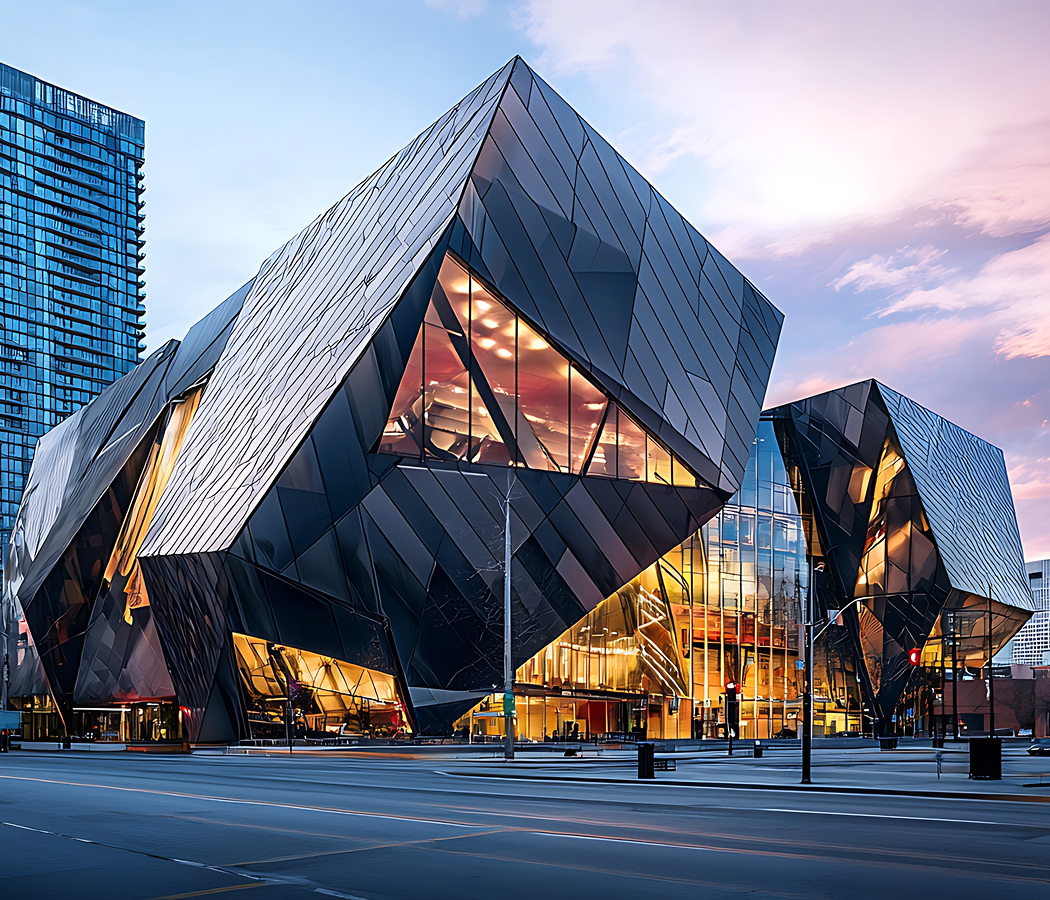
Occupying the northern bank of the Ottawa River directly opposite Parliament Hill, Canadian Museum of History stands in Gatineau's Hull sector, with Laurier Street bordering its western grounds, Alexandra Bridge rising immediately northeast, and Jacques-Cartier Park extending along the river toward the east. The museum's sweeping limestone walls, curving rooflines, and expansive glass surfaces establish an architectural composition inspired by the geological forces that shaped the Canadian landscape. Two principal wings frame a landscaped central plaza, where water features and pedestrian terraces connect the building with the surrounding riverfront. Rounded exterior walls clad in Manitoba Tyndall stone evoke weathered rock formations, and copper roofs introduce undulating forms above the building's pale masonry. The river-facing Grand Hall rises behind an immense glass curtain wall, framing the Gothic towers of Parliament Hill across the water. Interior circulation follows sweeping curves, with broad staircases, spacious galleries, and sculptural architectural elements connecting the exhibition areas. The surrounding grounds incorporate gardens, public artworks, and waterfront pathways, extending the museum's architectural composition into the broader ceremonial landscape of Canada's capital region. The result is an extraordinary national museum whose sculptural architecture, commanding riverfront position, and expansive exhibition spaces establish one of Canada's most significant cultural landmarks.
What defines Canadian Museum of History.
Canadian Museum of History is best known for its transformation from a nineteenth-century geological collection into Canada's national museum of human history, culminating in the construction of one of the country's most consequential public buildings. The institution's origins reach to the Geological Survey of Canada, established in 1842 to investigate the mineral resources and geological character of the Province of Canada. Its founding director, Sir William Edmond Logan, recognized the importance of preserving specimens and objects gathered through the organization's scientific activities. In 1856, Logan established a public museum in Montréal under legislation supporting the Geological Survey, creating the institutional foundation for a national collection. The museum initially concentrated on geological specimens, minerals, and natural history, reflecting the scientific priorities of British North America's expanding colonial administration. A legislative expansion in 1877 introduced the systematic collection of objects associated with Indigenous peoples, archaeological discoveries, languages, and cultural traditions. The institution relocated to Ottawa in 1881, bringing its collections into the emerging national capital and strengthening their relationship with federal scientific administration. Subsequent acquisitions expanded the human-history holdings through archaeology, ethnology, and the preservation of objects associated with communities across Canada. The museum moved into the Victoria Memorial Museum Building in 1911, sharing the expansive Ottawa structure with natural history collections. During the twentieth century, the human-history program developed into a substantial national undertaking, incorporating field expeditions, Indigenous cultural collections, historical objects, and extensive photographic holdings. The institution also became an important center for Canadian folklore through the work of anthropologists and collectors who preserved oral traditions, music, and regional cultural practices. Marius Barbeau emerged as a consequential figure in this development, joining the Geological Survey's anthropology division in 1911 and undertaking extensive work involving Indigenous cultures and French Canadian traditions. His collecting activities contributed significantly to the institution's ethnological holdings and the broader development of Canadian anthropology. Diamond Jenness, another influential anthropologist, joined the institution following his participation in the Canadian Arctic Expedition of 1913-1916, contributing major investigations of Inuit cultures and archaeological history. The expansion of the national collections eventually produced a more formal division between natural history and human history. In 1968, the Human History Branch became the National Museum of Man under the National Museums of Canada Corporation, with archaeologist William E. Taylor serving as its first director. The new institutional structure strengthened the museum's focus on archaeology, ethnology, historical interpretation, and the cultural development of Canada's peoples. Growing collections and increasingly ambitious exhibitions exposed the limitations of the institution's existing accommodation, prompting federal plans for a purpose-built museum. In 1982, the government announced a major new facility on the Quebec shore of the Ottawa River, establishing a permanent location opposite Parliament Hill. Architect Douglas Cardinal, a Canadian architect of Métis and Blackfoot ancestry, received the commission for the project. Cardinal had developed an international reputation through his distinctive approach to curving architectural forms, particularly St. Mary's Church in Red Deer, Alberta, and the Alberta Government Services Building in Edmonton. His design for the national museum developed the relationship between Canadian geography, Indigenous cultural traditions, and the geological evolution of the continent. The architectural program incorporated forms associated with glacial erosion, river movement, and the sculptural character of ancient rock formations. Cardinal collaborated with architect Michel Languedoc and the Montréal firm Tétrault, Parent, Languedoc et Associés on the development of the building. Construction introduced an extensive complex incorporating exhibition galleries, collection facilities, public gathering spaces, and an expansive river-facing hall. The institution adopted the name Canadian Museum of Civilization in 1986, reflecting its expanded interpretation of human cultural development. Governor General Jeanne Sauvé officially inaugurated the new building on June 29, 1989, establishing a major cultural landmark within the National Capital Region. The Canadian Museum of Civilization Corporation subsequently received independent Crown corporation status under the Museums Act of 1990. The new complex supported a succession of major permanent exhibitions, including the Canada Hall, whose reconstructed historical environments explored the country's social and economic development. The Canadian Children's Museum became another important component of the institution's public program, introducing interactive cultural environments designed for younger audiences. The First Peoples Hall opened on January 30, 2003, following extensive collaboration with Indigenous advisers, artists, and community representatives. Its substantial exhibition program brought together historical objects and contemporary cultural expression, strengthening the museum's interpretation of Indigenous histories. A further institutional transformation followed the Canadian Museum of History Act, which received royal assent on December 12, 2013. The legislation established the Canadian Museum of History under a revised mandate emphasizing the people, events, and objects that shaped Canada's development. A major redevelopment of the permanent historical exhibitions followed, culminating in the opening of the Canadian History Hall on July 1, 2017, during the 150th anniversary of Confederation. Designed through a renewed collaboration with Cardinal, the hall introduced a comprehensive presentation of Canadian history across three galleries and two exhibition levels. The institution's collection has grown to more than four million objects, encompassing archaeological discoveries, historical artifacts, Indigenous cultural works, and objects associated with everyday life throughout Canada. Its development reflects the transformation of federal collecting practices, the increasing prominence of Indigenous perspectives, and the evolution of national historical interpretation across more than a century and a half.
Douglas Cardinal's architectural vision establishes the museum's distinctive relationship between cultural interpretation and the physical geography of Canada, with permanent exhibitions organized around expansive spaces and extensive historical collections. The Grand Hall introduces the cultures of Indigenous peoples from the Pacific Northwest through six reconstructed house fronts created by artisans representing different coastal traditions. Its soaring interior follows the shape of an ocean-going canoe, with structural columns recalling upright paddles and an expansive glass wall connecting the exhibition to the river beyond. Expansive carved poles occupy the central space, establishing a powerful architectural relationship between Indigenous artistic traditions and the museum's contemporary construction. Works by Bill Reid, Robert Davidson, Beau Dick, and other distinguished artists extend the presentation into contemporary Indigenous cultural expression. The First Peoples Hall develops a broader account of First Nations, Inuit, and Métis histories through more than 2,000 cultural objects, images, and historical documents. Its exhibitions address agricultural practices, fishing traditions, technological innovation, political organization, artistic production, and the continuing cultural achievements of Indigenous communities. Inuit snow goggles introduce the ingenuity of Arctic material culture, and works including Shelley Niro's Sky Woman connect historical traditions with contemporary artistic practice. The galleries also confront the consequences of colonial policies and the resilience of Indigenous peoples through successive periods of Canadian history. The Canadian History Hall provides the institution's principal chronological exhibition, developing a sweeping account of human habitation, colonial settlement, Confederation, industrialization, and the development of modern Canada. Its three galleries occupy 3,700 square metres, incorporating eighteen historical chapters and thousands of objects. The central gathering space introduces an enormous satellite image of Canada and an interactive chronology of significant events. Archaeological discoveries establish the antiquity of human settlement, and subsequent sections explore the political, economic, and cultural relationships among Indigenous peoples, European settlers, and successive immigrant communities. Historical objects connect national developments with individual lives, including clothing, household possessions, transportation equipment, and artifacts associated with political movements. Alex Janvier's expansive ceiling painting Morning Star, completed in 1993, introduces another major artistic achievement through a composition addressing Indigenous history and cultural renewal. The painting occupies the dome above the Haida Gwaii Salon, extending across 4,500 square feet. The Canadian Children's Museum develops an interactive counterpart through recreated international settings, including a Mexican kitchen, an open-air market, and a cargo ship. Its activities introduce younger audiences to cultural diversity through imaginative play and practical exploration. The Canadian Stamp Collection adds another dimension through more than 3,000 stamps, connecting postal imagery with the country's political, artistic, and technological development. Temporary exhibitions expand the institution's interpretation into international history, archaeology, and contemporary cultural subjects. Canadian Museum of History's distinction rests upon the integration of expansive Indigenous art, extensive historical collections, interactive cultural interpretation, and an architectural masterpiece conceived around the relationship between people, geography, and the passage of time.
How Canadian Museum of History fits.
Canadian Museum of History works as the cultural centerpiece of an Ottawa River excursion connecting Gatineau's historic waterfront, the engineering heritage of the national capital, and one of Canada's most significant collections of visual art.
Begin at Jacques-Cartier Park, the expansive waterfront landscape extending northeast from the museum toward the mouth of the Gatineau River. Developed during the 1930s, the park occupies 22.68 hectares along the northern bank of the Ottawa River, preserving a substantial public landscape associated with the historical development of Hull. The area served as a stopping place for travelers navigating the river and preparing to portage around Chaudière Falls, connecting its geographical significance with the region's longstanding transportation history. The park incorporates several surviving nineteenth-century buildings, including Charron House, constructed in stages between 1826 and 1841. The residence preserves a rare example of traditional Quebec domestic architecture within the National Capital Region. Farther north, the Gilmour and Hughson Limited Office, built in 1892, preserves a connection with the Ottawa Valley's substantial timber industry. The building served a company associated with the movement of lumber through the river corridor and subsequently became the Maison du vélo, supporting recreational cycling along the capital's extensive pathway network. Continue southwest toward Alexandra Bridge, the expansive steel crossing linking Gatineau with Ottawa across the river. Completed in 1901, the bridge developed from a railway project intended to strengthen transportation connections between the two provincial capitals. Its substantial steel trusses and cantilever construction represented a major engineering achievement during the expansion of Canada's railway network. The bridge subsequently accommodated changing transportation requirements, incorporating road traffic and pedestrian movement alongside its original railway function. Its elevated crossing introduces extraordinary views of the Ottawa River, the parliamentary escarpment, and the surrounding cultural institutions. Conclude at National Gallery of Canada, the expansive art museum occupying a commanding site near the southern end of the bridge. Founded in 1880 through the initiative of Governor General John Campbell, Marquess of Lorne, and Princess Louise, the institution developed from a small collection of Canadian paintings into one of the country's principal national cultural organizations. Architect Moshe Safdie designed its purpose-built Ottawa facility, which opened on May 21, 1988. The building's crystalline glass towers, pale granite surfaces, and expansive exhibition halls establish a distinctive architectural counterpart to Cardinal's museum across the river. Its collections encompass Canadian painting, First Nations and Inuit art, European masterpieces, photography, and international contemporary works. Louise Bourgeois's expansive bronze spider Maman occupies the exterior plaza, introducing a powerful sculptural landmark near the entrance. The progression moves from Jacques-Cartier Park's historic riverfront landscape through Alexandra Bridge's expansive transportation engineering and culminates at National Gallery of Canada, where Canada's artistic heritage extends the cultural exploration across the Ottawa River.
Where your story begins.
Foresyte Travel reveals places that feel extraordinary long before you arrive.
Enjoy editorial crafted for luxury travelers.
Foresyte may earn a commission when you book.