Why Parliament Hill matters.
Parliament Hill is an expansive parliamentary precinct where Downtown Ottawa's national institutions meet Canada's constitutional history, Gothic Revival architecture, and the ceremonial traditions of federal democracy.
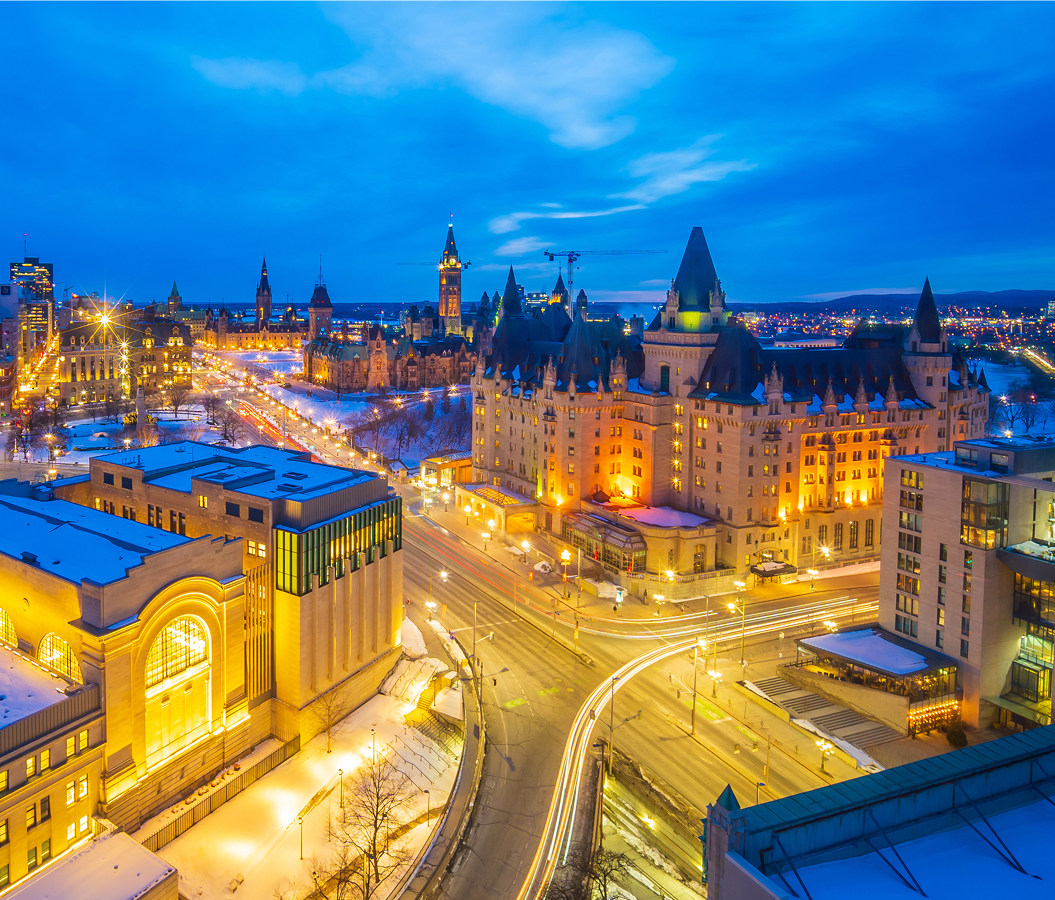
Occupying a limestone escarpment fifty metres above the Ottawa River, Parliament Hill rises along the northern edge of Downtown Ottawa, with Wellington Street defining its southern frontage, the Rideau Canal descending toward the river to the east, and the government buildings of the western parliamentary precinct extending toward Kent Street. The complex combines three expansive Gothic Revival buildings with landscaped lawns, commemorative sculpture, ceremonial spaces, and elevated pathways overlooking the Ottawa River and Gatineau Hills. Centre Block dominates the architectural composition through its soaring Peace Tower, pointed arches, elaborate stone carving, and steep copper roofs. East Block and West Block establish a complementary arrangement of asymmetrical towers, turrets, and richly textured masonry around the principal grounds. The Library of Parliament occupies a distinctive polygonal structure behind Centre Block, its circular arrangement and ornamental roofline contributing to the northern skyline. The broad southern lawn provides an open ceremonial setting between the parliamentary buildings and Wellington Street, with the Centennial Flame positioned near the principal entrance. Paths along the northern escarpment introduce views of the river, surrounding bridges, and the Quebec shoreline. The result is an extraordinary national landscape whose expansive architecture, commanding geography, and ceremonial grounds establish the physical center of Canada's parliamentary democracy.
What defines Parliament Hill.
Parliament Hill is best known as the seat of Canada's federal Parliament and the architectural expression of the country's transformation from British North American colonies into an independent constitutional democracy. The promontory occupies the traditional unceded territory of the Algonquin Anishinaabe, whose communities maintained longstanding relationships with the Ottawa River as a transportation corridor, gathering place, and source of sustenance. European colonial development accelerated during the early nineteenth century as the Ottawa Valley became an important center of the British North American timber trade. Lieutenant-Colonel John By arrived in 1826 to direct construction of the Rideau Canal, establishing the settlement of Bytown around the waterway's northern entrance. The elevated ground west of the canal became known as Barrack Hill through its association with military facilities supporting the construction project. Bytown incorporated as Ottawa in 1855, establishing a municipal government within a rapidly developing commercial settlement. On December 31, 1857, Queen Victoria selected Ottawa as the permanent capital of the United Province of Canada, resolving a prolonged dispute among competing cities including Toronto, Kingston, Montréal, and Québec. The location's distance from the American border, defensible elevation, and position between English- and French-speaking Canada contributed to the decision. The government allocated twenty-five acres for a new parliamentary complex and organized an architectural competition in May 1859. The competition attracted 298 submissions, with Thomas Fuller and Chilion Jones winning the commission for the principal legislative building and Thomas Stent and Augustus Laver receiving responsibility for the eastern and western departmental buildings. Their designs established a coordinated Gothic Revival ensemble inspired by British parliamentary architecture and the scenic principles of Victorian design. Construction began in December 1859, and the first Nepean sandstone blocks were laid during the following spring. Albert Edward, Prince of Wales and future King Edward VII, laid the cornerstone on September 1, 1860, during a major royal visit to British North America. Financial difficulties interrupted construction in 1861, when expenditures substantially exceeded the original estimates. A commission of inquiry investigated the project's management, and building activity resumed in 1863. The principal structures became sufficiently complete for government occupation during the middle of the decade, with the legislative building formally opening on June 6, 1866. Confederation followed on July 1, 1867, establishing the Dominion of Canada through the union of Ontario, Quebec, Nova Scotia, and New Brunswick. The first Parliament of the new federation assembled in Ottawa on November 6, transforming the complex into the permanent institutional center of the Dominion's legislative government. The Library of Parliament, whose architectural development involved Thomas Seaton Scott, reached completion in 1877, introducing an elaborate circular reading room beneath a vaulted timber ceiling. Subsequent expansion accommodated the growing federal administration, although the original architectural composition retained its commanding position above the river. Disaster struck on February 3, 1916, when a fire began in the Centre Block reading room during an evening sitting of the House of Commons. Flames spread rapidly through the building, killing seven people and destroying the original legislative structure, including its Victoria Tower. The Library survived through the protection afforded by its iron fire doors, which separated the building from the advancing flames. Prime Minister Robert Borden's government arranged temporary parliamentary accommodation inside the Victoria Memorial Museum, preserving legislative operations during the First World War. Architects John A. Pearson and Jean-Omer Marchand designed the replacement Centre Block, combining Gothic Revival ornament with a more formal Beaux-Arts arrangement and improved fire-resistant construction. The new structure incorporated a steel frame, limestone and marble interiors, and clearer circulation routes. Prince Arthur, Duke of Connaught, laid the reconstructed building's cornerstone in September 1916, reusing the stone recovered from the destroyed structure. Parliamentary sittings resumed in the unfinished building in February 1920. The reconstruction introduced a substantially taller central tower conceived as a national memorial to Canadians who died during the First World War. Governor General Viscount Willingdon dedicated the Peace Tower on July 1, 1927, during celebrations marking the sixtieth anniversary of Confederation. The ceremony inaugurated its fifty-three-bell carillon, whose inaugural performance formed part of a coast-to-coast radio broadcast. Parliament Hill subsequently became a principal setting for national ceremonies, political demonstrations, royal visits, and events associated with Canada's constitutional development. The patriation of the Constitution in 1982 strengthened its symbolic association with Canadian sovereignty and the Charter of Rights and Freedoms. A substantial rehabilitation program began transforming the parliamentary precinct during the early twenty-first century, addressing deteriorating infrastructure and the demands of modern legislative operations. West Block underwent extensive restoration between 2011 and 2018, introducing a temporary House of Commons chamber beneath a glass roof spanning its historic courtyard. Members of Parliament began sitting there in January 2019, allowing Centre Block to close for the most extensive rehabilitation project in Canadian parliamentary history. The program encompasses structural conservation, seismic strengthening, modern building systems, and construction of a new Parliament Welcome Centre. Parliament Hill represents an exceptional convergence of nineteenth-century nation-building, architectural preservation, constitutional development, and the continuing institutional life of Canadian democracy.
Parliament Hill's distinctive character emerges through the relationship between its surviving architectural masterpieces, national memorials, public ceremonies, and the daily work of federal government. West Block provides an important introduction to parliamentary operations through guided visits to the interim House of Commons chamber, where a contemporary glass enclosure rises above the preserved stone walls of the former courtyard. The chamber's green seating, central aisle, Speaker's chair, and opposing government and opposition benches preserve the spatial traditions of Canada's Westminster parliamentary system. Its restored interiors incorporate elaborate stone fireplaces, ornamental woodwork, and historic offices associated with prominent political figures. East Block introduces a complementary architectural setting through rooms preserved from the nineteenth-century federal administration, including offices associated with Sir John A. Macdonald and Sir George-Étienne Cartier. The building's High Victorian Gothic interiors connect the political development of Confederation with the craftsmanship of Canada's earliest parliamentary architects. Centre Block's ceremonial spaces establish the most elaborate expression of the precinct's national significance. Confederation Hall incorporates a soaring central column surrounded by Gothic arches, establishing an expansive entrance beneath the principal tower. The Hall of Honour extends northward toward the Library, with carved stone ornament and commemorative elements connecting the building's legislative functions with Canadian history. The House of Commons and Senate chambers occupy opposite sides of the central axis, reflecting the institutional relationship between elected representation and the upper house. The Memorial Chamber within the Peace Tower contains the Books of Remembrance honoring Canadians who died in military service. The Library's circular reading room incorporates carved pine shelving, galleries, and a central statue of Queen Victoria, preserving one of the most distinguished surviving interiors of Canada's original parliamentary complex. These Centre Block interiors remain closed during the rehabilitation program, with selected parliamentary functions and commemorative displays accommodated elsewhere in the precinct. The surrounding grounds extend the institution's cultural significance through an extensive collection of statues and memorials honoring political leaders and consequential national events. The Centennial Flame introduces a prominent symbolic feature through a continuously burning flame surrounded by water and the heraldic emblems of Canada's provinces and territories. Prime Minister Lester B. Pearson inaugurated the monument on December 31, 1966, beginning the national celebrations of Confederation's centennial. Its original twelve-sided arrangement was expanded in 2017 to incorporate Nunavut's coat of arms and territorial flower. The Famous Five Monument commemorates the women whose legal campaign culminated in the 1929 Persons Case decision, establishing the eligibility of women for appointment to the Canadian Senate. Statues of prime ministers and other historical figures contribute additional layers of political interpretation across the landscaped grounds. Public ceremonies connect these permanent monuments with the continuing civic life of the capital through Canada Day celebrations, Remembrance observances, and demonstrations associated with national political debates. The ceremonial traditions of the Canadian Armed Forces contribute another dimension through military music and formal guard activities. Parliament Hill's cultural distinction rests upon the integration of functioning legislative institutions, exceptional Gothic Revival architecture, national commemoration, and public participation in Canada's democratic life.
How Parliament Hill fits.
Parliament Hill works as the starting point for a Central Ottawa exploration connecting Canada's military remembrance traditions, the engineering origins of the national capital, and the preservation of the city's earliest surviving stone architecture.
Begin at National War Memorial, the expansive granite arch occupying Confederation Square southeast of Parliament Hill. British sculptor Vernon March developed the composition through an international competition, creating a bronze procession of twenty-two military figures beneath allegorical representations of Peace and Freedom. Following March's death in 1930, members of his family completed the sculptural program and supervised its installation in Ottawa. King George VI unveiled the memorial on May 21, 1939, before an audience at 100,000 people. Originally dedicated to Canadians who served during the First World War, the monument subsequently received inscriptions commemorating additional conflicts. The Tomb of the Unknown Soldier was added in May 2000, receiving the remains of an unidentified Canadian serviceman repatriated from a cemetery near Vimy Ridge. The memorial provides the principal setting for Canada's national Remembrance Day ceremony. Continue northeast to Rideau Canal Ottawa Locks, the expansive flight of eight interconnected locks descending from the canal's urban entrance toward the Ottawa River. British military engineers developed the waterway as a secure transportation route between Montréal and Kingston following the War of 1812. The project required substantial excavation, stone masonry, dams, and water-control infrastructure across a 202-kilometre corridor. Construction involved thousands of laborers, including Irish immigrants and French Canadian workers, whose difficult working conditions and exposure to disease produced substantial loss of life. The completed canal opened in May 1832, establishing a navigable connection between the Ottawa River and Lake Ontario. Its original engineering survives through the operation of traditional lock gates and the carefully arranged stone chambers. UNESCO inscribed the Rideau Canal on the World Heritage List in 2007, recognizing its exceptional preservation as a nineteenth-century military canal. Conclude at Bytown Museum, occupying the historic Commissariat Building beside the western bank of the canal locks. Constructed in 1827 under the direction of the Royal Engineers, the three-storey limestone building originally accommodated supplies, administrative offices, and financial operations supporting canal construction. Its thick masonry walls, gabled roof, and substantial loading doors preserve the practical architecture of a British military storehouse. The Women's Canadian Historical Society of Ottawa established the museum in 1917, initially operating from the former City Registry Office. The institution relocated to the Commissariat in 1952, transforming Ottawa's oldest surviving stone building into a permanent museum devoted to the capital's early history. Exhibitions connect the city's timber industry, canal construction, immigration, and urban development with the people who shaped the transition from Bytown to Ottawa. The progression moves from National War Memorial's commemoration of Canadian military service through Rideau Canal Ottawa Locks' nineteenth-century engineering and culminates at Bytown Museum, where the capital's earliest surviving stone architecture preserves the origins of its urban development.
Where your story begins.
Foresyte Travel reveals places that feel extraordinary long before you arrive.
Enjoy editorial crafted for luxury travelers.
Foresyte may earn a commission when you book.