
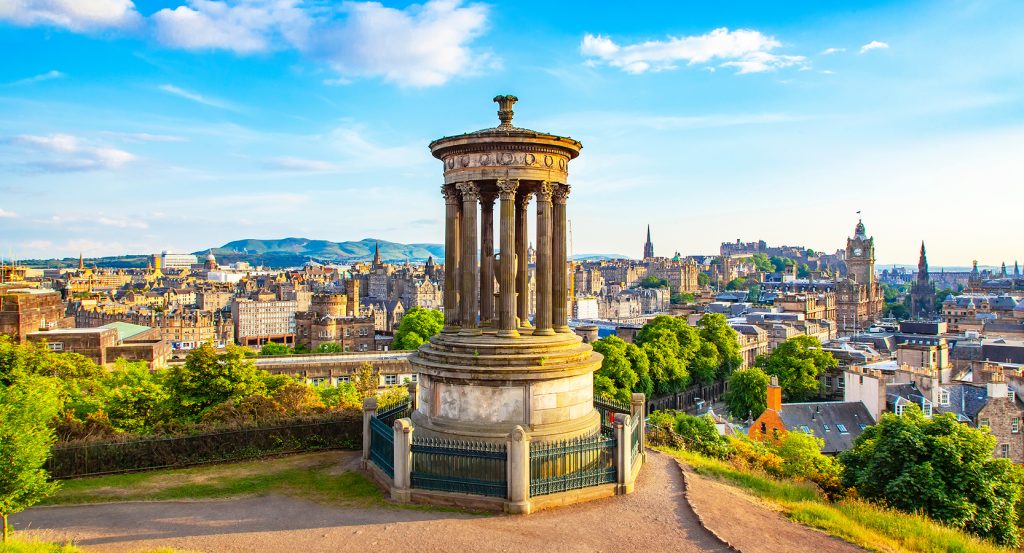
Why National Monument of Scotland matters.
Rising like a fragment of ancient Athens above the skyline, the National Monument of Scotland commands attention on Calton Hill, a structure that feels both timeless and unfinished, noble and tragic.
Conceived in the spirit of the Scottish Enlightenment, it was designed to honor those who died in the Napoleonic Wars, an architectural statement that sought to unite national pride with classical beauty. What stands today, twelve Doric columns of gray Craigleith stone, was meant to be the full-scale replica of the Parthenon, but when funds ran out in 1829, construction halted forever. Yet that incompletion has become its poetry. Against Edinburgh's moody skies, the monument looks less like failure and more like a metaphor for ambition itself, a monument to dreams so grand they outgrew their means. Standing before its colonnade, you feel the hum of history in the wind and understand why locals affectionately call it “Edinburgh's Disgrace.” In truth, it's anything but, it's a reminder that greatness often lies in the pursuit, not the perfection.
What defines National Monument of Scotland.
Though its columns suggest ancient Greece, every stone of the National Monument tells a story of 19th-century Scotland, a nation striving to define itself through intellect, art, and heroism.
The monument was commissioned by the Highland Society of Scotland, designed by architects Charles Robert Cockerell and William Henry Playfair, and laid upon Calton Hill in 1826. It was envisioned as a Pantheon for the modern world, a place to honor fallen soldiers and the Scottish spirit that carried them. When financial support collapsed, Edinburgh's elite debated whether to finish it, but public sentiment had already transformed it into something more symbolic: a romantic ruin standing at the crossroads of aspiration and humility. Over the centuries, the monument has witnessed royal processions, military parades, and even protests, always a gathering point for collective memory. During sunsets, its pillars glow gold, framing panoramic views that stretch from Arthur's Seat to the Firth of Forth, merging history with horizon in a way that feels almost mythic.
How National Monument of Scotland fits.
Visiting the National Monument of Scotland is one of those simple yet transcendent experiences that define a trip to Edinburgh.
Make your way up Calton Hill, following the gentle path from Regent Road or Waterloo Place, and the monument will rise before you like a mirage of marble and shadow. Bring comfortable shoes and a camera, the columns create natural frames for the city's skyline, particularly at sunrise and dusk when light drifts between them. Climb the grassy slope for a closer look; the scale of each column reveals the ambition behind its creation. This is also one of the best spots for quiet reflection, an open, wind-swept plateau where you can sit on the steps and watch the city breathe below. Pair your visit with nearby landmarks such as the Nelson Monument and the City Observatory for a complete Calton Hill experience. As the day fades and the sky turns violet over Edinburgh, you'll understand what countless travelers before you have felt here, that beauty can live just as powerfully in what remains unfinished.
Where your story begins.
Foresyte Travel reveals places that feel extraordinary long before you arrive.
Enjoy editorial crafted for luxury travelers.
Foresyte may earn a commission when you book.














































































































