Why you should experience Hall of One Hundred Rivers in Vancouver, British Columbia.
Hall of One Hundred Rivers at Dr. Sun Yat-Sen Classical Chinese Garden is where the garden's philosophy crystallizes, a chamber where architecture, poetry, and nature converge into pure contemplation.
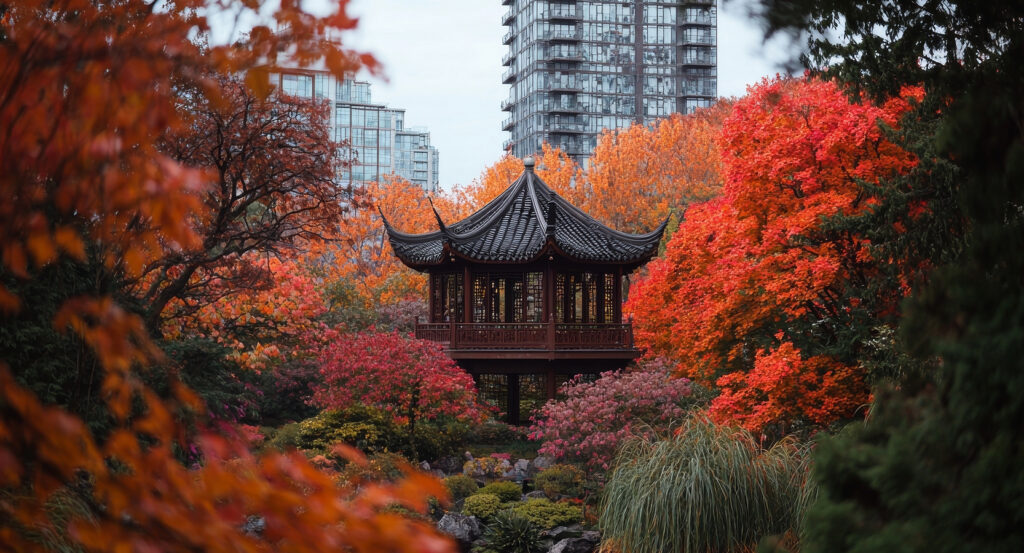
Step through its carved wooden doors and the city vanishes, replaced by the whisper of water and the scent of cedar and camphorwood. The hall opens directly onto the Jade Water Pond, its latticed windows framing reflections that shift like living scrolls. Inside, the air is cool and dim, filtered through geometric screens that cast delicate shadows across the polished stone floor. Every detail is intentional: the sloping roof that draws rainwater into the pond, the placement of columns aligned with sightlines toward moon gates and bridges, the calligraphy panels that speak of rivers joining into one sea, a metaphor for unity through diversity. The hall feels timeless, designed not to impress but to quiet the mind. When sunlight spills across the wooden beams or rain ripples the pond outside, the space becomes something more than architecture, it becomes meditation turned solid, an example of harmony made visible.
What you should know about Hall of One Hundred Rivers.
Hall of One Hundred Rivers is the principal structure of the Dr. Sun Yat-Sen Classical Chinese Garden, a masterpiece of Ming Dynasty architectural design recreated in the heart of Vancouver.
It was constructed in 1986 by master artisans from Suzhou, using techniques unchanged for centuries. Not a single nail or screw was used; every beam and bracket was joined through precise mortise-and-tenon carpentry, locking the structure together through balance and tension alone. The hall's name derives from a Confucia style: “The sea receives one hundred rivers,” symbolizing the virtue of openness and inclusivity, that wisdom comes not from isolation but from embracing all streams of thought. Its architecture reflects this idea in form: windows open in every direction, allowing air, light, and reflection to flow freely through. The roof's upturned eaves are ornamented with clay dragons and phoenixes, symbols of balance between masculine and feminine forces, and the pillars are crafted from Chinese fir, chosen for its warmth and fragrance. Inside, the hall once hosted scholars' gatherings, poetry recitations, and tea ceremonies, moments of shared reflection meant to align human rhythm with the natural world. The floor is paved with hand-laid stone mosaics in wave-like patterns, representing the flow of rivers toward the sea. Along its northern wall hangs a series of wooden calligraphy plaques inscribed with classical Chinese poems, their characters brushed by visiting scholars from both Vancouver and Suzhou. The structure was deliberately oriented so that its southern façade faces the Jade Water Pond, integrating light and water as central design elements, sunlight reflects off the surface, painting fluid patterns across the interior walls. The hall's proportions are also mathematical in their perfection: the width and height follow the “golden ratio”, believed in ancient Chinese geomancy to bring spiritual equilibrium. Though tranquil by nature, the hall has witnessed decades of cultural celebration, from Mid-Autumn lantern festivals to New Year's blessings, its open doors a symbol of the continuing discussion between East and West.
How to fold Hall of One Hundred Rivers into your trip.
Hall of One Hundred Rivers is the poetic center of the garden, best experienced in silence, with unhurried steps and open senses.
Begin your visit in the late morning, when sunlight filters softly through the latticed windows and the pond outside glows a muted jade. Approach from the Moon Gate Pavilion, and as you enter the hall, pause, from here, the pond, bridge, and scholar's study align in one perfect sightline, revealing the garden's layered geometry. Sit on one of the wooden benches beneath the beams and watch the koi drift beneath the reflection of the roofline; it's an experience as meditative as it is aesthetic. Allocate 20-30 minutes here, enough time for your eyes to adjust to the dimness and for the space's quiet rhythm to settle in. If you visit during spring or autumn, light plays across the interior surfaces like moving calligraphy, each hour offering a new composition. Bring a small notebook if you like, this is a place that seems to summon reflection, where even a few lines of writing feel different, slower, truer. For photographers, the best time is mid-afternoon, when golden light catches the carved window frames and ripples off the pond into the hall's shadowed corners. In winter, when mist rises from the water, the hall becomes otherworldly, the reflections blurring into abstraction, the line between inside and outside disappearing entirely. Whether you come for the architecture, the philosophy, or the stillness, Hall of One Hundred Rivers will meet you where you are, a sanctuary of thought shaped by light and water, reminding you that all rivers, in time, flow into one sea.
Where your story begins.
Foresyte Travel reveals places that feel extraordinary long before you arrive.
Experience premium editorial crafted for luxury travelers.