Why Dr. Sun Yat-Sen Classical Chinese Garden matters.
Stepping into Dr. Sun Yat-Sen Classical Chinese Garden feels like crossing a portal, from the pulse of Vancouver's Chinatown into a world where time slows, water shimmers, and philosophy takes form in stone and shadow.
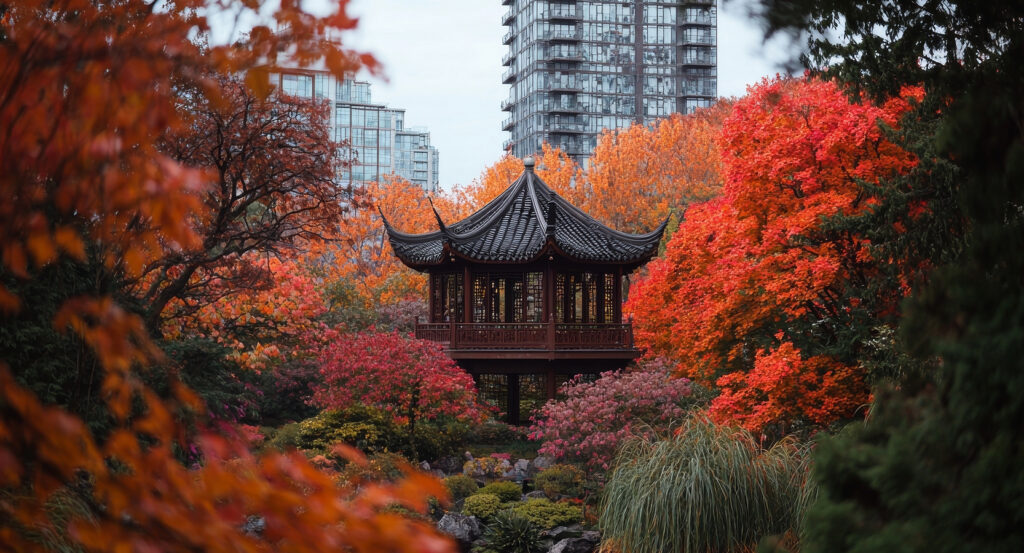
It's not just a garden; it's a living poem, a place where balance, beauty, and intention converge in every line and reflection. Built in the mid-1980s as the first full-scale classical Chinese garden constructed outside China, it was crafted entirely using traditional methods, no nails, no screws, no glue, just interlocking wood, hand-carved stone, and human harmony. Here, geometry bends to nature's rhythm. Covered walkways twist around jade-colored ponds, koi glide beneath moon bridges, and the delicate scent of magnolia drifts through the air. The garden isn't designed to be seen in one glance but rather felt in layers, a metaphor for life itself. Every element, from the placement of rocks to the curves of rooftiles, carries symbolic meaning: strength in the mountain stones, grace in the water's reflection, renewal in the bamboo's gentle sway. It's a masterpiece of Ming Dynasty design recreated with painstaking authenticity, a discussion between ancient Chinese aesthetics and the multicultural heartbeat of modern Vancouver. Whether you visit in spring under cherry blossoms or in winter mist when reflections turn dreamlike, Dr. Sun Yat-Sen Classical Chinese Garden feels less like a tourist attraction and more like an awakening.
What defines Dr. Sun Yat-Sen Classical Chinese Garden.
The garden is as much a cultural ambassador as it is an architectural wonder, born from collaboration, craftsmanship, and a shared vision between two cities separated by an ocean.
In 1986, Vancouver partnered with its sister city, Suzhou - China's renowned “City of Gardens”, to commemorate Expo 86 and to symbolize the enduring friendship between East and West. Fifty-two master artisans from Suzhou were brought to Vancouver, where they spent over a year constructing the garden entirely by hand using traditional materials sourced from China. Limestone boulders from Lake Tai, clay roof tiles, and intricately latticed windows were shipped across the Pacific to ensure complete authenticity. The result was not just a garden but a cultural milestone, the first of its kind built outside China in the traditional Ming style. Named after Dr. Sun Yat-Sen, the revolutionary leader known as the “Father of Modern China,” the garden was intended to embody his ideals of harmony, unity, and renewal. The design follows the Taoist principles of yin and yang, where every element finds its counterpart: rock and water, solid and fluid, dark and light. Even the asymmetry is intentional, reminding visitors that perfection lies in balance, not symmetry. Few realize that beneath its tranquil beauty lies an intricate irrigation and drainage system that sustains the ponds and plants year-round, as well as a layout that mirrors classical Chinese cosmology, positioning the garden's features to align with the natural flow of qi, or energy. Over time, the garden has become a sanctuary for reflection, education, and cultural exchange. It hosts festivals for Lunar New Year and Mid-Autumn, as well as tai chi classes, poetry readings, and tea ceremonies that keep its spirit alive. Within its walls, visitors aren't just surrounded by history, they become part of a centuries-old discussion between humanity and nature.
How Dr. Sun Yat-Sen Classical Chinese Garden fits.
A visit to Dr. Sun Yat-Sen Classical Chinese Garden isn't about sightseeing, it's about slowing down and letting stillness speak.
Start the visit early in the morning, before the hum of the city fully wakes, when the light falls softly across the jade pond and the koi swim lazily through their mirrored world. As you pass through the moon gate, pause, that circular frame isn't just an entryway but a symbol of wholeness and harmony. Walk the zigzag bridge that cuts across the water, designed to slow your pace and sharpen your awareness. Listen to the sounds: the ripple of fountains, the rustle of bamboo, the echo of your own footsteps against stone. These physical details are intentional, each meant to heighten mindfulness and evoke tranquility. Spend time in the Scholar's Study, where intricate wood carvings and calligraphy scrolls reflect the intellectual heart of Ming-era culture. Step into the Courtyard of Tranquility, where perfectly placed rocks rise like miniature mountains above still water, their reflections completing the landscape below. After exploring the main garden, linger in the public park next door, a more contemporary extension that maintains the same reverent tone while inviting casual visitors to rest beneath willows or feed the koi. If you're visiting in spring, the garden glows with blossoms; in autumn, it's gilded in gold. Join one of the guided tours led by local experts, they reveal stories hidden in the architecture, from the symbolism of the lattice windows to the philosophy behind each pavilion's placement. Don't rush to leave, the magic of the garden unfolds slowly, often in moments you don't expect. When you step back through the gate and into Chinatown's thriving streets, you'll notice something subtle: the world feels louder, brighter, but also somehow softer. Dr. Sun Yat-Sen Classical Chinese Garden leaves you with a rare stillness, a sense that peace isn't something you find, but something you cultivate. And in a city defined by its meeting of worlds, this garden remains one of Vancouver's most eloquent reminders that true harmony is both ancient and eternal.
Where your story begins.
Foresyte Travel reveals places that feel extraordinary long before you arrive.
Enjoy editorial crafted for luxury travelers.
Foresyte may earn a commission when you book.