Why you should experience The Circular Crypt at Dôme des Invalides in Paris, France.
The circular crypt beneath the Dôme des Invalides is not merely an architectural feature, it is a stage where reverence and performance converge.
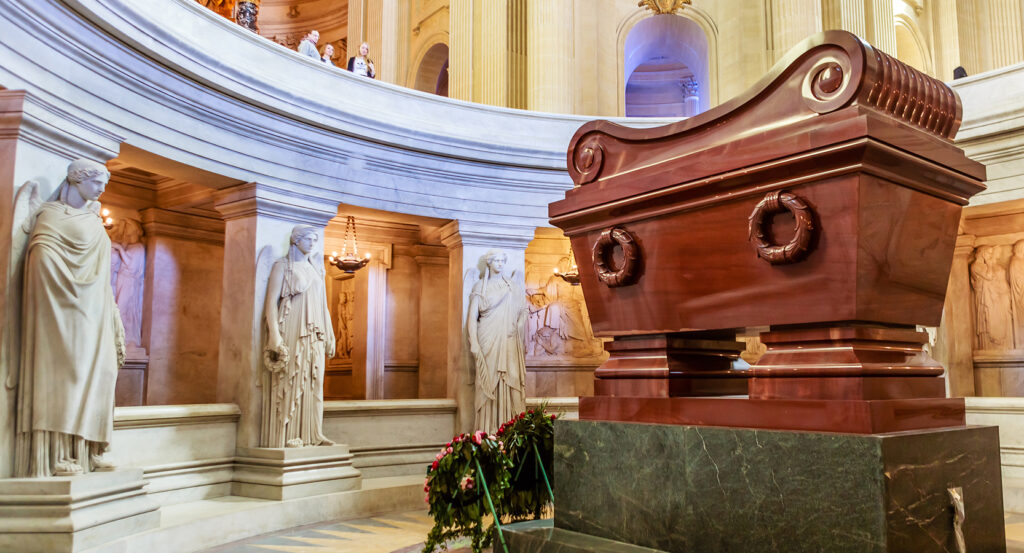
Descending into this marble sanctum feels like crossing the threshold from history into mythology. The rotunda unfurls in concentric perfection, its polished stone reflecting the glow of filtered light from above. The air is still, the acoustics hushed, and every whisper of a shoe's sole seems amplified against eternity. The design intentionally compels visitors to look downward upon Napoleon's sarcophagus, creating a paradox of perspective, one must bow, physically and metaphorically, before the emperor who once stood above all. Twelve marble statues representing his greatest victories encircle the space, their sculpted drapery and stoic faces radiating quiet authority. The crypt's symmetry evokes both divine order and imperial control, every line and curve drawing the eye inward, toward the red quartzite coffin at its center, the gravitational core of French ambition, legacy, and loss.
What you should know about the Circular Crypt.
What many don't realize is that the crypt's circular design was born from more than aesthetic genius, it was a deliberate exercise in ideology.
Architect Louis Visconti crafted the chamber to symbolize eternal continuity, both of France and of Napoleon's myth. The twelve goddess-like figures carved around the tomb represent the Emperor's military triumphs, but also the cyclical nature of glory, victories that, though immortalized in marble, inevitably fade with time. The decision to position the tomb below ground level was controversial in its day; some saw it as a gesture of humility, while others interpreted it as a symbolic act of submission by the state before its most formidable ruler. Even the oculus above was engineered to align sunlight with the sarcophagus at specific times of day, a cosmic coronation repeated endlessly through time. The crypt's geometry, its alignment, its use of light and shadow, all conspire to remind the viewer that Napoleon's empire, though fallen, still commands order in the language of architecture.
How to fold the Circular Crypt into your trip.
To fold the circular crypt into your Paris journey, carve out a quiet hour and treat it as an encounter, not an attraction.
Arrive in the late morning, when the dome's golden rays filter through the oculus and trace the edge of the tomb with light that feels almost sacred. As you descend, pause at each level, absorb how the echo of footsteps softens as you reach the heart of the rotunda. This is not a place to rush through or photograph hastily; it rewards those who linger, who read the inscriptions around the perimeter, who feel the coolness of the marble under their hand. When you ascend again into daylight, the transition feels cinematic, the return from empire to republic, from myth to modernity. Pair your visit with a stroll across the Esplanade des Invalides or an hour in the Musée de l'Armée above; only then does the crypt's stillness reveal its full dimension, a memorial not just to Napoleon, but to France's eternal romance with grandeur.
Where your story begins.
Start your planning journey with Foresyte Travel.
Experience immersive stories crafted for luxury travelers.