Why La Petite Cachée matters.
La Petite Cachée is an established French-inspired restaurant where Mont-Tremblant's mountain hospitality culture meets Laurentian culinary traditions, chalet architecture and a restaurant whose evolution connects regional cooking with the entrepreneurial career of Julie Zyromski.
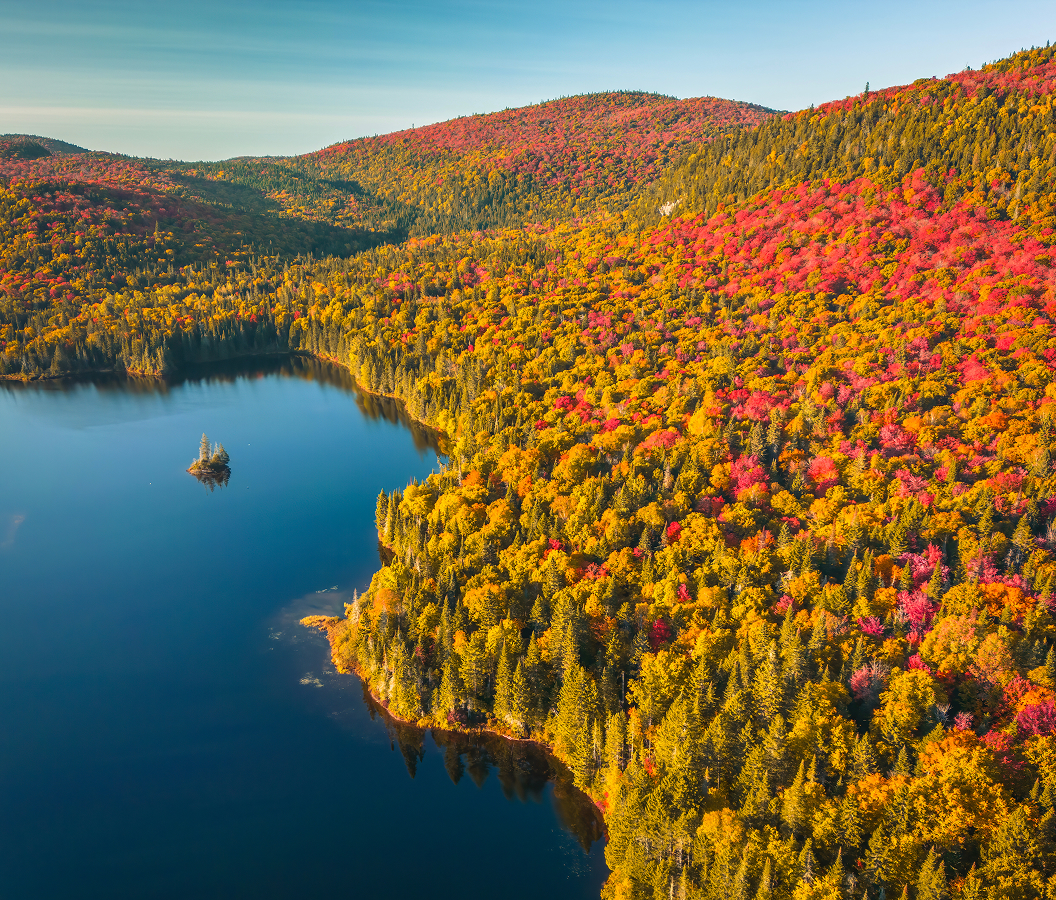
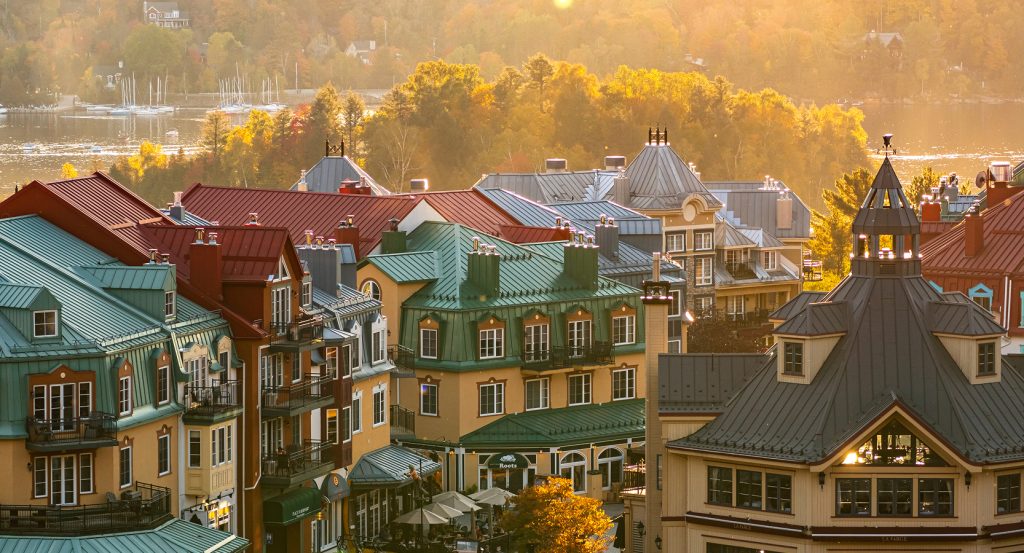
Set along Chemin du Village between the Old Village and Mont-Tremblant's resort district, La Petite Cachée occupies a wooded hillside near Lac Tremblant, with Lac Mercier to the southwest, Chemin de la Chapelle approaching the mountain and the Laurentian peaks rising beyond the surrounding forest. The restaurant inhabits a timber chalet whose substantial log construction, sloping roof and elevated position preserve the architectural character of Quebec's mountain retreats. Inside, exposed beams, natural wood surfaces and a central fireplace establish a dining room whose broad windows frame the surrounding wooded slopes. A terrace extends the restaurant toward the mountain landscape, complementing French-inspired cooking built around seasonal Laurentian ingredients, carefully prepared meats and an extensive selection of wines. The result is a mountain restaurant whose timber architecture, wooded surroundings and regional culinary direction connect the dining traditions of Quebec with the established hospitality culture of Mont-Tremblant.
What defines La Petite Cachée.
La Petite Cachée is best known for evolving from a longstanding Laurentian chalet restaurant into a renewed French-inspired dining destination shaped by chef, cookbook author and entrepreneur Julie Zyromski. The restaurant developed a substantial following through its combination of Mediterranean-influenced cooking, seasonal Quebec ingredients and an intimate dining room overlooking the mountains. An earlier culinary chapter centered on chef Bruno Théberge-Krivak, whose kitchen combined fresh pasta, seafood, grilled meats and wood-fired preparations with changing seasonal selections. By 2020, chef Michael Petit had assumed kitchen leadership, continuing the restaurant's established culinary operation through another period of its development. A consequential ownership transition followed when Julie Zyromski acquired La Petite Cachée 2022, bringing an unusually varied professional background to the Laurentian restaurant. Zyromski had studied at Montreal's Institut de tourisme et d'hôtellerie du Québec before completing a master's degree at the University of Gastronomic Sciences in Italy, developing her understanding of food through formal culinary training and international education. Her entrepreneurial career subsequently brought her into the founding team of Oatbox, the Quebec breakfast-food company whose subscription business developed into a broader consumer-food enterprise. Zyromski served as its culinary director, combining recipe development and food styling with the creative responsibilities of an expanding food business. Her work also extended into publishing through Saisons, La Table Végane, a cookbook exploring plant-based preparations and seasonal ingredients. After selling her interest in Oatbox, Zyromski returned to Mont-Tremblant and devoted her attention to La Petite Cachée, spending her first year examining the restaurant's established practices before undertaking a substantial renewal. The transformation brought renovations to the chalet interior and the development of a new culinary team, preserving the restaurant's established French character through changes in its presentation and kitchen leadership. Chef Roberto Rodriguez subsequently introduced his interpretation of French bistro cooking, maintaining preparations such as steak frites, rack of lamb and foie gras alongside seasonal dishes reflecting the availability of regional ingredients. The restaurant developed a twice-yearly menu cycle, connecting those established preparations with changing Laurentian produce and a wine selection emphasizing private imports. Zyromski's wider culinary career entered another chapter in September 2024 when Parfum d'encre published her cookbook Samedi, developed with photographer Patricia Brochu around twenty complete menus for entertaining. The book received a Canadian distinction at the 2024 Gourmand Awards and became a finalist for a Taste Canada Award in 2025, extending her culinary work into nationally recognized publishing. Her involvement with Vins Zyromski, an experimental greenhouse vineyard in the Laurentians, further connected her professional interests with the agricultural possibilities of Quebec's northern climate. La Petite Cachée's development unites an established mountain restaurant, successive generations of kitchen leadership and an owner whose work across culinary education, entrepreneurship, publishing and regional agriculture has shaped its renewed direction.
How La Petite Cachée fits.
La Petite Cachée works as the evening destination for a Mont-Tremblant exploration connecting the Laurentians' conservation history, international motorsport heritage and the religious architecture developed during the mountain's emergence as a Canadian ski destination.
Begin at Domaine Saint-Bernard, the protected Laurentian landscape whose transformation from private agricultural land into a conservation territory unfolded across the twentieth century. Paul-Émile Raynaud acquired the former Crown land in 1913, and the property later supported the Onontio Inn enterprise before the Brothers of Christian Instruction purchased it in December 1951. The congregation developed the grounds as a retreat and educational property, with Brother Herman Deshaies directing an expanding trail network that eventually supported the region's growing cross-country skiing community. The Brothers planted 130,000 trees, extending the property's environmental development through decades of forest restoration. Mont-Tremblant acquired the land in December 1999, and a public-interest trust created in November 2000 secured 1,500 acres for permanent conservation. Continue to Circuit Mont-Tremblant, the racing circuit whose development introduced international motorsport into the Laurentian mountains during the 1960s. The original course hosted its first event on August 3, 1964, when Canadian driver Ludwig Heimrath won the principal race in a Cooper-Ford. An extension completed in 1965 established the 4.26-kilometer configuration, and John Surtees won an early event driving a Lola T70 Chevrolet. The circuit subsequently hosted the Canadian Formula One Grand Prix in 1968 and 1970, with Denny Hulme winning the first race after Chris Amon retired from the lead. Mario Andretti dominated the circuit's IndyCar events during 1967 and 1968, strengthening its international reputation. Lawrence Stroll acquired the property in 1999 and directed a substantial modernization, extending the racing circuit's significance into another generation of Canadian motorsport. Conclude at Chapelle Saint-Bernard, the wooden Catholic chapel commissioned by Joseph Bondurant Ryan's family during the early development of Mont-Tremblant as an international ski resort. Ryan established the ski destination in 1938 and opened its first hotel the following year, developing a mountain village whose architecture drew inspiration from Quebec's traditional settlements. Constructed between 1941 and 1942, the chapel incorporated a steeply pitched roof, modest bell tower and architectural references to eighteenth-century parish churches on Île d'Orléans. Sunday services became closely associated with the ski community, with priests blessing assembled skiers in French and English. Ryan's widow donated the chapel to the Sacré-Coeur-de-Jésus parish in 1965, and Mont-Tremblant granted the building protected heritage status in July 1988. The progression moves from the Brothers of Christian Instruction's conservation work through the international racing history of Circuit Mont-Tremblant into the Ryan family's mountain chapel, connecting environmental stewardship, sporting ambition and religious architecture across the development of the Laurentians.
Where your story begins.
Foresyte Travel reveals places that feel extraordinary long before you arrive.
Enjoy editorial crafted for luxury travelers.