Why Lawrence Avenue matters.
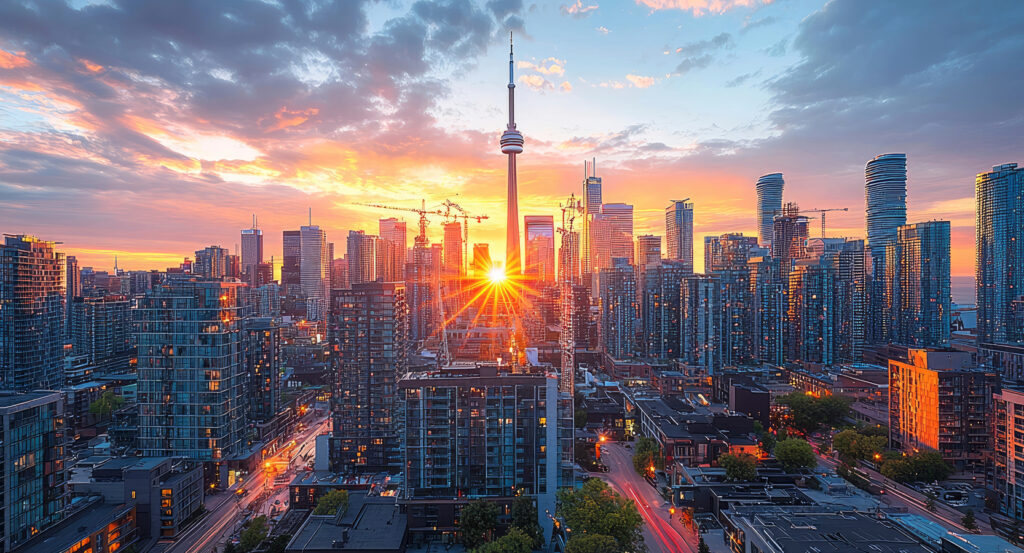
Lawrence Avenue is an enterprising corridor where Lawrence Park's suburban vision, transportation history, institutional legacy, and metropolitan evolution define one of Toronto's most significant cross-city thoroughfares.
Running through Lawrence Park between Bedford Park and Bridle Path-Sunnybrook-York Mills, the corridor connects early garden suburbs, major civic institutions, postwar commercial centres, and long-established residential districts that collectively demonstrate Toronto's northward expansion beyond its original urban core. Successive stretches reveal how railway access, planned suburban development, arterial transportation, and continued public investment transformed a rural concession road into one of the city's principal east-west avenues. Throughout the corridor, historic neighbourhoods, cultural institutions, and employment centres remain closely intertwined, creating an avenue that reflects more than a century of metropolitan growth. The result is an experience defined by continuity, ambition, and one of Toronto's most historically influential corridors.
What defines Lawrence Avenue.
Lawrence Avenue is best known for following the alignment of Concession Road 3, surveyed during the closing years of the eighteenth century as part of the township grid established across York Township north of the original Town of York. The avenue takes its name from the nearby Village of Lawrence, a crossroads settlement established during the 1840s around the intersection of present-day Yonge Street and Lawrence Avenue and named after the influential Lawrence family, whose hotel, general store, and agricultural enterprises served travellers moving between York and communities farther north. Transformation of the corridor accelerated after the Toronto and York Radial Railway extended electric interurban service along nearby Yonge Street in 1897, encouraging suburban subdivision beyond the city limits, while the Dovercourt Land Building and Savings Company formally introduced Lawrence Park in 1907 as Canada's first planned garden suburb. Construction of Highway 401 immediately north of the avenue during the 1950s, together with completion of the Yonge subway's Lawrence Station in 1954, permanently reinforced Lawrence Avenue as one of metropolitan Toronto's principal east-west transportation corridors linking emerging residential districts with the city's growing commercial and institutional centres. Together, these surveying, transportation, planning, and suburban development milestones established Lawrence Avenue among Toronto's defining historic arteries.
Expansion beyond Yonge Street introduced nationally significant institutions whose development reflected the corridor's growing metropolitan importance, including Sunnybrook Hospital, established in 1948 on the former Kilgour Estate through the estate bequeathed by businessman Joseph Kilgour, and Yorkdale Shopping Centre, which opened in 1964 as the largest enclosed shopping centre in Canada at the time with 1.2 million square feet of retail space. Continued widening projects undertaken by Metropolitan Toronto during the postwar decades transformed Lawrence Avenue into a major arterial road while preserving key residential districts that had developed during its earlier suburban era. Heritage conservation within Lawrence Park Heritage Conservation District continues protecting early twentieth-century streetscapes, landscape planning, and residential architecture that distinguish the corridor from later suburban development. Collectively, these institutional investments, transportation improvements, and preservation initiatives demonstrate how Lawrence Avenue evolved from a nineteenth-century concession road into one of Toronto's most influential metropolitan corridors.
How Lawrence Avenue fits.
Lawrence Avenue works as an exploration of Toronto's suburban planning, civic institutions, and architectural legacy.
Begin at Alexander Muir Memorial Gardens, where formal gardens, mature trees, and commemorative landscapes introduce the planning ideals that helped shape Lawrence Park's early residential identity. Continue to Lawrence Station, whose role on Toronto's original Yonge subway demonstrates the transportation investments that accelerated postwar growth while reinforcing the avenue's importance within the metropolitan network. Conclude at Edwards Gardens, where the restored estate landscape and Toronto Botanical Garden provide the historical culmination by illustrating how former private country estates evolved into treasured public landscapes along the Lawrence Avenue corridor. Together, the sequence progresses from planned suburb to metropolitan transit before culminating in preserved landscape heritage, revealing why Lawrence Avenue remains one of Toronto's defining east-west corridors.
Where your story begins.
Foresyte Travel reveals places that feel extraordinary long before you arrive.
Enjoy editorial crafted for luxury travelers.
Foresyte may earn a commission when you book.