
Why Le Club Chasse et Pêche matters.
Le Club Chasse et Pêche is a distinguished French-Canadian fine-dining restaurant where Old Montréal's colonial architectural heritage meets Claude Pelletier's contemporary cuisine bourgeoise, Hubert Marsolais's hospitality entrepreneurship and an influential interpretation of Québec's hunting and fishing traditions.
Positioned along Saint-Claude Street immediately east of Montréal City Hall, the restaurant occupies a discreet historic building between Château Ramezay, the nineteenth-century commercial streets surrounding Place Jacques-Cartier and the waterfront architecture of the Old Port. Its understated entrance leads into a series of intimate dining spaces distinguished by substantial stone walls, exposed timber beams and subdued lighting. Deep leather armchairs, dark furnishings and carefully arranged tables establish the atmosphere of a private dining club, with the building's historic masonry contributing warmth and architectural character. A separate bar-lounge incorporates a vintage counter dating to 1965, extending the restaurant's hospitality into a more informal setting. Contemporary photographic works by Nicolas Baier and distinctive animal-inspired lighting fixtures introduce an artistic dimension that complements the restaurant's traditional materials. The result is a carefully composed dining environment whose historic architecture, contemporary design and restrained atmosphere establish one of Old Montréal's most distinctive restaurant interiors.
What defines Le Club Chasse et Pêche.
Le Club Chasse et Pêche is best known for the partnership between chef Claude Pelletier and restaurateur Hubert Marsolais, whose collaboration helped reshape Montréal's fine-dining culture during the early twenty-first century. Pelletier established his professional reputation at Cube, the restaurant he operated between 2000 and 2004, developing a contemporary approach to French cooking that attracted considerable attention within Québec's restaurant industry. His culinary philosophy emphasized precise technique, exceptional ingredients and the richness of traditional French bourgeois cuisine. Marsolais brought complementary expertise in hospitality, service and the creation of distinctive restaurant environments. Their partnership culminated in the opening of Le Club Chasse et Pêche on December 31, 2004, within premises previously occupied by the French restaurant Le Fadeau. The new establishment introduced a deliberately discreet identity, using the language of private hunting and fishing clubs to create an intimate setting for sophisticated contemporary dining. Its opening coincided with a broader transformation of Montréal's restaurant culture, as ambitious independent establishments developed increasingly informal interpretations of traditional fine dining. Pelletier and Marsolais commissioned designer Bruno Braën to develop the interior, collaborating with Antoine Laverdière on distinctive lighting and decorative elements. Braën's design combined the building's historic architectural character with contemporary furnishings, creating a setting that established a recognizable character for the new restaurant. Laverdière contributed animal-inspired lighting fixtures that reinforced the establishment's hunting-and-fishing theme through contemporary design. The partners also incorporated photographs by Montréal artist Nicolas Baier, connecting the restaurant with the city's contemporary visual arts community. Its dining spaces were organized around a principal room and an adjoining lounge, creating distinct environments within a unified architectural composition. The restaurant quickly developed a national reputation, earning recognition among Canada's best new restaurants in Air Canada's enRoute awards in 2005. Its success strengthened Pelletier's standing among Québec's leading chefs and established Marsolais as an influential figure in Montréal hospitality. Their partnership subsequently expanded through Le Filet, which opened in 2011 and developed a complementary culinary character centered on seafood. The opening of Le Serpent in 2013 extended the group's influence into Montréal's contemporary Italian restaurant culture, connecting the original partnership with the redevelopment of the former Darling Foundry industrial complex. These establishments demonstrated the partners' ability to create restaurants with distinct culinary identities and architectural settings. Le Club Chasse et Pêche also became an important professional environment for successive generations of kitchen and hospitality staff, contributing to the transmission of contemporary French culinary techniques within Montréal. Chef Olivier Larocque subsequently assumed responsibility for the daily kitchen program, working alongside Pelletier to maintain the restaurant's established culinary direction. The contemporary leadership team includes dining-room director Helen Karagiannakis and sommelier Joris Gutierrez Garcia, who won the title of Canada's Best Sommelier in 2023. Garcia's appointment strengthened an already substantial wine program, extending the restaurant's reputation for sophisticated pairings and cellar management. The establishment also earned recognition in the MICHELIN Guide's inaugural Québec selection in 2025, consolidating its position among Montréal's established fine-dining institutions. Its historical significance rests on the sustained collaboration between Pelletier and Marsolais, whose combination of culinary ambition, distinctive design and professional hospitality established a restaurant that helped define a generation of contemporary Montréal dining.
Claude Pelletier's culinary philosophy develops through French cuisine bourgeoise, combining substantial sauces, carefully selected proteins and seasonal ingredients within compositions distinguished by technical precision. His approach places particular importance on the relationship between land and sea, reflecting the restaurant's hunting-and-fishing character through preparations that incorporate seafood, poultry, game and carefully prepared meats. The kitchen's signature risotto with braised suckling pig and foie gras provides a representative expression of this philosophy, combining the richness of slow-cooked pork with the delicate texture of rice and the concentrated flavor of foie gras. The preparation develops its character through controlled cooking and the integration of substantial ingredients into a balanced composition. Sweetbreads contribute another important expression of classical French technique, prepared with cauliflower, almonds, brown butter and grenobloise accompaniments that introduce contrasting textures and acidity. Their preparation reflects the restaurant's commitment to traditional ingredients whose successful execution depends upon precise handling and careful temperature control. Confit trout introduces a complementary approach to seafood, using gentle cooking to preserve the fish's delicate texture and natural richness. Accompaniments of rösti, sour cream, maple and dill connect European culinary techniques with ingredients and flavors associated with Québec. The restaurant's interpretation of suckling pig belly and scallops develops its characteristic relationship between meat and seafood through a preparation incorporating grilled rice, enoki mushrooms and ponzu. Its contrasting ingredients demonstrate the kitchen's ability to integrate selected international influences into a fundamentally French culinary structure. Seasonal changes introduce additional preparations centered on carefully selected fish, duck and beef, with sauces providing the principal connection between individual ingredients and the broader culinary philosophy. The wine program contributes an equally important dimension through a cellar containing more than 500 selections from established international producers. Joris Gutierrez Garcia's approach emphasizes the relationship between wine structure, acidity and the richness of classical French sauces, supporting pairings across the restaurant's contrasting seafood and meat preparations. The professional service team maintains the measured hospitality associated with formal dining, preserving the restaurant's intimate character through attentive timing and informed presentation. Le Club Chasse et Pêche's culinary distinction emerges from this sustained integration of French technique, Québec ingredients and sophisticated wine service, establishing a recognizable approach to contemporary cuisine bourgeoise.
How Le Club Chasse et Pêche fits.
Le Club Chasse et Pêche works as the dining culmination of an exploration connecting Montréal's French colonial government, nineteenth-century commercial expansion and the architectural development of the city's historic waterfront, placing the restaurant within the institutions that shaped the political and economic history of Old Montréal.
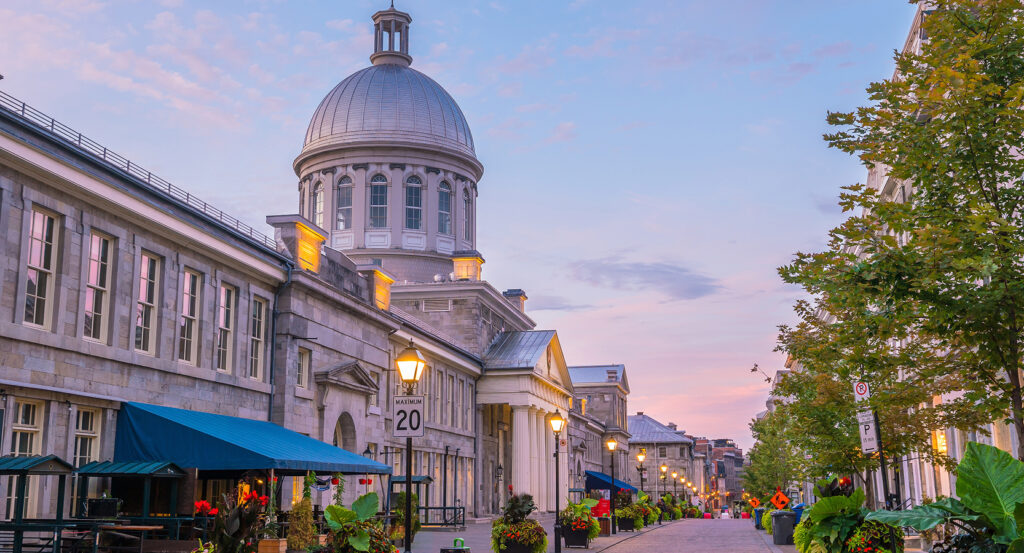
Begin at Château Ramezay, the historic residence commissioned by Montréal governor Claude de Ramezay in 1705 and completed the following year. Designed by master mason Pierre Couturier, the substantial stone residence reflected the governor's political position within the fortified colonial settlement. The property subsequently entered the ownership of the French West India Company, which undertook major alterations in 1756 under the direction of Paul Tessier dit Lavigne. During the American invasion of 1775-1776, the building accommodated military officers associated with the Continental Army, connecting the residence with an important episode in the history of the American Revolution. The Antiquarian and Numismatic Society of Montréal established its museum within the property in 1895, preserving the building as a major institution devoted to the city's historical development. Continue to Bonsecours Market, the expansive Neoclassical building constructed between 1844 and 1847 under architect William Footner. Its long symmetrical facade, prominent central dome and classical architectural details reflected Montréal's growing commercial importance during the nineteenth century. The building briefly accommodated the Parliament of the Province of Canada in 1849 and served as Montréal's city hall from 1852 until 1878. Architect George Browne subsequently contributed to its interior development, including the addition of public assembly and concert facilities. The market remained an important center of urban commerce for more than a century, preserving a substantial architectural record of Montréal's development into a major Canadian metropolis. Conclude at Sir George-Étienne Cartier National Historic Site, the preserved nineteenth-century residences associated with one of the principal architects of Canadian Confederation. Constructed during the late 1830s, the adjoining houses accommodated Cartier during two periods of his political career, from 1848 to 1855 and from 1862 to 1872. Cartier played a decisive role in the negotiations leading to Confederation in 1867, advocating for a federal structure that protected the political and cultural interests of French-speaking Canadians. The residences preserve important elements of Montréal's nineteenth-century domestic architecture and the material culture associated with its emerging professional and political classes. Their location near the eastern boundary of Old Montréal connects the city's colonial streetscape with the political developments that shaped modern Canada. The progression connects Montréal's French colonial administration with its nineteenth-century commercial expansion and concludes at the residence of a central figure in Canadian Confederation, establishing the historical setting surrounding Le Club Chasse et Pêche.
Where your story begins.
Foresyte Travel reveals places that feel extraordinary long before you arrive.
Enjoy editorial crafted for luxury travelers.
Foresyte may earn a commission when you book.























































































































