
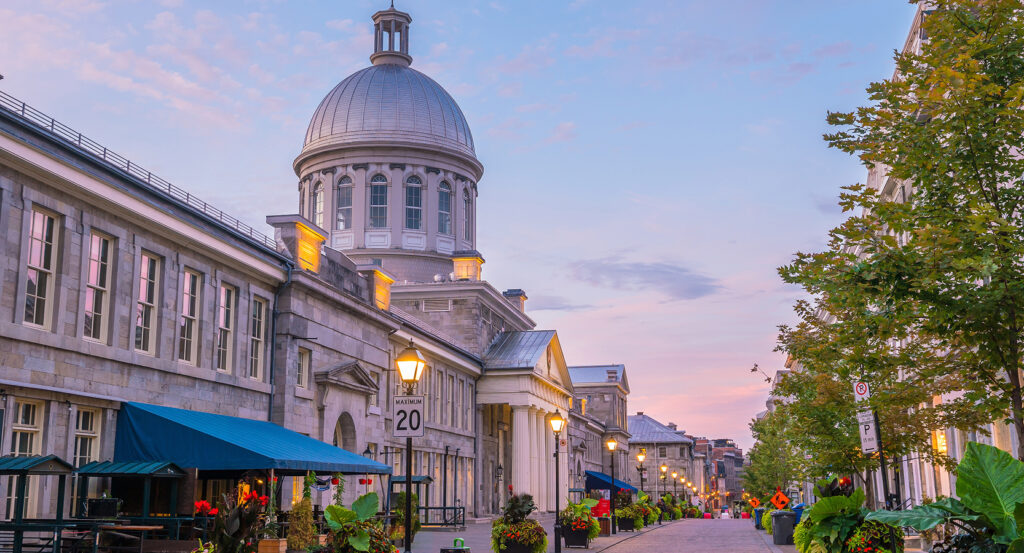
Why Old Montréal matters.
Old Montréal is a historic waterfront enclave where Montréal's French colonial origins meet the commercial ambitions of British North America, the architectural inheritance of nineteenth-century finance and the urban institutions that shaped Canada's largest city for much of its history.
Positioned between the St. Lawrence River and the southern edge of downtown, the historic district occupies the original colonial settlement surrounding Place d'Armes and Place Jacques-Cartier, where narrow streets, limestone commercial buildings and former mercantile properties extend toward the harbor beneath Montréal's modern skyline. Rue Saint-Paul follows one of the city's oldest commercial routes through a closely built streetscape of shops, galleries and restaurants. Substantial stone warehouses and former financial institutions preserve the scale of the nineteenth-century port economy. Public squares interrupt the compact street network, connecting religious architecture with civic buildings and former trading establishments. The result is an exceptionally layered urban district where French settlement, British mercantile expansion and modern cultural preservation remain visible within the same historic streets.
What defines Old Montréal.
Old Montréal is best known for preserving the original urban nucleus of Ville-Marie, the French colonial settlement founded in 1642 that developed into one of North America's principal commercial and financial centers. Paul de Chomedey de Maisonneuve and Jeanne Mance arrived with a group of settlers associated with the Société Notre-Dame de Montréal, establishing a missionary community on the island's southern shore. The settlement occupied territory long inhabited and traversed by Indigenous peoples, including the Haudenosaunee, whose earlier village of Hochelaga had been visited by Jacques Cartier in 1535. Ville-Marie developed around religious institutions, agricultural activity and the exchange of goods along the St. Lawrence. The Sulpicians assumed an influential role in the colony's religious and landholding affairs during the seventeenth century. Montréal subsequently became a major center of the North American fur trade, connecting European merchants with Indigenous trading networks extending deep into the continent. British forces occupied the city in 1760 during the Seven Years' War, initiating a political transition formalized through the Treaty of Paris in 1763. British merchants expanded commercial operations along the waterfront, strengthening the city's connections with Atlantic trade. The opening of the Lachine Canal in 1825 facilitated navigation around the Lachine Rapids and contributed to Montréal's industrial and commercial growth. The Bank of Montreal, founded in 1817, became an important financial institution within the expanding mercantile economy. Montréal served as the capital of the Province of Canada between 1844 and 1849, bringing parliamentary government into the historic city center. The construction of substantial stone warehouses, commercial offices and banking halls during the nineteenth century altered the architectural character of the former colonial settlement. Railway expansion and the development of port facilities strengthened Montréal's position as a transportation and distribution center. Twentieth-century commercial activity gradually shifted toward newer downtown districts, leaving many historic buildings available for adaptation. The designation of Vieux-Montréal as a historic district in 1964 established a structure for protecting its architectural fabric and street pattern. Subsequent restoration projects converted former commercial properties into cultural institutions, residences, hotels and restaurants, preserving the historic center as an inhabited part of the modern city.
Where your story begins.
Foresyte Travel reveals places that feel extraordinary long before you arrive.
Enjoy editorial crafted for luxury travelers.























































































































