Why Rue Saint-Paul, Montréal matters.
Rue Saint-Paul is a storied corridor where Old Montréal's mercantile character meets the city's seventeenth-century origins, nineteenth-century commercial architecture and enduring relationship with the St. Lawrence River.
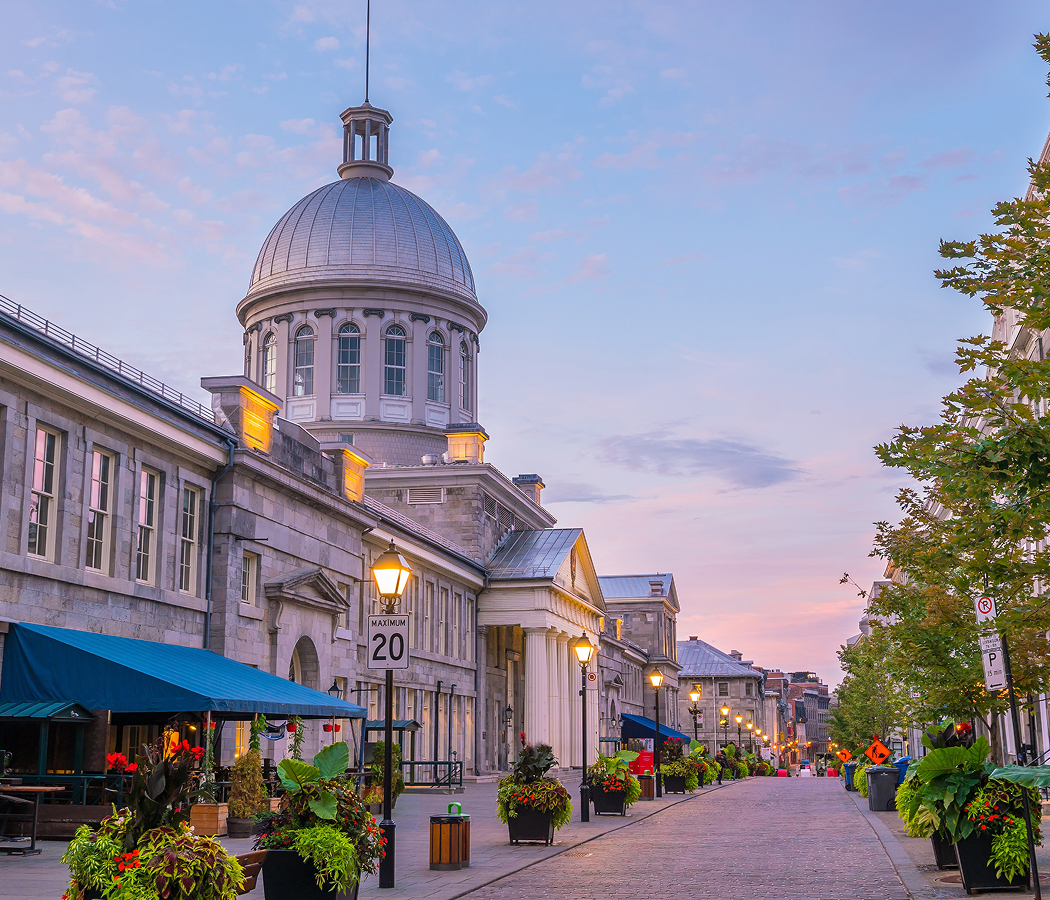
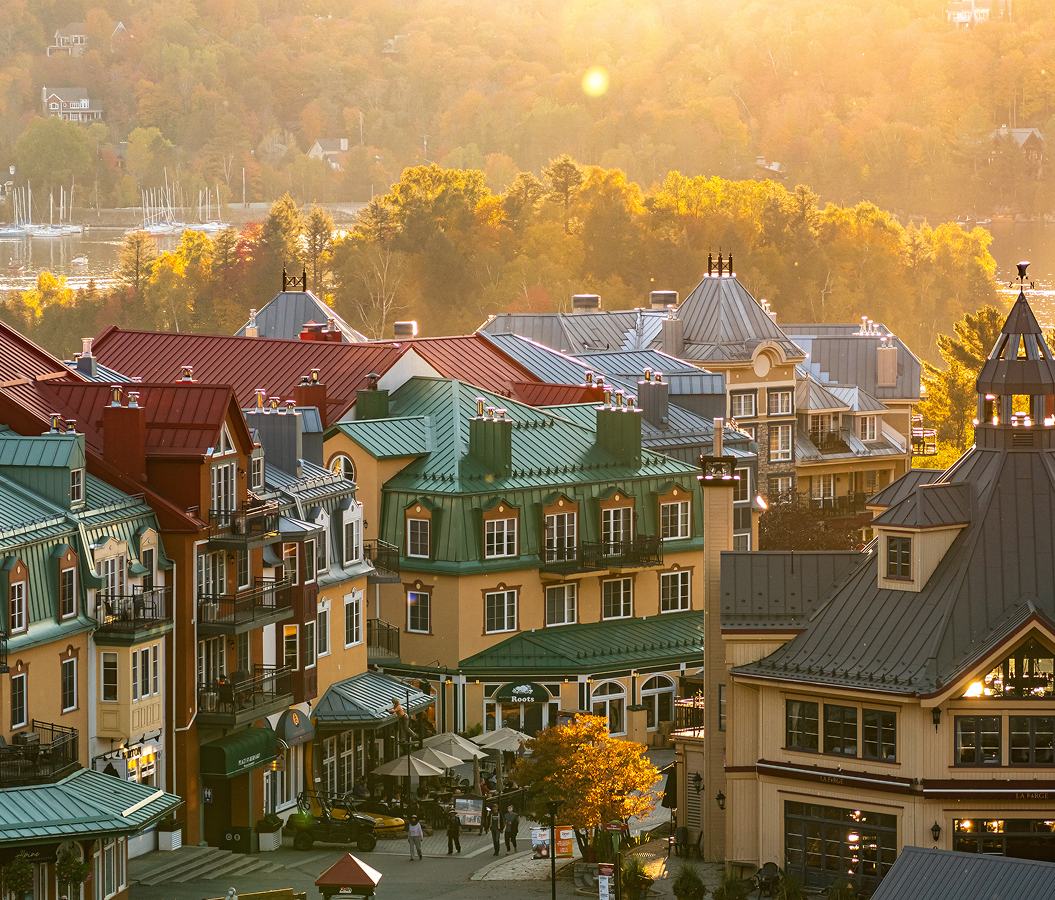
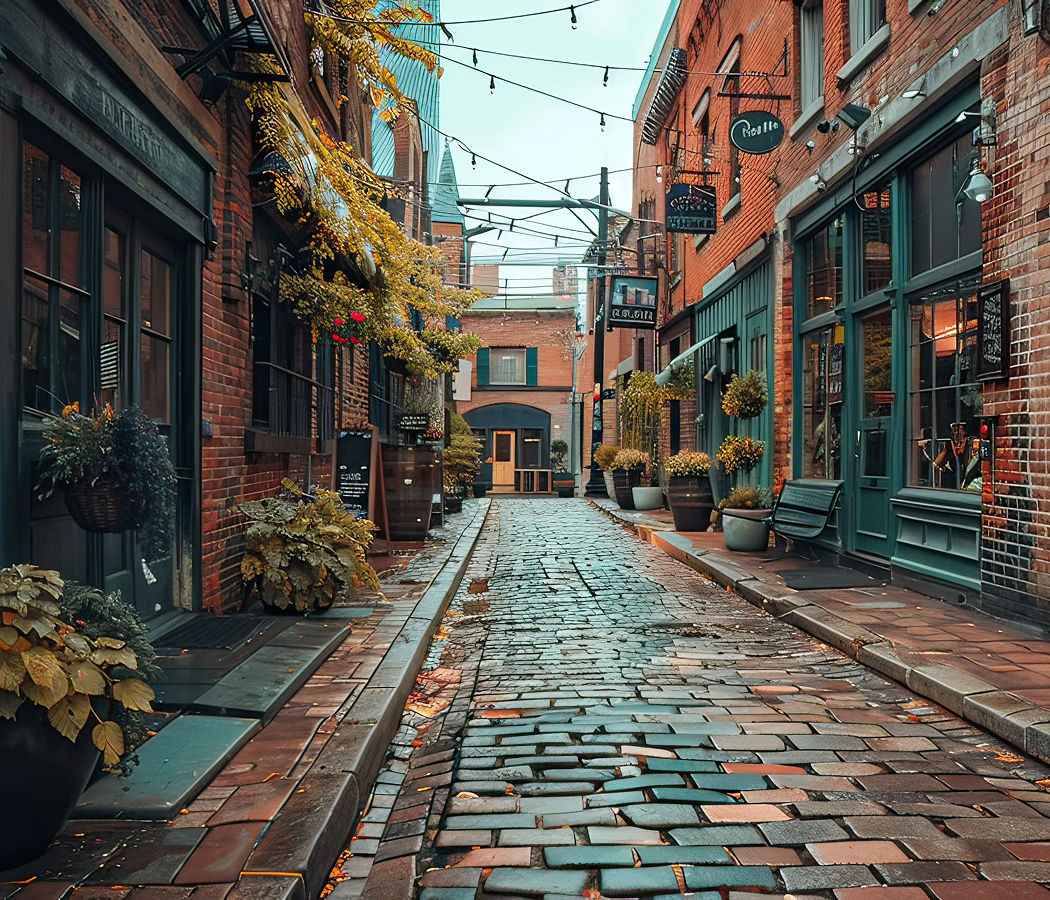
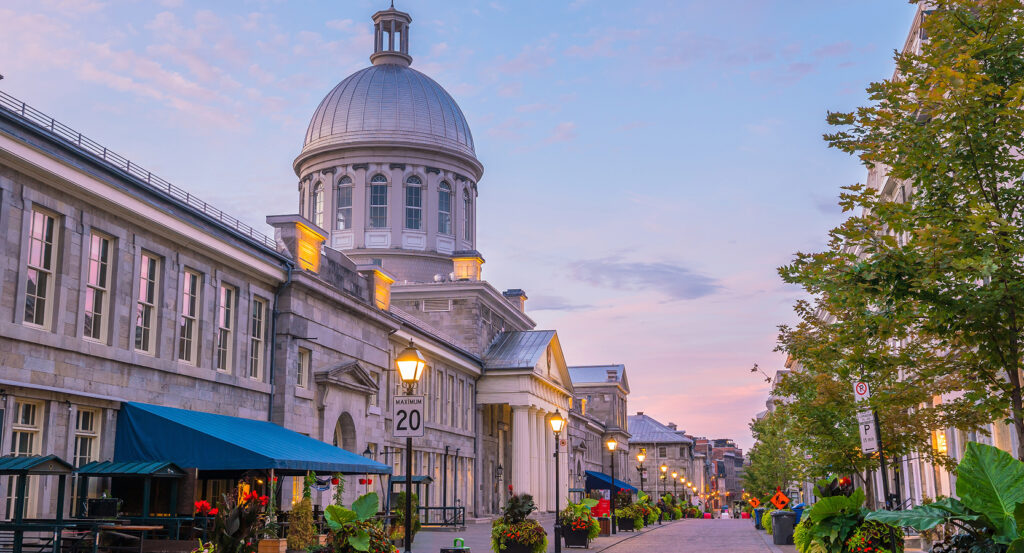
Running through Old Montréal between the western edge of the historic district and the streets approaching the eastern waterfront, the narrow corridor follows an irregular line parallel to the St. Lawrence beneath stone warehouses, former commercial buildings and tightly spaced façades. Cobblestone paving reinforces the unusually intimate scale of sections that remain little changed in width from the historic street pattern. Storefronts, galleries and restaurants occupy masonry buildings whose upper floors preserve the vertical proportions of earlier warehouses and merchant premises. East of Boulevard Saint-Laurent, the street passes broader civic spaces before approaching the old port district beneath the dome and towers that define its eastern skyline. The result is a remarkably continuous urban passage whose changing width, masonry architecture and river-oriented geography preserve the physical structure of Montréal's earliest commercial center.
What defines Rue Saint-Paul.
Rue Saint-Paul is best known for being Montréal's oldest surviving street and the principal commercial artery around which much of the colonial town developed. Its origin lay in an earlier path connecting Paul de Chomedey de Maisonneuve's fort at Pointe-à-Callière with the Hôtel-Dieu and nearby buildings. François Dollier de Casson, superior of the Sulpicians in New France, incorporated that route into his plan for Montréal, and the street received formal boundaries in 1673 at a width of 24 French feet. Its name honored Maisonneuve, Montréal's cofounder and first governor, who had left New France eight years earlier. The street subsequently extended east and west toward the Sainte-Marie and Récollets suburbs, placing it across the growing colonial settlement. Place Royale became its principal commercial focus and remained a market site until 1803. Prestigious buildings followed the merchant activity, including the Intendant's Palace in 1698 and Château de Vaudreuil in 1724. Shops multiplied along the corridor, and Rue Saint-Paul became Montréal's first street illuminated with oil lamps. Its significance endured beyond the French colonial period as nineteenth-century warehouses and commercial buildings increasingly defined the streetscape beside the expanding port.
Printing and journalism gave the corridor another major role as Montréal developed into a publishing center. French-language and English-language printers established operations around the street, producing a dozen political and literary newspapers during a period when the surrounding quarter concentrated merchants, publishers and civic institutions. La Minerve, founded in 1826 and acquired by Ludger Duvernay the following year, became one of the influential French-language newspapers associated with this wider publishing culture. Commercial expansion increasingly linked the street with the port immediately to its south, and nineteenth-century stone buildings accommodated importers, wholesalers and warehouses serving maritime trade. Changing transportation patterns subsequently shifted Montréal's principal business activity north and west, leaving much of the old commercial fabric intact. The historic district received provincial protection during the twentieth century, giving the former mercantile core a new role centered on architectural preservation and cultural use. Galleries, workshops, restaurants and independent shops subsequently occupied former commercial premises along the corridor. Seasonal pedestrianization now removes vehicles from part of Rue Saint-Paul between Rue du Marché-Bonsecours and Boulevard Saint-Laurent from April through October, returning a substantial section of the old commercial artery to movement on foot.
How Rue Saint-Paul fits.
Rue Saint-Paul works as the historical anchor for an outing connecting Montréal's archaeological birthplace, the institutional heart of French Catholic settlement and a nineteenth-century financial district built during the city's emergence as Canada's commercial capital.
Begin at Pointe-à-Callière, where Montréal's founding settlement took shape near the meeting of the St. Lawrence and the former Petite Rivière Saint-Pierre. Paul de Chomedey de Maisonneuve and Jeanne Mance arrived with the Société Notre-Dame de Montréal expedition in May 1642 and established Ville-Marie on the site. Archaeological remains beneath the museum preserve successive layers of occupation, including the first Catholic cemetery created in 1643 and later defensive and commercial structures. The museum itself opened in 1992 during Montréal's 350th anniversary, with Dan Hanganu designing a principal building whose form responds to the historical structures below. Continue to Place d'Armes, whose development concentrates several centuries of Montréal institutions around a single public space. The Sulpicians constructed the Old Seminary beginning in 1684, producing one of the city's oldest surviving buildings. Notre-Dame Basilica followed in the nineteenth century to designs by Irish-American architect James O'Donnell, whose immense Gothic Revival church opened in 1829 and dramatically altered Montréal's skyline. Financial institutions subsequently transformed the square again, with Bank of Montreal establishing its expansive headquarters there in 1847. Conclude at Square Victoria, where nineteenth-century Montréal's commercial expansion pushed the business district beyond the old fortified town. The square received its present name following the 1860 visit of the Prince of Wales and later became surrounded by banks, insurance companies and office buildings serving a rapidly industrializing city. Hector Guimard's original Paris Métro entrance, installed there in 1967 as a gift from the Régie autonome des transports parisiens, added a surviving piece of French Art Nouveau to the modern square. The progression moves from Montréal's seventeenth-century founding ground through the religious and institutional center of the colonial city and culminates in the financial district that accompanied its nineteenth-century commercial expansion, tracing the metropolitan growth that gradually extended outward from Rue Saint-Paul.
Where your story begins.
Foresyte Travel reveals places that feel extraordinary long before you arrive.
Enjoy editorial crafted for luxury travelers.
Foresyte may earn a commission when you book.