Why Mill Street matters.
Mill Street is a storied corridor where Distillery District's industrial heritage, architectural craftsmanship, cultural revival, and entrepreneurial legacy define one of Toronto's most evocative historic streets.
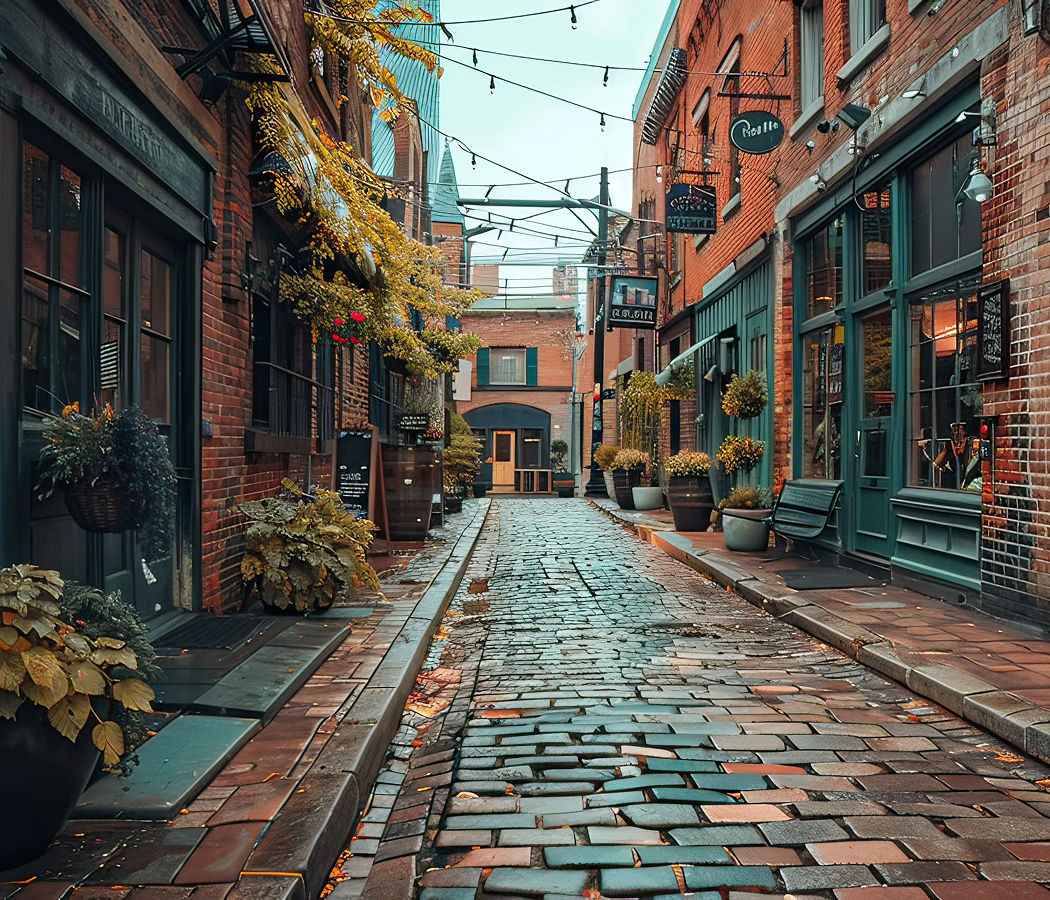
Running through Distillery District between Corktown and the West Don Lands, the corridor threads together Victorian industrial architecture, restored brick streetscapes, former manufacturing complexes, and energetic public spaces that collectively demonstrate Toronto's transformation from colonial trading town to international city. Successive blocks reveal how nineteenth-century industry, preservation, and adaptive reuse reshaped a manufacturing precinct into one of North America's finest heritage districts. Throughout the corridor, preserved industrial buildings, pedestrian streets, and creative enterprise remain closely intertwined, creating a cohesive expression of Toronto's industrial past and cultural present. The result is an experience defined by architectural authenticity, industrial legacy, and one of downtown's most remarkable historic corridors.
What defines Mill Street.
Mill Street is best known for serving as the historic spine of the Gooderham and Worts Distillery, founded in 1832 by James Worts and William Gooderham, which became the largest distillery in the British Empire by the late nineteenth century. Expansion throughout the 1850s, 1860s, and 1870s produced an extraordinary concentration of Victorian industrial buildings constructed in red brick, heavy timber, limestone, and cast iron, establishing one of Canada's most complete collections of nineteenth-century industrial architecture. The corridor supported every stage of whisky production, including grain storage, milling, distillation, cooperage, and distribution, while direct railway access strengthened Toronto's position within national and international trade networks. Mill Street preserves an unparalleled architectural and industrial record of the city's emergence as one of Canada's foremost manufacturing centers.
Construction of the Stone Distillery in 1859, designed by engineer David Roberts Jr., introduced one of Canada's earliest large-scale fire-resistant industrial structures through the extensive use of limestone, brick vaulting, and heavy timber engineering. The district's designation as a National Historic Site of Canada recognized the exceptional survival of more than forty Victorian industrial buildings that collectively document nineteenth-century manufacturing technology, urban planning, and commercial expansion. Comprehensive heritage restoration completed during the early twenty-first century carefully conserved original masonry, timber framing, cobblestone streets, and industrial infrastructure while demonstrating internationally respected standards for adaptive preservation. Together, these engineering achievements, heritage designations, and conservation initiatives demonstrate how Mill Street evolved into one of Canada's most significant industrial heritage corridors.
How Mill Street fits.
Mill Street works as an exploration of Toronto's industrial origins, architectural preservation, and cultural reinvention.
Begin at Parliament Square Park, where the open landscape and proximity to the Town of York's earliest expansion establish the historical context for the industrial growth that would soon transform Toronto's eastern waterfront, providing the essential foundation for understanding Mill Street's later development. Continue to Corktown Common, whose award-winning flood protection landscape demonstrates how contemporary engineering and ecological design have reclaimed former industrial lands, naturally extending the story from nineteenth-century manufacturing toward twenty-first-century urban resilience before returning to the district's preserved historic fabric. Conclude at The Distillery Historic District, where restored Victorian industrial buildings, brick-lined lanes, and surviving manufacturing infrastructure deliver the historical and resonant payoff by revealing how one of the British Empire's greatest distilleries became an internationally celebrated model of heritage conservation and adaptive reuse. Together, the sequence moves from the city's early foundations through modern environmental renewal before culminating in Canada's finest preserved industrial district, revealing why Mill Street remains the defining corridor of Toronto's manufacturing legacy.
Where your story begins.
Foresyte Travel reveals places that feel extraordinary long before you arrive.
Enjoy editorial crafted for luxury travelers.
Foresyte may earn a commission when you book.