
Why Sea Pines Forest Preserve matters.
Sea Pines Forest Preserve is a protected maritime forest and wetland sanctuary where Sea Pines' coastal conservation heritage meets ancient Indigenous settlement, the agricultural history of South Carolina's Lowcountry and Charles Fraser's influential approach to environmentally planned resort development.
Set along Greenwood Drive near Lawton Canal Road and a short drive from the Sea Pines entrance, the preserve occupies 605 acres in southern Hilton Head, between the resort's residential neighborhoods and the inland waterways draining toward Calibogue Sound. Maritime forests of live oak, pine and palmetto surround freshwater lakes, seasonal wetlands and former agricultural fields. Walking trails cross wooded ridges and open clearings, with elevated boardwalks extending through flooded forest and marsh vegetation. Historical earthworks and archaeological features survive among the trees, connecting the protected landscape with successive periods of human occupation. The result is a coastal sanctuary whose forests, freshwater habitats and preserved historical features protect an extensive portion of Hilton Head's natural and cultural heritage.
What defines Sea Pines Forest Preserve.
Sea Pines Forest Preserve is best known for protecting 605 acres of undeveloped coastal habitat within one of America's earliest comprehensively planned resort communities, preserving archaeological features dating back 4,800 years and agricultural landscapes shaped by successive generations of Lowcountry inhabitants. The island's physical formation began through changing sea levels and coastal sediment deposition over thousands of years, producing the sandy ridges, wetlands and tidal environments underlying its later settlement. Indigenous communities occupied the region during the Late Archaic period, harvesting shellfish, fishing surrounding waterways and constructing substantial accumulations of oyster and other shells. The Sea Pines Shell Ring, measuring 200 feet across, became one of the surviving archaeological features associated with these early coastal populations. Its circular arrangement and associated deposits preserve evidence of food preparation, habitation and communal activity long before European colonization. Colonial settlement introduced plantation agriculture, with portions of the surrounding landscape cultivated for rice, indigo and cotton beginning in the eighteenth century. Enslaved African laborers constructed agricultural infrastructure and maintained fields whose surviving drainage features preserve the physical organization of plantation production. Agricultural activity declined through the nineteenth and twentieth centuries, and portions of the property subsequently supported timber harvesting and recreational hunting. Charles Fraser established the Sea Pines Company in 1956, beginning the development of a residential resort on Hilton Head's southern peninsula. Landscape architect Hideo Sasaki prepared the community's master plan, incorporating extensive open space and conservation areas into the arrangement of roads, housing and recreational facilities. Fraser and his brother Joseph filed protective covenants in 1970, dedicating the preserve as a wildlife habitat and outdoor recreation facility. The protected area formally opened on June 1, 1971, establishing a permanent conservation tract within the expanding resort. Its first walking trails were constructed during the early 1970s, followed by additional boardwalks, bridges and recreational facilities. The National Audubon Society designated the preserve an Important Bird Area in 1998, recognizing the ecological value of its habitats. Hurricane Matthew damaged thousands of trees in October 2016, prompting substantial restoration work and renewed attention to habitat management. The preserve's continuing protection demonstrates the lasting influence of landscape conservation within Hilton Head's residential and recreational development.
Warner W. Plahs Wildflower Field occupies an open meadow beside Lake Thomas, where seasonal flowering plants attract butterflies, bees and other pollinating insects. Spring blooms develop across the field between March and June, producing changing concentrations of native and cultivated flowers. The Old Lawton Rice Field Boardwalk crosses former agricultural wetlands, with observation platforms overlooking shallow water and vegetation occupying the historic field. Surviving rice dikes preserve the earthworks that once controlled water movement across cultivated ground. The Vanishing Swamp Boardwalk enters a shaded forest basin where seasonal fluctuations in water levels periodically flood the ground beneath the surrounding trees. Bald cypress and other moisture-tolerant vegetation occupy wetter portions of the landscape, supporting amphibians, reptiles and woodland birds. Lake Joe provides an open-water habitat surrounded by wooded banks and the walking paths leading toward Fish Island. The Fish Island Pavilion incorporates picnic tables and sheltered facilities beside the lake, establishing a recreational area within the larger protected landscape. A surviving live oak along the Fish Island Trail dates to the late seventeenth century, connecting the woodland with the island's early colonial period. The preserve's freshwater lakes support largemouth bass and other fish, with regulated recreational fishing available to eligible Sea Pines residents and resort patrons. American alligators inhabit the lakes and wetlands, occupying sunny banks and shallow water during warmer weather. Great blue herons, egrets, wood ducks and other waterbirds use the surrounding ponds and marshes for feeding and shelter. White-tailed deer move through forest clearings, and smaller mammals occupy the dense vegetation bordering the trails. Approximately eight miles of walking and multipurpose routes connect the principal habitats, with separate provisions for horseback riding and guided recreational activities. The network includes natural paths, former service roads and elevated timber walkways, allowing access across terrain with substantially different drainage conditions. The combination of archaeological preservation, managed freshwater habitats and extensive maritime forest maintains a protected coastal landscape within Hilton Head's developed southern peninsula.
How Sea Pines Forest Preserve fits.
Sea Pines Forest Preserve works as the ecological centerpiece for a southern Hilton Head itinerary connecting the island's nineteenth-century plantation history, the development of its planned recreational waterfront and the preservation of coastal landscapes associated with the South Carolina Lowcountry.
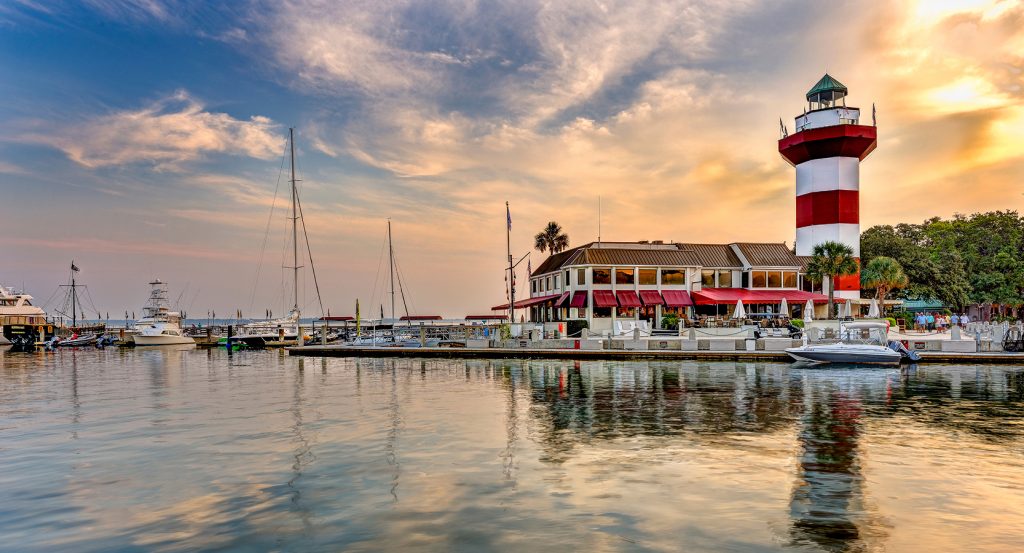
Begin at Stoney-Baynard Ruins, the surviving remains of a plantation residence situated near Baynard Park Road within Sea Pines. The property developed during the nineteenth century as part of Hilton Head's plantation economy and subsequently became associated with the Baynard family. Tabby foundations and surviving masonry walls preserve portions of the original residence, whose construction incorporated oyster shells, lime, sand and water. Additional structural remains connect the principal house with the agricultural activities supporting the estate. The site provides a physical introduction to plantation-era architecture and the economic systems that shaped the island before the Civil War. Continue to Harbour Town Lighthouse, the red-and-white-striped observation tower overlooking Harbour Town Marina and Calibogue Sound. Completed in 1970, the 90-foot structure became the principal architectural feature of the waterfront village developed under Charles Fraser's direction. Its 114-step interior staircase connects historical displays with an observation deck overlooking the yacht basin, surrounding waterways and neighboring coastal islands. The tower's distinctive exterior established a recognizable feature for the developing resort community. Its elevated viewpoint connects the marina's recreational activity with the tidal geography of Hilton Head's southern shoreline. Conclude at Coastal Discovery Museum, situated on the historic Honey Horn property in northern Hilton Head. Founded in 1985, the institution relocated to the 70-acre estate in 2007, preserving historic buildings, gardens and coastal habitats. Its exhibitions examine Indigenous settlement, plantation agriculture, Gullah heritage and the development of South Carolina's barrier islands. Walking paths connect historic structures with maritime forest, cultivated gardens and salt-marsh boardwalks. Educational programs examine native wildlife and the historical relationship between coastal communities and the region's natural resources. The progression moves from plantation-era architecture through planned resort development and culminates in the interpretation of Lowcountry history and ecology, connecting Sea Pines Forest Preserve with the broader development of Hilton Head.
Where your story begins.
Foresyte Travel reveals places that feel extraordinary long before you arrive.
Enjoy editorial crafted for luxury travelers.
Foresyte may earn a commission when you book.




















































































































