Why Taberna Social matters.
Taberna Social is a convivial Spanish restaurant where the St. Lawrence Market District's mercantile heritage meets Barcelona bodega culture, Madrid wine bars and a contemporary tapas program built for communal dining.
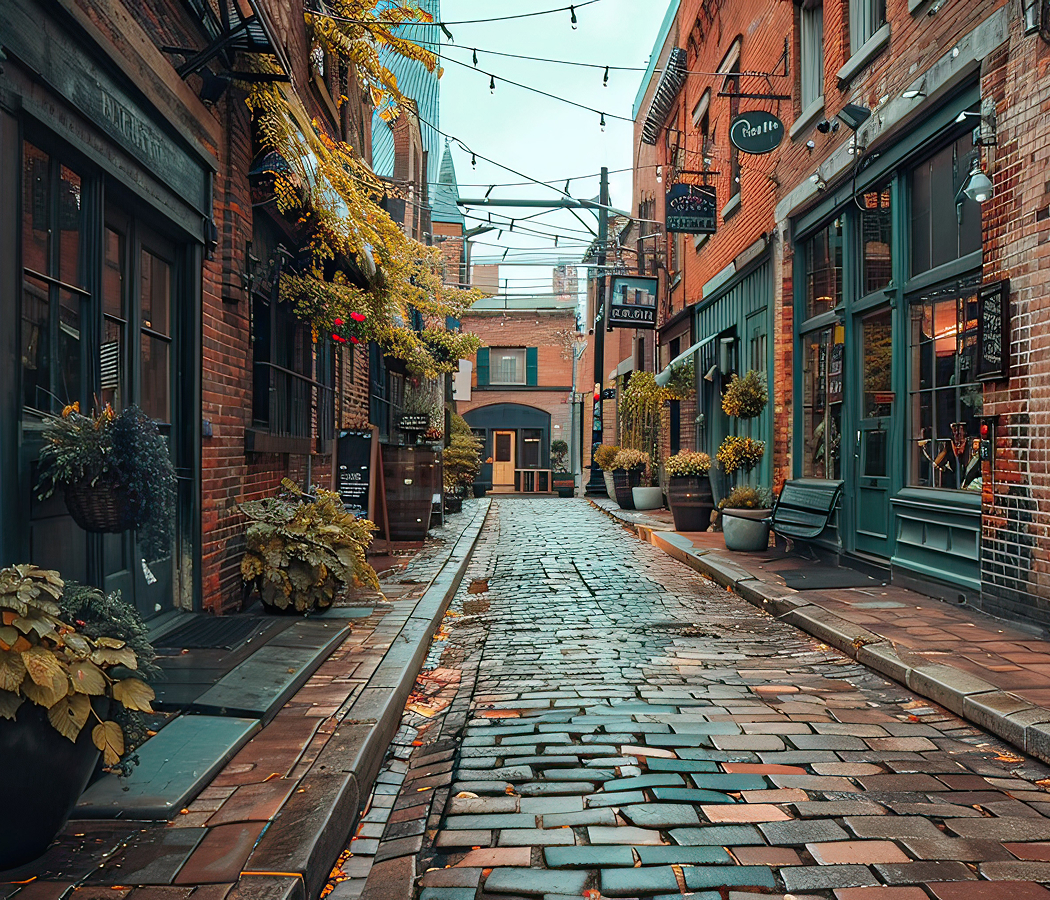
Set along Wellington Street East near Church Street and just steps from Berczy Park, the restaurant occupies the 1855 Hutchison Building between the wedge of Front Street, the King Street commercial spine and the St. Lawrence Market blocks extending east toward Jarvis Street, with the Financial District rising to the west and Toronto's historic waterfront lying beyond the rail corridor to the south. Exposed brick preserves the visual weight of the nineteenth-century commercial building, with warm timber and subdued lighting bringing a more intimate scale to its street-level interior. Artwork supplies a stronger contemporary layer across those older surfaces, giving the dining room a gallery-like component. Closely grouped tables and the wine-focused bar keep shared plates circulating through a room modeled on the social proportions of Spanish taverns. The result is a St. Lawrence Market restaurant whose heritage brickwork, art-filled interior and communal table arrangement place contemporary Spanish dining inside one of Toronto's oldest surviving commercial streetscapes.
What defines Taberna Social.
Taberna Social is best known for bringing chef-owner Dave Sidhu's Muskoka-born Spanish concept into Downtown after an earlier version developed from a pop-up at Katalyst Brewery. Sidhu converted that experiment into a permanent restaurant in Bracebridge, placing it beside his Playa Cabana operation before the Muskoka location eventually closed. His wider hospitality career had already produced Playa Cabana and Taco Fuego, giving the Toronto iteration an established restaurateur behind what remained a comparatively young concept. Taberna Social quietly opened on Wellington Street East in late November 2025, occupying a storefront only doors from Sidhu's Playa Cabana at 36 Wellington. The Toronto version deliberately pushed the food closer to traditional Spanish tapas than its Muskoka predecessor, with Sidhu characterizing the new approach as more authentic and more extensively shareable. Its physical setting adds another historical layer: 40 Wellington forms part of the Hutchison Building, a Classical Revival commercial property completed in 1855 and associated with former Toronto mayor John Hutchison. The red-brick warehouse row rose on the original Court House Reserve and participated in the nineteenth-century commercial intensification of the district, leaving Sidhu's Spanish restaurant inside a building already approaching its third century of downtown commercial use.
Pulpo con romesco places grilled Mediterranean octopus against avocado, Marcona almonds and the roasted-pepper depth of romesco, joining char, creaminess and nuttiness within a single small plate. Barcelona bomba encloses braised beef beneath a panko crust, translating the Catalan potato-and-meat tradition into a crisp fried preparation, and croquetas de jamón push cured pork through a softer croquette form. Cantabrian anchovy gilda compresses another Spanish bar tradition into skewered bites, with boquerones en vinagre shifting preserved fish toward vinegar before burrata and bread soften its acidity. Gambas al azafrán moves shellfish through saffron, and the black paella folds Mediterranean octopus, calamari and morcilla into squid-ink bomba rice for the darkest and most concentrated rice preparation. Oxtail receives its own bomba-rice treatment, giving the paella section a slow-braised meat counterpart to the seafood versions. Spanish wine follows the same regional breadth through Rioja, Priorat, Rías Baixas and Ribera del Duero, bringing tempranillo, albariño and cava into a drinks program supplemented by vermouth and botanical cocktails. The strongest preparations move through preservation, frying, grilling and rice cookery, giving the restaurant multiple routes into Spanish tavern food without reducing the concept to one regional specialty.
How Taberna Social fits.
Taberna Social works as the dining anchor for a St. Lawrence Market outing connecting Toronto's original civic marketplace, a Gothic Revival cathedral repeatedly rebuilt after fire and the wedge-shaped headquarters of a nineteenth-century industrial empire.
Begin at St. Lawrence Market, whose civic history reaches to 1803, when Lieutenant Governor Peter Hunter designated the Market Block within the original Town of York. Successive market buildings followed before Toronto's first purpose-built City Hall opened on the site in 1845, combining municipal government, market functions, a police station and holding cells. Council remained there until 1899, and the 1902 rebuilding preserved the former council chamber inside the South Market; rediscovered during 1970s renovations, that room became the Market Gallery in 1979. Continue to St. James Cathedral, where York's Anglican congregation formed in 1797 and completed its first wooden church in 1807. American troops damaged the building during the War of 1812, a replacement stone church burned in 1839 and another fire destroyed its successor in 1849. The present Gothic Revival cathedral opened for services in 1853, gained its bells in 1865 and received the completed spire in 1875, preserving on the same site an architectural lineage extending back to Toronto's earliest colonial settlement. Conclude at Gooderham Building, commissioned by George Gooderham as his family's distilling and financial interests reached extraordinary scale. David Roberts Jr. designed the five-storey wedge-shaped office building in 1891, with construction completed by 1892 on the triangular parcel where Front and Wellington converge. Gooderham & Worts had produced more than two million gallons of spirits in 1874-75, representing one-third of the Canadian market, and George subsequently expanded family interests through banking, property, mining and railways before using the Flatiron as a headquarters suited to that commercial reach. The progression moves from Toronto's original public marketplace through a cathedral rebuilt across successive urban disasters and culminates at the headquarters of an industrial family whose fortunes reshaped the surrounding district, placing Taberna Social inside the concentrated nineteenth-century city that survives around Wellington Street East.
Where your story begins.
Foresyte Travel reveals places that feel extraordinary long before you arrive.
Enjoy editorial crafted for luxury travelers.
Foresyte may earn a commission when you book.