Why Canadian Museum of Nature matters.
Canadian Museum of Nature is a landmark natural-history institution where Centretown's historic architecture meets Canada's scientific heritage, extraordinary fossil collections, and the evolution of the country's national museum system.
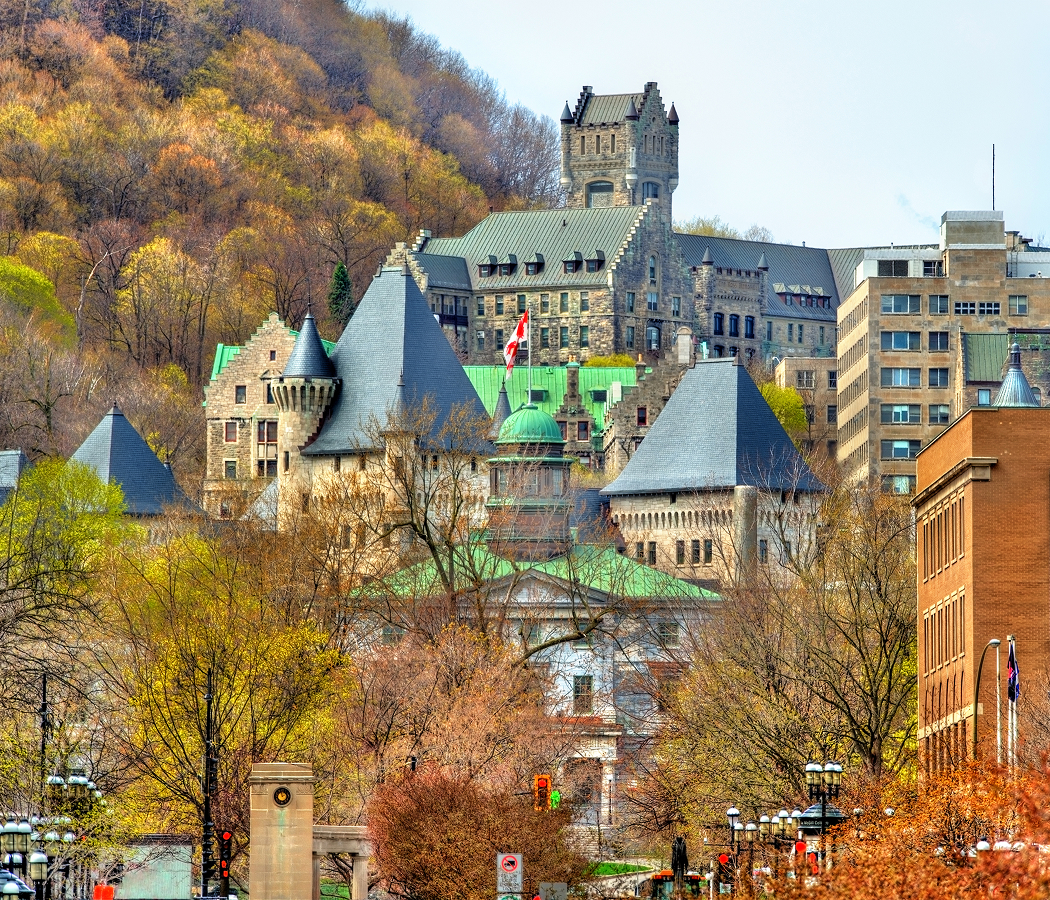
Occupying the southern end of Metcalfe Street near the intersection with McLeod Street, Canadian Museum of Nature rises above a landscaped city block in Ottawa's Centretown district, with the Glebe extending south and the established residential streets surrounding Elgin Street and Bank Street framing its expansive setting. The Victoria Memorial Museum Building presents an elaborate combination of Scottish Baronial, Tudor Gothic, and Beaux-Arts architecture, its symmetrical composition dominated by crenellated parapets, projecting entrance bays, corner towers, and carefully proportioned windows. Architect David Ewart incorporated Canadian wildlife into the building's decorative program, replacing conventional European ornament with sculptural representations of animals and plants native to the country. Two carved moose heads guard the principal entrance, and sandstone reliefs introduce further natural motifs across the exterior. Nepean sandstone supplies the building's substantial walls, complemented by finer Wallace sandstone used for decorative carving and granite from Stanstead, Quebec. Inside, broad staircases, substantial stone columns, and richly ornamented architectural details establish the atmosphere of an expansive early twentieth-century museum. The Queens' Lantern rises above the central entrance as a contemporary glass addition, introducing daylight into the circulation spaces and creating a striking contrast with the historic masonry. The building's orientation establishes a direct visual relationship with Parliament Hill along the Metcalfe Street axis, connecting the museum's architectural composition with the ceremonial geography of the national capital. Landscaped grounds soften the building's substantial scale, with native vegetation and open lawns creating a distinctive transition between the surrounding residential streets and the institutional landmark. The result is an expansive natural-history museum whose castle-like architecture, Canadian sculptural ornament, and carefully integrated contemporary additions embody more than a century of national scientific and cultural development.
What defines Canadian Museum of Nature.
Canadian Museum of Nature is best known for emerging from the Geological Survey of Canada's nineteenth-century scientific collections into the country's principal natural-history institution, occupying a building that also served as the temporary seat of Canada's Parliament. The institution's origins reach to 1842, when the Province of Canada established the Geological Survey under William Edmond Logan to investigate the territory's mineral resources and geological formations. Logan's fieldwork generated substantial collections of rocks, fossils, and mineral specimens, establishing the foundation for a national scientific museum. In 1856, he received authorization to create a public geological museum, transforming the survey's scientific holdings into an institution accessible beyond the professional geological community. The collection developed further through the appointment of botanist John Macoun in 1882, whose extensive field expeditions contributed substantially to the study of Canadian plants and animals. Macoun had previously participated in western Canadian exploration and became an influential figure in the development of the country's botanical collections. The growing institution eventually required a purpose-built home, prompting Parliament to authorize a national museum building in 1901. The project also commemorated Queen Victoria, whose death that year ended a reign closely associated with Canada's development into a self-governing Dominion. Prime Minister Wilfrid Laurier's ambition to transform Ottawa into a distinguished national capital influenced the building's expansive scale and prominent position within the city. Chief Dominion Architect David Ewart developed the design, drawing upon the architectural style of medieval European castles while establishing a formal composition appropriate to a major national institution. The site had previously belonged to Supreme Court Justice William Stewart, whose nine-acre property occupied what was then the southern outskirts of Ottawa. Construction began in 1905 under contractor George Goodwin, with three hundred Scottish stonemasons contributing specialized craftsmanship to the immense stone building. The original construction contract carried a value of $950,000, reflecting the scale of the federal government's investment in scientific infrastructure. Collections began moving into the completed structure in 1910, and public exhibition galleries opened in 1912. The museum initially accommodated natural-history collections alongside the National Gallery of Canada and other scientific and cultural institutions, establishing a shared home for several organizations that would eventually develop into independent national museums. Its architectural ambitions encountered an extraordinary engineering problem when the building began settling into the unstable clay beneath its foundations. The original central tower had to be dismantled in 1915, permanently altering Ewart's intended silhouette and exposing the irony of a geological institution occupying a building constructed on inadequately assessed ground. A far more consequential transformation followed the destruction of Parliament's Centre Block by fire on February 3, 1916. The museum became the temporary home of the House of Commons and Senate, accommodating parliamentary proceedings during the reconstruction of the federal legislative complex. The building's auditorium served as the temporary House of Commons chamber, placing national political debate within an institution originally conceived for scientific discovery. Former prime minister Wilfrid Laurier lay in state there following his death in 1919, giving the museum another significant association with Canada's political history. Parliament returned to the reconstructed Centre Block in 1920, allowing the institution to resume its scientific and cultural functions. The National Museum of Canada emerged as a separate organization in 1927, strengthening the institutional foundation for the country's developing museum system. Subsequent decades brought increasing specialization, with natural history, human history, science and technology, and fine art gradually developing into distinct national institutions. The building also became an important center for Canadian anthropology through the work of figures including Edward Sapir and Diamond Jenness, whose contributions extended its intellectual significance beyond the natural sciences. The National Museum of Natural Sciences emerged through successive institutional reorganizations and became the Canadian Museum of Nature in 1990. The departure of the Canadian Museum of Civilization to its purpose-built facility in Gatineau completed the building's transition into a dedicated natural-history museum. The Victoria Memorial Museum Building received National Historic Site designation in 1990, recognizing its exceptional architectural and institutional significance. A major restoration subsequently addressed the building's structural vulnerabilities and transformed its interior, culminating in a $216 million federal rehabilitation completed in 2010. The project introduced substantial seismic reinforcement, renewed exhibition spaces, and the Queens' Lantern, restoring the architectural prominence of the entrance through a contemporary interpretation of Ewart's original tower. Queen Elizabeth II dedicated the glass structure in June 2010, linking the museum's architectural renewal with the two monarchs commemorated through its history.
Where your story begins.
Foresyte Travel reveals places that feel extraordinary long before you arrive.
Enjoy editorial crafted for luxury travelers.