Why National Gallery of Canada matters.
National Gallery of Canada is an expansive art museum where Lowertown's historic institutional landscape meets Canada's artistic heritage, Indigenous cultural expression, and Moshe Safdie's internationally celebrated museum architecture.
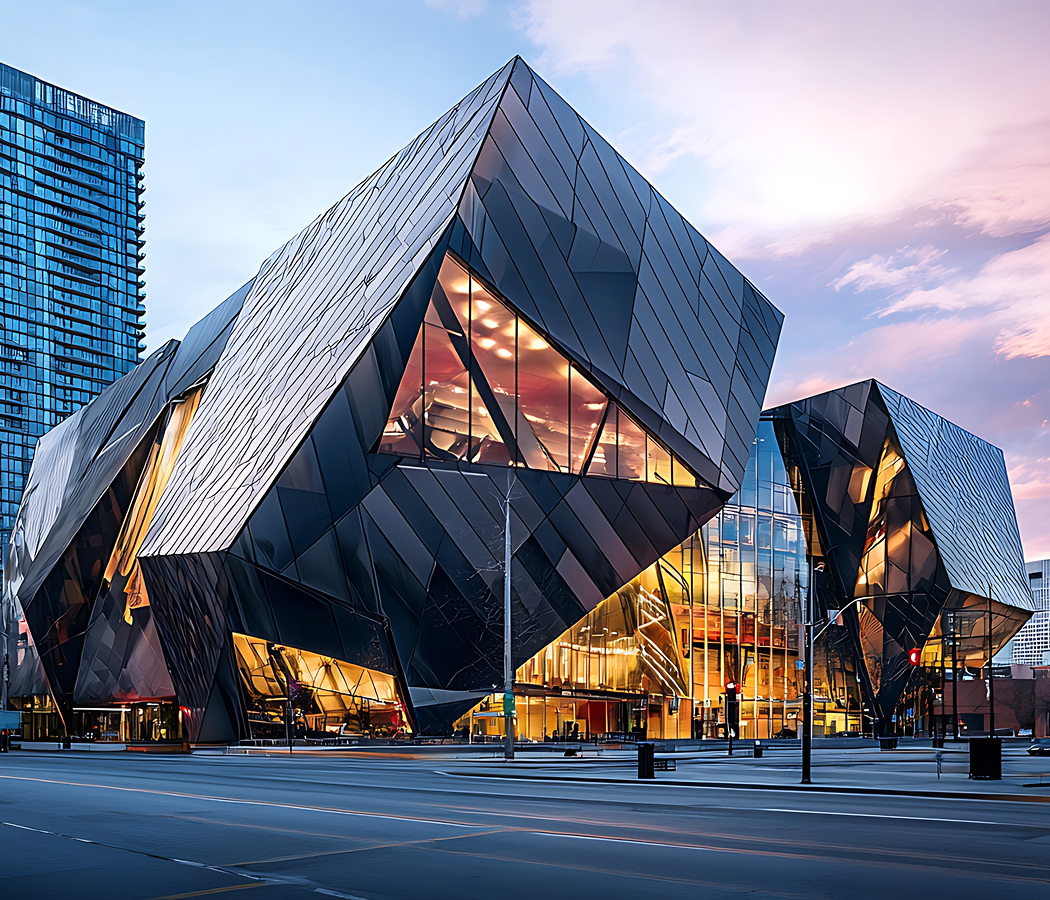
Occupying a commanding site above the Ottawa River near the northern end of Sussex Drive, National Gallery of Canada stands opposite the Notre-Dame Cathedral Basilica, with Major's Hill Park extending south toward the Rideau Canal and the Alexandra Bridge connecting Ottawa with Gatineau across the river. The museum's crystalline glass-and-granite architecture rises above a broad landscaped plaza, establishing a distinctive composition of geometric towers, transparent galleries, and expansive public spaces. Its principal entrance introduces a soaring glass colonnade that directs visitors toward the Great Hall, where expansive windows frame Parliament Hill, the Ottawa River, and the surrounding national capital landscape. The building's pale granite surfaces, carefully arranged exhibition wings, and angular glass roofs establish a relationship between contemporary architecture and the expansive civic buildings of Ottawa. A landscaped courtyard incorporates the reconstructed Rideau Street Convent Chapel, whose nineteenth-century interior introduces an intimate historical setting within the modern complex. The museum's exterior grounds accommodate major public artworks, including Louise Bourgeois's expansive bronze spider Maman, whose towering legs establish an extraordinary sculptural presence beside the principal entrance. Interior galleries extend across multiple levels, with carefully controlled natural and artificial lighting supporting the presentation of paintings, sculpture, photography, decorative arts, and contemporary installations. The result is an exceptional national museum whose expansive architecture, commanding riverfront geography, and extensive exhibition spaces establish one of Canada's most significant cultural institutions.
What defines National Gallery of Canada.
National Gallery of Canada is best known for preserving and interpreting Canada's artistic heritage through a collection whose development reflects the country's political history, cultural institutions, and expanding understanding of Indigenous and international art. The institution originated in 1880, when Governor General John Campbell, Marquess of Lorne, and his wife, Princess Louise, supported the creation of a national art collection in Ottawa. Their initiative accompanied the establishment of the Royal Canadian Academy of Arts, whose members contributed works intended to form the foundation of a permanent national gallery. The first collection comprised fourteen paintings, establishing a modest institutional beginning within a country whose federal cultural infrastructure remained in its earliest stages. The gallery initially occupied rooms in the Supreme Court building, beginning a succession of temporary locations that reflected the absence of a purpose-built national museum. In 1882, the collection moved to the Supreme Court's new premises, and subsequent expansion introduced additional works by Canadian and European artists. The gallery relocated to the Victoria Memorial Museum in 1911, sharing space with the national collections of natural history and anthropology. The institution's administrative development accelerated under Eric Brown, appointed its first full-time director in 1910. Brown pursued a systematic acquisition program that extended the collection beyond the original Royal Canadian Academy holdings, introducing important examples of European painting and modern Canadian art. The National Gallery of Canada Act of 1913 established a board of trustees and strengthened the institution's independent administrative structure, providing a formal legislative foundation for its collection and public responsibilities. During the following decades, the gallery acquired works by the Group of Seven, whose landscape paintings became central to the development of a distinctively Canadian national art history. Artists including Tom Thomson, Lawren Harris, A. Y. Jackson, Arthur Lismer, Frederick Varley, Franklin Carmichael, Frank Johnston, and J. E. H. MacDonald contributed to the broader movement toward modern Canadian landscape painting. Thomson's The Jack Pine, completed in 1916-1917, entered the national collection in 1918, establishing one of the gallery's most enduring associations with Canadian modernism. The institution also expanded its European holdings through acquisitions of Old Master paintings, sculpture, and works on paper, connecting Canadian artistic development with the broader history of Western art. In 1936, the gallery acquired Paul Cézanne's Forest, introducing an important example of French Post-Impressionism into the collection. The gallery's growing international reputation was strengthened through exhibitions and loans involving major museums in Europe and the United States. A substantial institutional transition occurred in 1960, when the gallery moved into the Lorne Building on Elgin Street, occupying premises that provided additional exhibition space but remained inadequate for its expanding collections. The appointment of Jean Sutherland Boggs as director in 1966 introduced a period of major scholarly development and institutional modernization. Boggs strengthened the gallery's international relationships, expanded its acquisitions program, and advocated for a permanent building suited to the scale of a national art museum. Her leadership contributed to the development of major exhibitions and the establishment of the Canadian Museum of Contemporary Photography, whose origins lay in the National Film Board of Canada's Still Photography Division. The Canadian Museum of Contemporary Photography was formally established in 1985, expanding the gallery's institutional commitment to photographic art. The federal government selected architect Moshe Safdie to design a new National Gallery building during the early 1980s, initiating one of Canada's most ambitious cultural construction projects. Safdie, whose international reputation had developed through Habitat 67 in Montréal, conceived a museum combining expansive civic architecture with carefully controlled exhibition environments. Construction began in 1985, with the project incorporating substantial granite surfaces, crystalline glass structures, and a spatial arrangement organized around views of Parliament Hill and the Ottawa River. The new building opened on May 21, 1988, during the administration of Prime Minister Brian Mulroney, providing the institution with its first purpose-built home. Its completion transformed the gallery's public presence and established a major architectural landmark within the national capital. The collection expanded through important acquisitions and donations, including major holdings of Inuit art, Canadian historical painting, European Old Masters, and contemporary international works. The gallery acquired Barnett Newman's Voice of Fire in 1989, introducing an expansive example of American Color Field painting that became the subject of intense public debate following disclosure of its purchase price. The controversy contributed to a broader national discussion concerning public cultural funding, artistic value, and the responsibilities of national collecting institutions. In 2005, the gallery acquired Louise Bourgeois's Maman, whose installation outside the museum introduced one of Ottawa's most recognizable public sculptures. The institution subsequently expanded its presentation of Indigenous art through major exhibitions and the reorganization of permanent galleries. The Canadian and Indigenous Galleries opened in June 2017, introducing a substantial reinterpretation of the national collection through the integration of First Nations, Inuit, and Métis artistic traditions with the broader development of art in Canada. The project involved consultation with Indigenous communities and the presentation of historical and contemporary works within a more inclusive institutional structure. The gallery's contemporary collection continued developing through acquisitions of photography, video, installation art, and works addressing the cultural and political concerns of modern Canada. The institution's history reflects the evolution of Canada's national cultural institutions, the changing interpretation of artistic heritage, and the development of a major museum whose collections connect Indigenous, Canadian, European, and international art.
Where your story begins.
Foresyte Travel reveals places that feel extraordinary long before you arrive.
Enjoy editorial crafted for luxury travelers.