
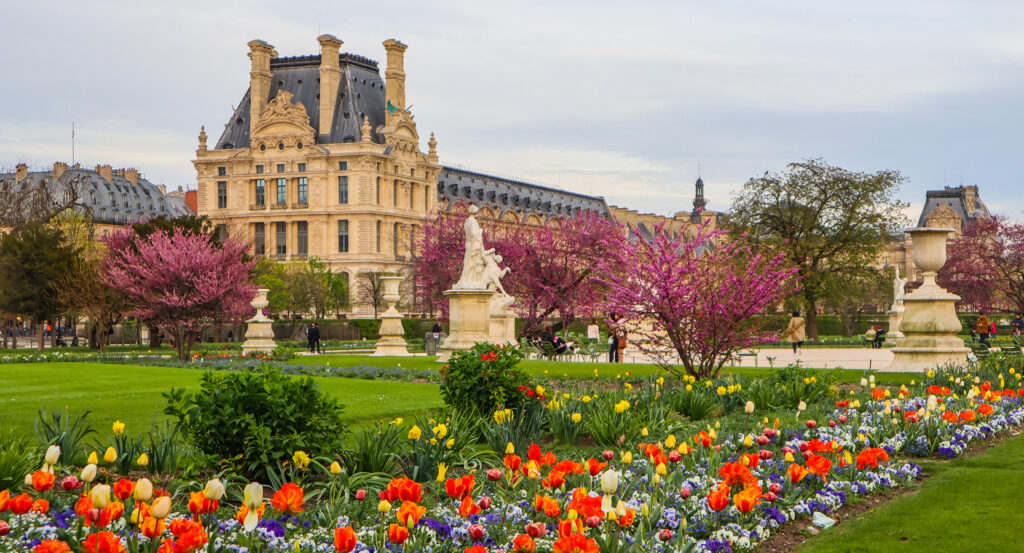
Why Jardin du Carrousel matters.
Jardin du Carrousel is a stately historic garden where the Louvre Quarter's palatial character meets the vanished Tuileries Palace, a Napoleonic triumphal arch and an open-air collection of Aristide Maillol sculpture.
Set along the western front of the Louvre near Place du Carrousel and just steps from Jardin des Tuileries, the garden occupies a 6.2-hectare esplanade where clipped yew hedges, broad lawns and sculpture extend between the museum's long northern and southern wings. The Arc de Triomphe du Carrousel rises on the central axis as the Louvre Pyramid closes the view east and the Grande Allée of the Tuileries carries the perspective west toward the Champs-Élysées. Fan-shaped hedges divide the open ground without obstructing the immense sightlines created after the Tuileries Palace disappeared. Maillol bronzes emerge throughout the planting, turning the transition between museum and historic garden into an outdoor sculptural sequence. The result is a formal Parisian landscape where palace history, imperial architecture, twentieth-century sculpture and the Louvre's great east-west axis occupy the same expansive ground.
What defines Jardin du Carrousel.
Jardin du Carrousel is best known for occupying the former eastern garden and ceremonial court of the Tuileries Palace, a site whose repeated transformations span Henri IV, Louis XIV, the Paris Commune and the Grand Louvre. Henri IV established a new garden along the palace's eastern side, complementing the older Jardin des Tuileries to the west. Expansion in 1638 created flowerbeds for Anne Marie Louise d'Orléans, the Grande Mademoiselle, who resided in the palace. That garden disappeared before the extraordinary equestrian festival staged by Louis XIV on June 5 and 6, 1662 to celebrate the birth of the Dauphin Louis. 1,300 riders participated before an audience numbering between 10,000 and 15,000, and the performance permanently attached the Carrousel name to the site. The cleared ground subsequently functioned for centuries as the Cour du Carrousel, the principal ceremonial court of the Tuileries Palace. Fire consumed the palace during the Paris Commune in 1871, leaving ruins between the Louvre and Tuileries until their demolition in 1883 opened an uninterrupted axis across the former palace footprint. Edmond Guillaume designed a new Jardin du Carrousel for the Exposition Universelle of 1889, arranging formal parterres in symmetry with the neighboring Tuileries. Academic sculpture populated that landscape until André Malraux and Dina Vierny initiated another major change in 1964 and 1965, replacing those works with bronzes by Aristide Maillol and establishing the nucleus of an open-air museum devoted to the sculptor. The site consequently preserves successive reinventions of royal garden, ceremonial court, palace forecourt and sculpture garden within ground whose changing uses repeatedly altered the spatial relationship between the Louvre and western Paris.
Jacques Wirtz and Peter Wirtz recast that inherited landscape during the Grand Louvre project at the beginning of the 1990s. Their 1990 design replaced flowerbeds with precisely clipped yew hedges radiating outward in fan-shaped alignments from the Arc de Triomphe du Carrousel. The intervention tied the garden visually to the immense perspective running from the Louvre through the Tuileries and beyond while preserving spaces for Maillol's bronzes among the planting. Those sculptures had entered the garden through the collaboration of Malraux and Dina Vierny, Maillol's final model and a major steward of his work after his death in 1944. Olivier Lahalle had simplified the earlier garden during their 1964 to 1965 installation campaign, establishing the immediate landscape inherited by the Wirtz redesign. The Louvre now treats the collection as its principal open-air concentration of Maillol, placing twenty sculptures within the garden. Their rounded human forms emerge against the controlled geometry of the hedges, distributing works across a landscape conceived as an extension of the museum precinct. Jacques and Peter Wirtz consequently transformed an earlier formal garden into the present sculptural landscape without erasing the historical axis created by the disappearance of the Tuileries Palace.
How Jardin du Carrousel fits.
Jardin du Carrousel works as the anchor for a daytime exploration across the Tuileries using three nearby sites that move from Napoleonic commemoration through a Second Empire exhibition pavilion into a nineteenth-century sporting hall transformed by successive chapters of modern art.
Begin at Arc de Triomphe du Carrousel, commissioned by Napoleon I from Charles Percier and Pierre Fontaine and constructed between 1806 and 1810 as the ceremonial entrance to the Tuileries Palace. Its three archways and Corinthian columns of pink marble draw from Roman triumphal architecture, with the arches of Septimius Severus and Constantine providing major precedents. Dominique Vivant Denon devised a decorative program devoted to the campaigns of 1805, Charles Meynier supplied designs for the reliefs and different sculptors executed the individual panels. Eight statues above the columns represent principal corps of the Grande Armée. The original quadriga incorporated horses taken from Saint Mark's Basilica in Venice; those returned in 1815, and François-Joseph Bosio's replacement quadriga arrived in 1827. A major conservation campaign completed in 2024 reinforced and cleaned the structure. Continue to Musée de l'Orangerie, whose building was erected in 1852 to shelter the orange trees decorating the Jardin des Tuileries during winter. Its most consequential conversion followed Claude Monet's decision after the 1918 Armistice to offer his Nymphéas to France as a monument to peace. Monet and Georges Clemenceau developed the undertaking into a far larger installation, and the painter formally donated nineteen panels in 1922. Monet retained them for continued work until his death in 1926; the purpose-designed oval rooms opened in 1927 with eight compositions arranged across nearly one hundred linear meters of painted surface. The installation joined architecture and painting through a continuous aquatic panorama developed from Monet's garden at Giverny. Conclude at Jeu de Paume, built after construction of the Palais Garnier displaced a racquet-sport club from Passage Sandrié in 1861. Napoleon III authorized its relocation to the northwestern corner of the Tuileries, where Melchior Viraut designed a new building inaugurated on January 29, 1862. Viraut echoed the decorative treatment of the Orangerie erected nine years earlier, creating a deliberate architectural pair at the western end of the garden. Sporting use later gave way to exhibition functions, beginning the institutional evolution that eventually established Jeu de Paume as a center devoted to photography and image-based art. The progression moves from Percier, Fontaine and Denon's imperial monument through Monet and Clemenceau's postwar Nymphéas installation into Viraut's sporting pavilion and its later artistic life, extending the Carrousel through three structures whose changing purposes parallel the repeated reinvention of the Tuileries precinct.
Where your story begins.
Foresyte Travel reveals places that feel extraordinary long before you arrive.
Experience premium editorial crafted for luxury travelers.
Foresyte Travel may earn a commission when you book through the link on this page.














































































































