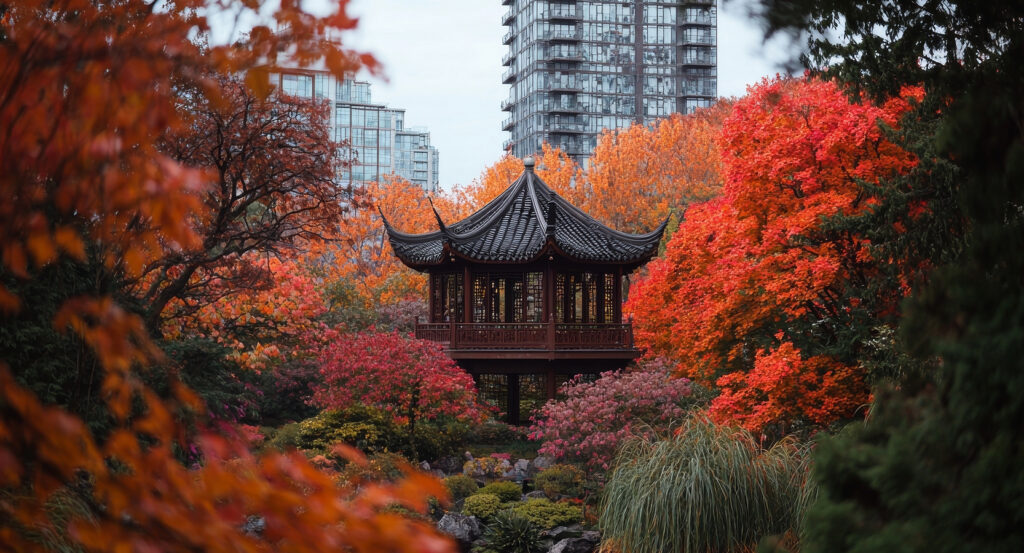
Why you should experience Jade Water Pavilion in Vancouver, British Columbia.
The Jade Water Pond at the Dr. Sun Yat-Sen Classical Chinese Garden is the living heart of the entire composition, a mirror of heaven set within a scholar's landscape.
Stand at its edge, and you'll feel the stillness that defines the garden's spirit: reflections of tiled roofs and willows ripple across the surface like brushstrokes in motion, and koi drift slowly beneath, flashes of orange and white gliding through jade-green depths. The pond isn't just decoration, it's the central axis around which everything else flows, the element that unites stone, plant, and architecture into one fluid conversation. Its color, a natural shade of celadon, shifts throughout the day, silver at dawn, green at midday, gold by dusk, a visual metaphor for life's impermanence. Walk the perimeter and notice how every pavilion, corridor, and moon gate seems to reframe it; each view is deliberate, as though the garden itself were painting with perspective. The water's surface carries not only reflections, but rhythm, a quiet counterpoint to the bamboo's rustle and the distant toll of the city. To stand here is to understand what Chinese scholars called “borrowed scenery”: the merging of real and reflected worlds until the boundary disappears, leaving only balance.
What you should know about Jade Water Pavilion.
The Jade Water Pond was engineered with remarkable precision, both as a symbol and as a feat of craftsmanship, following the traditions of classical Suzhou gardens from the Ming Dynasty.
It was hand-dug and lined with a mixture of clay and stone to ensure natural filtration and cooling, then filled with rainwater collected from the garden's curved roofs, a design choice reflecting harmony between heaven (sky) and earth (stone). Its irregular shape, neither perfectly round nor square, captures the Taoist principle of “natural order through asymmetry.” The pond is shallow near the walkways, deepening toward the center, creating layered reflections that shift as you move, a reminder that truth changes with perspective. Surrounding its banks are elements chosen for their symbolic resonance: Taihu rocks rising like mountains, representing endurance; bamboo for resilience; lotus for purity blooming from the mud. Beneath the surface live koi, creatures long associated with perseverance and transformation, their slow movements meant to evoke meditative calm. When the garden was constructed in 1986, artisans from Suzhou carefully arranged every rock and stepping stone by hand, some positioned to mimic mountain peaks seen in Chinese scroll paintings. The pond's name, “Jade Water”, reflects not only its color but its essence: jade in Chinese culture symbolizes virtue and clarity of heart, qualities mirrored in the pond's still surface. The surrounding architecture was purposefully aligned to frame the pond's reflections; pavilions like the Hall of One Hundred Rivers and the Moon Gate Pavilion are positioned to appear perfectly balanced within its mirrored image. Even the pond's hydrology has meaning, water enters at the north, the direction of wisdom, and exits to the south, representing benevolence, mirroring the moral flow in Confucian philosophy. In traditional scholar gardens, water symbolized the dynamic counterpart to stone's stillness, and in this one, it anchors the entire design, transforming static beauty into living art.
How to fold Jade Water Pavilion into your trip.
The Jade Water Pond is the soul of the Dr. Sun Yat-Sen Classical Chinese Garden, and it's worth lingering here longer than anywhere else.
Enter the garden through the Carrall Street gate and follow the covered corridor until the pond first comes into view, the reveal is breathtaking, as the garden seems to unfold around it. Visit in the morning for quiet reflection, when the water perfectly mirrors the surrounding pavilions, or in the late afternoon, when sunlight filters through bamboo, scattering gold across the surface. Walk slowly along the pond's perimeter, pausing at the Double Corridor Bridge to see the koi gathering near the water's edge, a sign of good fortune in Chinese symbolism. From the Scholar's Study Pavilion, the view is particularly poetic: the water framed by carved lattice windows, each pattern creating a different vignette of the same scene. Allocate 30-45 minutes to fully absorb the experience, allowing the reflections to shift as the light changes. Bring a journal or sketchpad if you like, this is a place that invites stillness, observation, and thought. If you visit during spring, the wisteria and plum blossoms above the pond release a soft perfume; in autumn, the red maple leaves float across its surface like scattered calligraphy. During evening events or lantern festivals, the pond transforms into a mirror of flame and moonlight, its surface alive with reflections of floating lanterns and glowing pavilions. When you finally step away, take one last glance back, you'll see not just your reflection, but the world's quiet symmetry staring back at you. The Jade Water Pond isn't simply something to see; it's something to enter, absorb, and carry with you long after you've left, a calm echo of water and wisdom in the center of the city.
Where your story begins.
Foresyte Travel reveals places that feel extraordinary long before you arrive.
Experience premium editorial crafted for luxury travelers.