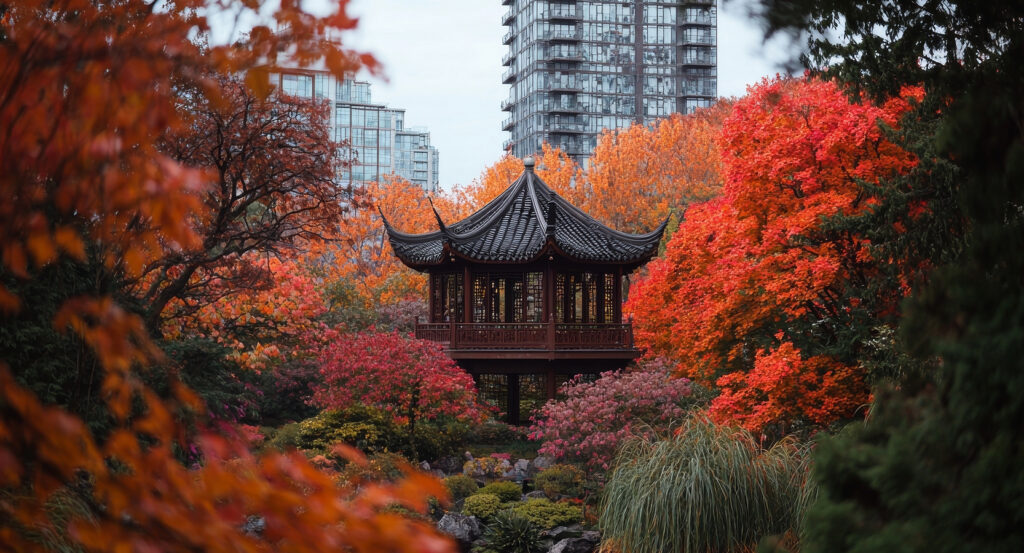
Why you should experience Moon Gate at Dr. Sun Yat-Sen Classical Chinese Garden in Vancouver, British Columbia.
The Moon Gate Pavilion at the Dr. Sun Yat-Sen Classical Chinese Garden is more than an architectural feature, it's a passage between worlds, a threshold where the clamor of modern Vancouver gives way to the measured stillness of Ming-dynasty philosophy.
Step beneath its perfect circular arch, and you immediately sense the shift: sound softens, light diffuses, and every line of sight becomes intentional. The shape of the moon gate, round, whole, and continuous, represents the celestial harmony between heaven and earth, the cyclical nature of time, and the unity of all opposites. Passing through it feels like stepping into a painting, where each frame, each vista, is composed with poetic precision. The limestone walls curve inward, guiding your movement naturally, while the play of shadow and sunlight across the carved latticework gives the gate an almost living quality, as if the garden itself were breathing through its opening. On one side, reflections of the pond shimmer like liquid jade; on the other, pavilions rise in gentle symmetry, their roofs rippling like ink brushstrokes. The experience is both intimate and infinite, a moment suspended between motion and stillness, meant to remind the visitor that transition itself is a form of beauty.
What you should know about Moon Gate at Dr. Sun Yat-Sen Classical Chinese Garden.
The Moon Gate Pavilion was built as the symbolic and literal entryway to the Dr. Sun Yat-Sen Classical Chinese Garden's inner scholar's landscape, embodying over a thousand years of Suzhou garden design philosophy.
Its design originates from the Southern Chinese tradition of “yuanlin,” or scholar's gardens, where moon gates were used to delineate one poetic scene from another, a threshold not of walls, but of perception. Every proportion in the gate's design is guided by classical harmony: the diameter of the opening corresponds to the human height ratio known as “the measure of heaven,” while the thickness of the surrounding frame ensures both structural balance and visual flow. Constructed from hand-carved limestone and clay tile, the pavilion was assembled entirely using traditional joinery techniques, no modern reinforcements, just as artisans in Suzhou would have built it centuries ago. The topmost keystone of the arch, slightly larger than its neighbors, symbolizes the “full moon,” the moment of wholeness in Taoist cosmology. Around the gate, bamboo and pine were planted deliberately, bamboo to signify integrity, pine to symbolize endurance, creating a living composition that changes with the seasons. When the garden opened in 1986, the Moon Gate was considered its heart, both a design anchor and a philosophical compass: every path and pavilion beyond it was oriented according to its central axis. Scholars describe it as a “silent poem in stone,” framing the pond, the Hall of One Hundred Rivers, and the Scholar's Study in a single, seamless perspective. At night, when lanterns glow through the gate's arch, it becomes a floating ring of light, reflecting perfectly in the pond, a double moon, one real and one imagined.
How to fold Moon Gate at Dr. Sun Yat-Sen Classical Chinese Garden into your trip.
The Moon Gate Pavilion is not just something to walk through, it's something to walk into mindfully.
When visiting the Dr. Sun Yat-Sen Classical Chinese Garden, approach the gate slowly from the Carrall Street entrance, allowing your eyes to adjust as you leave the sharp geometry of the city behind. Step through the circular opening and pause midway; from this spot, you can see the pond framed within the gate like a living scroll painting. In morning light, the reflection shimmers softly, while late afternoon brings a burnished warmth that deepens every shadow. This is the garden's most photogenic and meditative point, linger here to feel the breeze, hear the koi ripple the water, and notice how each sound is subtly amplified by the gate's acoustic curve. Allocate 10-15 minutes to simply observe, letting the experience slow you down. From here, continue toward the Scholar's Study Pavilion or follow the zigzag bridge across the pond to the Hall of One Hundred Rivers, each turn revealing a new composition framed by the gate behind you. For a more contemplative visit, come during spring or autumn, when wisteria or maple leaves trace delicate patterns across the arch. During evening events like the Mid-Autumn Festival, the gate is illuminated with lanterns, and its reflection in the water seems to float untethered, a reminder of the moon's presence even among city lights. The Moon Gate Pavilion isn't merely a doorway; it's a meditation in stone, a perfect circle that turns the simple act of passing through into a moment of awakening.
Where your story begins.
Foresyte Travel reveals places that feel extraordinary long before you arrive.
Experience premium editorial crafted for luxury travelers.