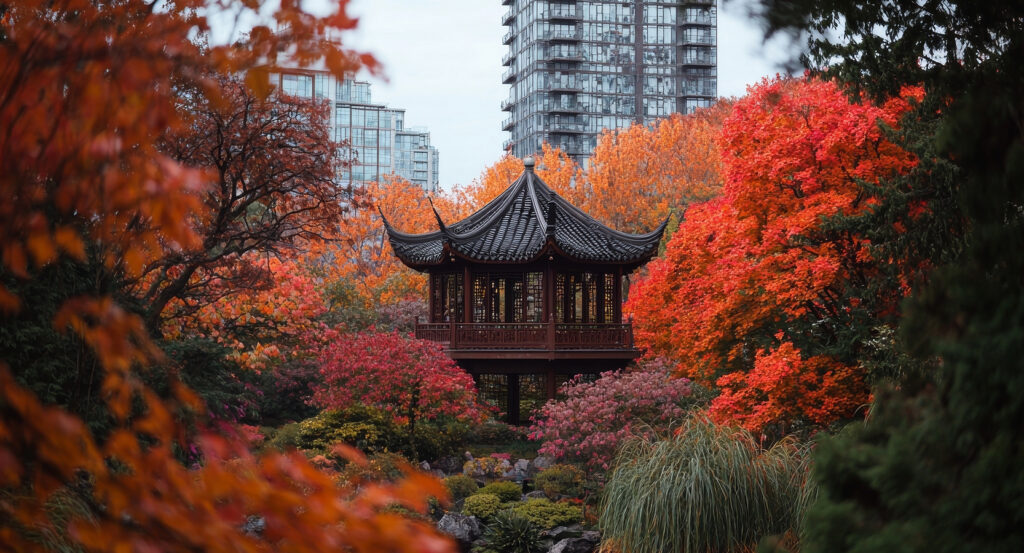
Why you should experience Scholar's Study & Courtyard in Vancouver, British Columbia.
The Scholars' Study Hall at the Dr. Sun Yat-Sen Classical Chinese Garden is a portal into the contemplative mind of the Ming scholar, a space built not for grandeur, but for thought, creation, and quiet discussion between the human spirit and the natural world.
Step inside and the air seems to change. The faint scent of old wood, ink, and paper lingers; the light, filtered through carved lattice windows, paints shifting patterns on the floor. Everything feels deliberate, restrained, and alive with meaning. Here, one can almost hear the faint scratch of a calligraphy brush or the echo of a guqin string vibrating in the stillness. The room opens toward the Jade Water Pond, its windows framing reflections of willows and Taihu rocks, the traditional companions of a scholar's solitude. The study is intimate yet profound, a microcosm of harmony, designed to blur the line between architecture and landscape, intellect and emotion. To stand here is to feel what ancient poets described as “the stillness where thought becomes soundless music.” The Scholars' Study Hall isn't just a room; it's an instrument of contemplation, tuned to the frequencies of light, silence, and the written word.
What you should know about Scholar's Study & Courtyard.
The Scholars' Study Hall was designed according to the Ming Dynasty scholar garden tradition, where the study (shu fang) served as the spiritual and intellectual nucleus of the household.
Every proportion, material, and orientation in this space reflects classical principles of Confucian and Taoist harmony. The room's placement on the garden's western edge was intentional, in Chinese geomancy, the west symbolizes introspection and literary refinement. The wooden beams, made of Chinese fir, were hand-carved by master artisans from Suzhou, who constructed the entire frame without nails, using mortise-and-tenon joints that expand and contract naturally with Vancouver's coastal humidity. The lattice windows, each a unique geometric pattern, create “framed views” of the garden, allowing the scholar to observe changing light, wind, and reflections as if studying a living scroll. The study's furnishings are true to historical form: a zitan wood writing desk, a porcelain brush washer, a small inkstone, and a scroll rack filled with reproductions of classical Chinese texts. On one wall hangs a calligraphy panel reading “心静自然凉”, “When the heart is still, the world is cool”, a maxim capturing the essence of the scholar's pursuit. Above, the ceiling is divided into coffered squares painted with subtle cloud motifs, symbolizing imagination and the open mind. A niche in the eastern corner once held a small incense burner, its smoke curling upward to purify thought. The floor tiles alternate between polished stone and baked clay, a tactile expression of yin and yang, opposites in balance. Historically, scholar's studies were not merely places to write or read; they were meditative environments for cultivating moral clarity and creative insight. The layout of this room mirrors that tradition: modest in size, yet infinite in atmosphere. Even its acoustics were tuned through design, sound carries softly, encouraging reflection and measured conversation. The Scholars' Study Hall represents the bridge between the natural world and the realm of ideas, where philosophy, poetry, and landscape become one.
How to fold Scholar's Study & Courtyard into your trip.
The Scholars' Study Hall rewards stillness and presence; it's not a place to glance through, but to inhabit for a time.
Enter through the covered corridor leading from the Hall of One Hundred Rivers, and pause before stepping over the raised wooden threshold, a symbolic gesture separating the everyday world from the contemplative. Visit in the late morning or early afternoon, when the light streaming through the lattice casts the most intricate patterns across the writing desk and floor. Sit on the wooden bench or lean against the window frame and watch the reflection of clouds shift across the Jade Water Pond outside; the experience is hypnotic in its quiet rhythm. Allocate 20-30 minutes here, long enough to feel the space's cadence slow your own thoughts. If you bring a notebook, this is the place to write, sketch, or simply think. During guided tours, docents often point out the study's symbolic details, the placement of the inkstone toward the north (representing wisdom), or the low window ledge designed to encourage humility. For a deeper experience, visit during one of the garden's cultural events, poetry readings, guqin performances, or calligraphy demonstrations, when the study briefly returns to its intended use. In the quiet intervals between these moments, the space seems to hum with memory, as if the minds that once filled it still linger in the air. As you leave, glance once more through the window toward the Courtyard of Tranquility, a deliberate architectural discussion between action and stillness, intellect and emotion. The Scholars' Study Hall is where thought takes root in silence, where time slows enough for wisdom to surface, one quiet breath, one ripple on jade water at a time.
Where your story begins.
Foresyte Travel reveals places that feel extraordinary long before you arrive.
Experience premium editorial crafted for luxury travelers.