Why Fairmont Château Laurier matters.
Fairmont Château Laurier is a defining capital hotel where Ottawa's parliamentary landscape meets Canadian railway history, French château architecture and the city's enduring culture of government, ceremony and public life.
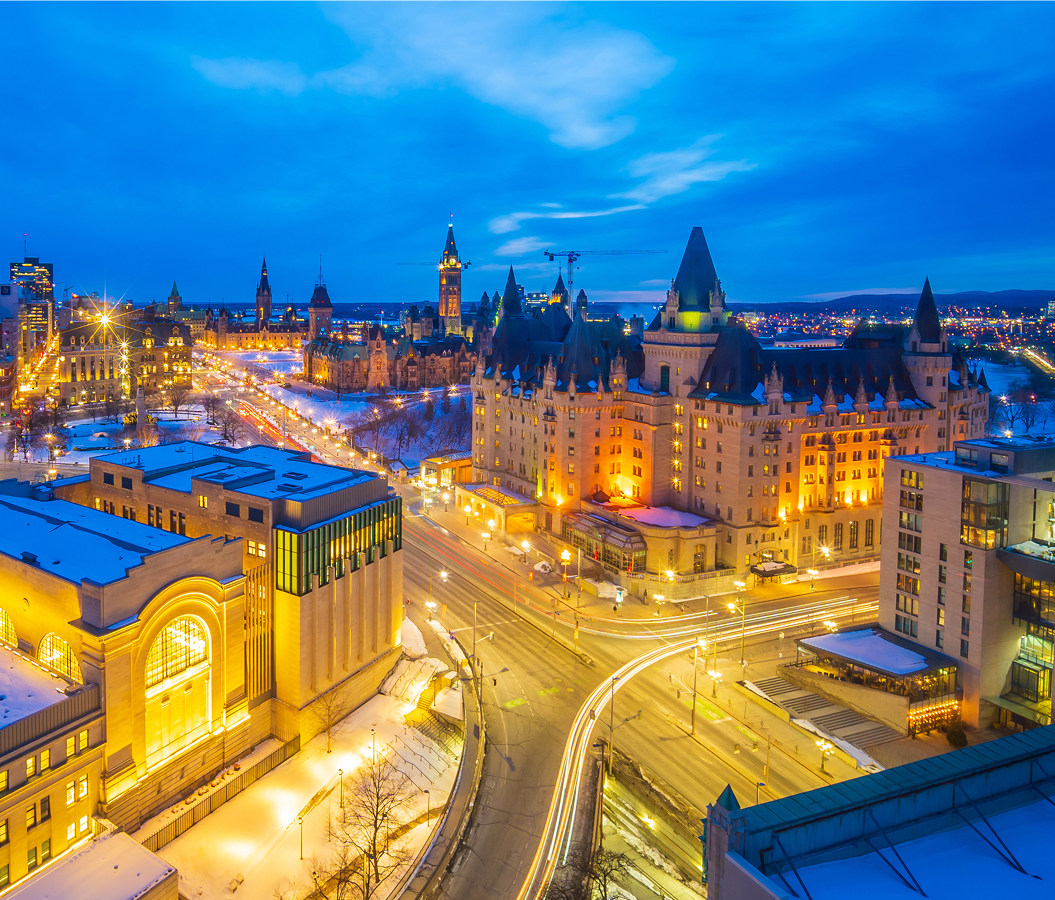
Set at the intersection of Rideau Street and Wellington Street beside the Rideau Canal, Fairmont Château Laurier occupies a position between Parliament Hill, ByWard Market, the National Arts Centre and the Ottawa River, with the central business district and historic canal locks surrounding the property. Its distinctive physical setting combines a grand railway hotel, Gothic Revival government buildings, public waterways, formal parks and the commercial streets of Central Ottawa. The capital is encountered primarily through movement between the hotel, Parliament Hill, the canal locks, ByWard Market, the National Gallery and the paths leading toward the river and Confederation Boulevard. A second atmosphere develops inside the property through historic public rooms, restaurants, lounges, guest floors, wellness facilities and event spaces that provide a formal refuge from Ottawa's seasons and civic activity. The result is an exceptional capital hotel whose architecture and setting connect Canada's railway origins, parliamentary identity, canal geography and national hospitality tradition.
What defines Fairmont Château Laurier.
Fairmont Château Laurier is best known for its expansive Châteauesque architecture and extraordinary relationship with Canada's political history, establishing one of Ottawa's defining landmarks beside Parliament Hill and the Rideau Canal. The hotel's origins trace to Charles Melville Hays, the American-born railway executive whose leadership of the Grand Trunk Railway inspired an ambitious program of grand hotels intended to encourage passenger travel across Canada. Hays commissioned New York architect Bradford Lee Gilbert in 1907 to develop a prestigious hotel alongside Ottawa's proposed Union Station, creating a coordinated railway and hospitality complex at the entrance to the nation's parliamentary district. Disagreements over the architectural conception subsequently brought Montréal architects George Allen Ross and David Huron MacFarlane into the project, establishing the French Renaissance-inspired design that would become an influential expression of Canadian railway architecture. The undertaking also carried considerable political significance because Prime Minister Sir Wilfrid Laurier had helped secure a prominent site adjoining Major's Hill Park, bringing federal involvement into a development intended to strengthen Ottawa's commercial and ceremonial importance. Construction began in 1908, incorporating the substantial financial resources of the Grand Trunk Railway into a landmark whose original development cost $2 million. Hays died aboard RMS Titanic on April 15, 1912, during his return from England, where he had been conducting railway business ahead of the hotel's anticipated inauguration. His death delayed the opening ceremony, and Sir Wilfrid Laurier formally inaugurated the hotel on June 12, 1912, establishing an enduring association between the property and the former prime minister whose name it bears. The building subsequently became a gathering place for Canada's political leadership, acquiring the nickname the Third Chamber of Parliament through its proximity to federal institutions and its importance within Ottawa's political society. The Grand Trunk Railway entered Canadian National Railways in 1923, bringing the hotel into a new institutional structure as the federal government consolidated the country's railway system. Architects John Archibald and John Schofield subsequently directed a substantial eastern expansion completed in 1929, extending the original establishment through an additional wing designed to complement its established architectural identity. The hotel also entered Canada's military history during the First World War when Raymond Brutinel recruited the original members of the Canadian Automobile Machine Gun Brigade at the property in August 1914, helping establish a formation that would become significant in the development of Canadian mechanized warfare. Its international prominence grew through visits by political leaders, entertainers, and cultural figures, including Nelson Mandela, Shirley Temple, Marlene Dietrich, and Roger Moore. Canadian Pacific acquired the hotel in 1988, subsequently incorporating the property into its international hospitality portfolio and undertaking substantial improvements to its historic interiors. The hotel adopted the Fairmont character in 1999, extending its railway heritage through the consolidation of Canadian Pacific Hotels and Fairmont Hotels & Resorts. Fairmont Château Laurier captures the development of Canada's transcontinental railway economy, the architectural ambitions of its national capital, and the enduring relationship between Ottawa's political institutions and its historic hospitality culture.
Yousuf Karsh's extraordinary relationship with Fairmont Château Laurier establishes one of the hotel's most consequential cultural identities, connecting its historic interiors with the development of twentieth-century portrait photography and the visual representation of international political leadership. The Armenian-born Canadian photographer established his studio on the hotel's sixth floor, developing an internationally influential career through portraits of statesmen, artists, scientists, and prominent cultural figures. His celebrated 1941 portrait of Winston Churchill originated during the British prime minister's wartime visit to Ottawa, following an address to Canada's Parliament. Karsh photographed Churchill after removing the cigar from his mouth, capturing the formidable expression that became one of the most recognizable images of the Second World War. The portrait, subsequently celebrated as The Roaring Lion, established an enduring visual representation of British wartime determination and helped elevate Karsh to international prominence. His association with the hotel continued for decades, and the property preserves a collection of original photographic portraits donated by Karsh and his wife, Estrellita, extending the photographer's artistic inheritance into the building's cultural identity. The collection includes portraits displayed in the hotel's public interiors and the Karsh Suite, establishing a direct relationship between its hospitality spaces and the history of international portraiture. The architectural environment surrounding these works preserves another exceptional dimension of the hotel's artistic significance through interiors associated with Canada's grand railway hotel tradition. The Adam Room incorporates delicate Wedgwood-blue ornament and neoclassical detailing, reflecting the influence of eighteenth-century English decorative architecture on the ceremonial interiors of early twentieth-century Canadian hotels. The Laurier Room develops a complementary classical style through expansive columns and formal architectural proportions, establishing a distinguished setting within the building's historic public spaces. The ballroom preserves an elaborate decorative composition associated with European imperial interiors, connecting Ottawa's diplomatic and ceremonial culture with the architectural traditions of grand international hotels. The Drawing Room introduces cream-and-gold plaster ornament, extending the property's historic craftsmanship through an interior conceived for formal gatherings and distinguished visitors. The Jasper Tea Room, developed during the hotel's interwar expansion, introduced another cultural interpretation through a decorative program associated with Canadian wilderness imagery and the artistic traditions of the country's western regions. Artist Edwin Holgate contributed to its conception, incorporating references to wildlife and Indigenous artistic forms into an environment that reflected contemporary Canadian approaches to national identity. The hotel's culinary and social traditions extend through Zoe's Lounge, whose contemporary interpretation of afternoon tea preserves the ceremonial hospitality associated with its historic public interiors. The lounge's display of Karsh's Churchill portrait creates a particularly significant connection between Ottawa's social culture and one of the defining photographic achievements of the twentieth century. Together, Karsh's artistic legacy, the surviving ceremonial interiors, and the architectural craftsmanship of Canada's railway hotel tradition establish Fairmont Château Laurier as an exceptional cultural institution within the nation's capital.
How Fairmont Château Laurier fits.
Fairmont Château Laurier works as the starting point for an exploration connecting Canada's parliamentary identity, Ottawa's canal-centered geography and the cultural institutions that preserve the history and artistic life of the capital.
Begin at Parliament Hill, the expansive federal precinct where Gothic Revival buildings, ceremonial grounds, the Peace Tower and views toward the Ottawa River establish the architectural and political center of Canada. The complex rises directly west of the hotel and frames the capital's principal civic landscape through stone façades, public ceremonies, lawns and formal avenues. Its buildings connect national government with the planned development and symbolic geography of Ottawa. Continue to National Gallery of Canada, the major cultural institution where Canadian, Indigenous and international art occupies a glass-and-granite building overlooking the Ottawa River and Parliament Hill. Its galleries, sculpture courts and architectural volumes provide a counterpoint to the formal government district, creating a setting where national character is explored through painting, sculpture, photography, design and contemporary practice. The museum's position links the capital's political center with Sussex Drive, Major's Hill Park and the historic neighborhoods east of the canal. Continue to ByWard Market, the historic market district where food stalls, restaurants, shops, galleries and nightlife occupy the streets east of Parliament Hill and north of Rideau Street. Established in the nineteenth century, the market developed around public commerce and remains one of Ottawa's most active pedestrian districts. Its restaurants, produce vendors, historic buildings and public spaces reveal the city's social and commercial life beyond the federal precinct. Conclude at Rideau Canal, the historic waterway where locks, bridges, promenades, parks and seasonal skating connect Ottawa's civic center with the river, neighborhoods and landscapes extending through eastern Ontario. The canal represents a major achievement of nineteenth-century engineering and remains one of the capital's defining public spaces. Its changing seasonal character connects transportation history, recreation, ceremony and the everyday movement of residents and visitors. The progression moves from Parliament Hill's national architecture through National Gallery of Canada's cultural landscape, continues across ByWard Market's commercial history and concludes at Rideau Canal, where Ottawa's government, art, commerce, engineering and public life meet.
Where your story begins.
Foresyte Travel reveals places that feel extraordinary long before you arrive.
Enjoy editorial crafted for luxury travelers.
Foresyte may earn a commission when you book.