
Why Garde Manger matters.
Garde Manger is a celebrated Canadian seafood restaurant where Old Montréal's historic commercial character meets Chuck Hughes's vivacious cooking, Québec's maritime ingredients and a restaurant culture that helped redefine the city's relationship between ambitious food and informal hospitality.
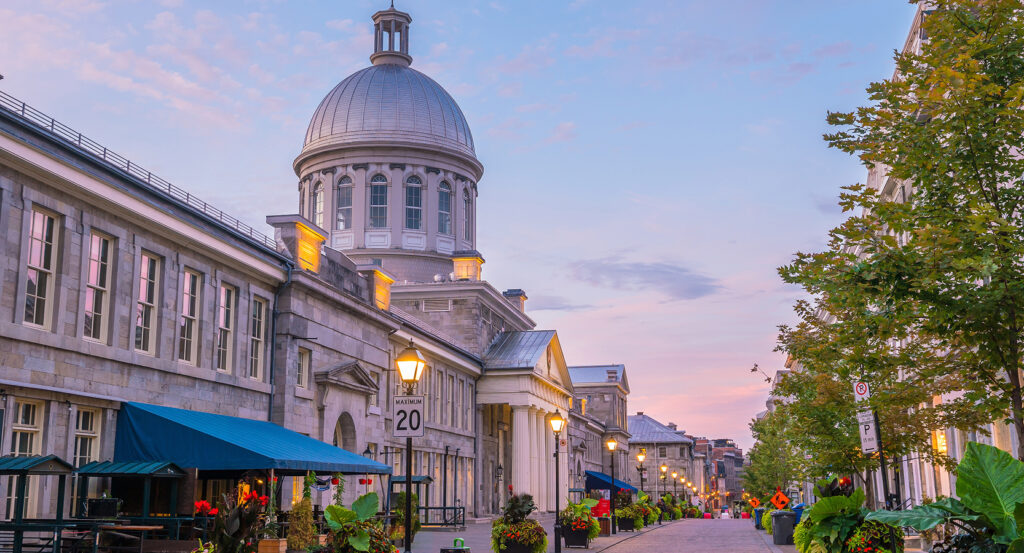
Positioned along Rue Saint-François-Xavier just north of Rue Saint-Paul, the restaurant occupies a discreet historic building between Place d'Armes, the former commercial warehouses surrounding Rue de la Commune and the cultural institutions of Montréal's original waterfront district. Its modest entrance opens into an intimate interior distinguished by wood-paneled ceilings, exposed masonry, leather banquettes and warm, subdued lighting. An open kitchen separates two dining areas, establishing a direct connection between the preparation of food and the surrounding tables. Bistro chairs and substantial wooden furnishings contribute to the character of an established neighborhood gathering place. A prominent chandelier introduces an unexpected decorative flourish, complementing the building's traditional materials and lively evening atmosphere. The result is a distinctive restaurant setting whose intimate proportions and energetic dining room connect the architectural character of Old Montréal with the city's contemporary seafood culture.
What defines Garde Manger.
Garde Manger is best known for chef Chuck Hughes's transformation of an independent Old Montréal restaurant into one of the city's most recognizable destinations for contemporary seafood and celebratory dining. Hughes began working in restaurants as a teenager, developing his professional experience in Montréal kitchens before pursuing the opportunity to establish an independent business. His ambitions coincided with a period of change in the city's restaurant industry, when younger chefs increasingly developed establishments combining serious cooking with informal service and distinctive personalities. In June 2006, Hughes opened Garde Manger with partners Kyle Marshall, Tim Rozon and Jessica Midlash. The group selected premises in Old Montréal, a district whose restaurant economy was beginning to benefit from renewed investment in its historic buildings and waterfront. Their original concept emphasized excellent ingredients, generous hospitality and the convivial atmosphere of a neighborhood gathering place. The restaurant's name came from the French culinary term garde-manger, traditionally associated with the kitchen station responsible for cold preparations, preserved foods and the organization of ingredients. Hughes's professional affinity for that station provided a fitting character for an establishment whose cooking would become closely associated with seafood. Garde Manger quickly attracted attention for its combination of substantial dishes, animated service and a dining room that grew increasingly energetic throughout the evening. Its reputation developed through the quality of the cooking and the accessibility of Hughes's public persona, helping establish the restaurant among Montréal's prominent independent dining destinations. The chef subsequently became a national television personality through Chuck's Day Off, a Food Network Canada series that introduced audiences to the restaurant's staff and the food Hughes prepared for them after service. The program established a distinctive relationship between his professional kitchen and his television career, presenting the restaurant as a working community of cooks, servers and friends. Hughes expanded his television presence through Chuck's Week Off, Chuck's Eat the Street and other culinary productions, bringing additional attention to Montréal's restaurant culture. His appearance on Iron Chef America further strengthened his reputation, introducing his cooking to a broader North American audience. The partnership expanded in 2011 with Le Bremner, a second Old Montréal restaurant that developed a complementary character centered on seafood and contemporary bistro cooking. Garde Manger also became part of the broader Crown Salt restaurant enterprise, connecting its original partnership with subsequent hospitality ventures. Over time, the establishment expanded its dining spaces and developed a more substantial restaurant operation, preserving the lively character that distinguished its earliest years. Executive chef Christopher Merrick subsequently assumed a central role in the kitchen, collaborating with Hughes on the restaurant's contemporary menus and tasting experiences. The establishment earned inclusion in the MICHELIN Guide's Québec restaurant selection, extending its recognition into the province's first comprehensive MICHELIN coverage. Its sustained reputation reflects the influence of Hughes and his partners on Montréal's modern dining culture, particularly their successful integration of ambitious seafood cooking, informal hospitality and a strongly recognizable restaurant identity.
Chuck Hughes's cooking centers on the exceptional seafood available through eastern Canada's maritime supply networks, combining classical techniques with substantial flavors and preparations designed for sharing. The kitchen's approach emphasizes the natural character of shellfish, carefully controlled cooking and sauces that contribute richness, acidity and aromatic depth. Raw oysters provide a direct expression of this approach, allowing the mineral character and salinity of individual varieties to establish the foundation of a seafood-focused meal. Wild prawns, razor clams and other shellfish extend the selection, introducing contrasting textures and the distinctive flavors of Atlantic waters. Elaborate seafood towers create a more substantial presentation, assembling carefully prepared shellfish into a shared opening course. The kitchen also develops composed dishes that combine seafood with ingredients drawn from broader contemporary restaurant cooking. Lobster agnolotti introduces an Italian pasta technique, enclosing the delicate richness of lobster within carefully prepared pasta and a complementary sauce. Turbot crudo provides a contrasting expression of seafood through precise slicing and assertive seasoning, incorporating ingredients such as black vinegar, fried garlic and XO sauce. The preparation connects the freshness of raw fish with concentrated savory flavors and aromatic complexity. McChuck croquettes introduce a more lively expression of the restaurant's cooking, combining chicken, Québec cheese curds and mortadella with a rich Mornay sauce and pickled accompaniments. Their composition reflects the kitchen's ability to transform familiar comfort-food ingredients through careful preparation and contrasting textures. Meat dishes contribute an additional dimension, including hanger steak accompanied by concentrated sauces and crisp potato preparations. The restaurant's tasting menus develop these elements through a sequence of four to seven courses, allowing the kitchen to combine established specialties with changing seasonal preparations. Its wine list incorporates French, Italian and American producers alongside organic and orange wines, supporting the contrasting requirements of raw seafood, substantial sauces and grilled meats. Cocktails and a full bar program contribute to the restaurant's energetic evening character. Christopher Merrick's leadership reinforces the relationship between careful culinary execution and the establishment's established tradition of generous hospitality. Garde Manger's distinction emerges from this integration of exceptional seafood, accomplished contemporary cooking and a convivial dining atmosphere that has become central to its reputation.
How Garde Manger fits.
Garde Manger works as the dining culmination of an exploration connecting Montréal's nineteenth-century religious architecture, the contemporary transformation of its historic commercial buildings and the archaeological preservation of the city's earliest settlement, placing the restaurant within the cultural landscape of Old Montréal.
Begin at Notre-Dame Basilica of Montréal, the expansive Gothic Revival church constructed between 1824 and 1829 under the direction of Irish-American architect James O'Donnell. Its imposing twin towers, completed during the 1840s, established a defining architectural presence overlooking Place d'Armes. The interior underwent an extensive decorative transformation under architect Victor Bourgeau, whose work introduced elaborate carved ornamentation and the remarkable blue-and-gold sanctuary. The basilica also houses an expansive Casavant organ installed in 1891, reflecting the development of Canadian organ building during the nineteenth century. Its architectural and artistic significance establishes an important introduction to the religious institutions that shaped colonial and industrial Montréal. Continue to PHI Centre, the multidisciplinary cultural institution established by Phoebe Greenberg in a renovated historic building on Rue Saint-Pierre. Opened in 2012, the center developed as a venue for contemporary cinema, visual art, music and digital experimentation, connecting Montréal's established cultural institutions with emerging forms of artistic production. Its facilities incorporate exhibition spaces, screening rooms and performance environments designed to accommodate varied creative practices. The institution became particularly associated with immersive and virtual-reality programming, contributing to Montréal's international reputation for digital arts. Its adaptation of historic commercial architecture demonstrates the continuing transformation of Old Montréal into a district supporting contemporary cultural production. Conclude at Pointe-à-Callière, the Montréal Archaeology and History Complex established in 1992 at the site associated with the city's founding. The institution occupies a historically significant position near Place Royale, where Paul de Chomedey de Maisonneuve and Jeanne Mance established the French settlement of Ville-Marie in 1642. Its archaeological collections preserve evidence of successive periods of Indigenous occupation, colonial settlement and commercial development. Underground exhibition spaces incorporate the remains of Fort Ville-Marie and other historical structures, allowing visitors to examine the physical foundations of the city. The museum's interconnected buildings establish an unusually comprehensive relationship between archaeology, architecture and the historical development of Montréal's waterfront. The progression connects the city's expansive religious architecture with its contemporary cultural institutions and concludes at the archaeological foundations of colonial Montréal, establishing the historical setting surrounding Garde Manger.
Where your story begins.
Foresyte Travel reveals places that feel extraordinary long before you arrive.
Enjoy editorial crafted for luxury travelers.
Foresyte may earn a commission when you book.























































































































