Why you should experience George Street in Toronto, Ontario.
George Street is a storied corridor where Old Town Toronto's civic foundations, institutional legacy, architectural heritage, and cultural evolution preserve one of the city's earliest urban streets.
Running through Old Town Toronto between St. Lawrence and Garden District, the corridor connects nineteenth-century public institutions, historic residential blocks, early commercial districts, and enduring civic landmarks that collectively demonstrate Toronto's transformation from the colonial Town of York into Canada's largest city. Successive blocks reveal how municipal government, healthcare, education, philanthropy, and urban planning shaped a corridor whose history reaches back to the city's earliest decades. Throughout the corridor, brick institutional buildings, heritage streetscapes, and longstanding public facilities continue preserving a remarkable record of Toronto's civic development. The result is an experience defined by continuity, public service, and one of Downtown's most historically significant corridors.
What you should know about George Street.
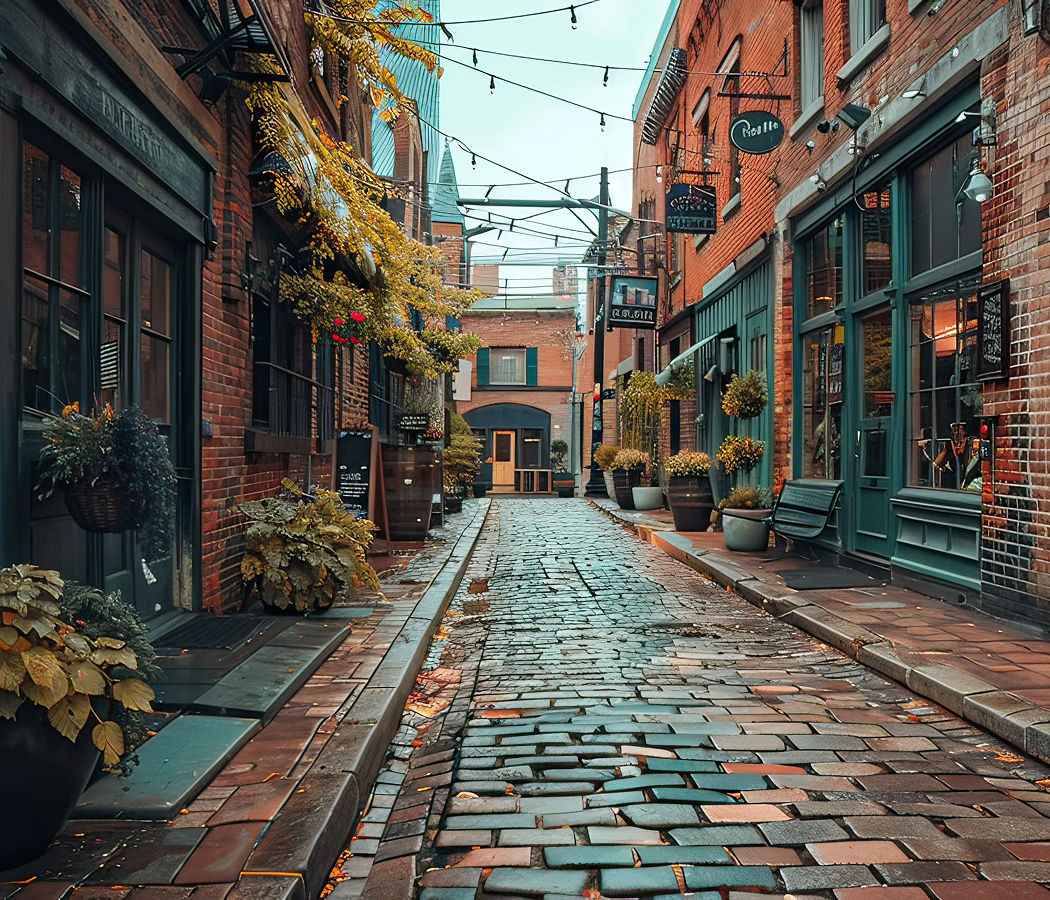
George Street is best known for originating within the original 1793 Town of York survey prepared under Lieutenant Governor John Graves Simcoe, making it one of Toronto's earliest planned north-south streets. The corridor derived its name from King George III, reflecting the British colonial street-naming traditions established during Upper Canada's formative years. Throughout the nineteenth century, George Street developed into a concentration of civic and charitable institutions including the House of Industry, founded in 1837 to provide relief for impoverished residents, and the Toronto General Hospital, whose early George Street campus expanded medical care before the institution relocated westward during the twentieth century. Residential and institutional construction introduced Georgian, Victorian, Italianate, and Second Empire architecture distinguished by red brick masonry, locally quarried limestone, segmental brick arches, decorative stone lintels, cast-iron fencing, slate roofs, and ornamental wood detailing. Together, these colonial planning decisions, institutional foundations, architectural traditions, philanthropic initiatives, and municipal expansion established George Street as one of Toronto's defining historic corridors.
Construction of St. Michael's Hospital beginning in 1892 established one of Canada's leading teaching hospitals, founded by the Sisters of St. Joseph to serve Toronto's rapidly growing population through medical education, research, and patient care. The nearby Toronto Necropolis, opened in 1850, preserved the resting places of prominent civic leaders, reformers, physicians, and military figures whose contributions shaped nineteenth-century Toronto. Heritage protection administered through the City of Toronto Heritage Register continues safeguarding original institutional buildings, historic masonry, decorative stonework, period rooflines, cast-iron fencing, and surviving nineteenth-century streetscape relationships throughout the corridor. Collectively, these healthcare institutions, commemorative landscapes, religious organizations, preservation initiatives, and civic investments demonstrate how George Street evolved into a corridor where Toronto's governmental, charitable, and medical history remain closely interconnected.
How to fold George Street into your trip.
George Street works as an exploration of Toronto's civic origins, institutional history, and architectural heritage.
Begin at St. Lawrence Market, where one of Toronto's oldest public marketplaces introduces the commercial foundations that supported the early growth of the Town of York. Continue to St. Michael's Cathedral Basilica, whose Gothic Revival architecture reflects the religious and cultural institutions that emerged alongside George Street during the nineteenth century. Conclude at Mackenzie House, where the preserved residence of reformer William Lyon Mackenzie provides the historical culmination by illustrating the political movements that profoundly influenced the development of early Toronto. Together, the sequence progresses from commercial beginnings to religious heritage before culminating in political history, revealing why George Street remains inseparable from Toronto's earliest civic story.
Where your story begins.
Foresyte Travel reveals places that feel extraordinary long before you arrive.
Experience premium editorial crafted for luxury travelers.